
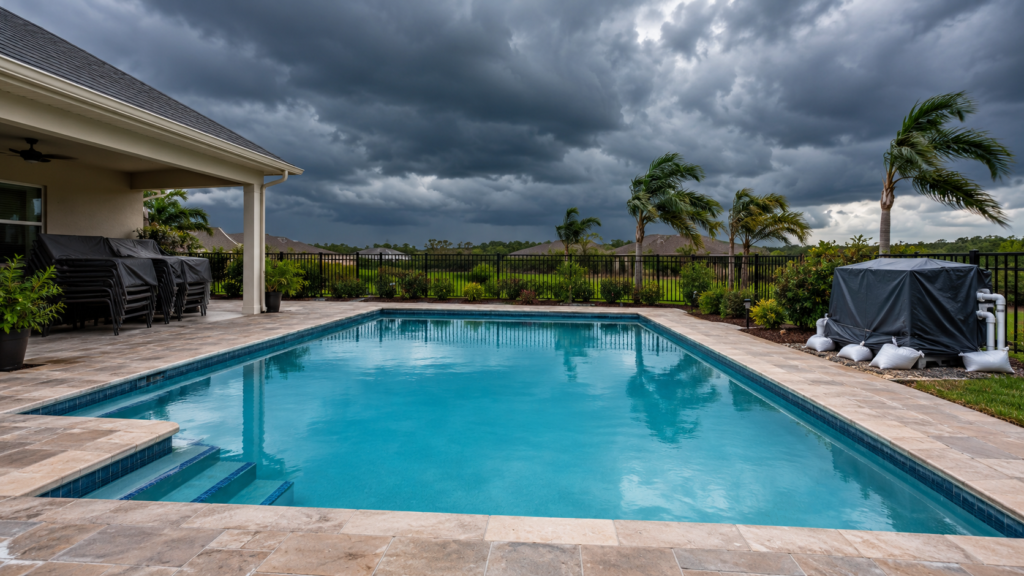
A storm warning just popped up on your phone, and your pool is sitting there full of water, furniture, and equipment you now have to deal with.
You can protect it in under an hour, and most of the job is knowing what not to do. This guide gives you the right order, the numbers, and a chart you can screenshot.
Quick Answer: Leave the pool full, but lower the water 1–2 feet only if overflow is a risk, and never below the skimmer. Turn off power at the breaker, store furniture and floats indoors, bring free chlorine to the high end of normal, and stay out of the water until thunder has been quiet for 30 minutes.
Table of Contents
What You Need to Know
- Never drain the pool. An empty pool can lift out of the ground when groundwater rises.
- Kill power at the breaker if lightning, flooding, or high winds are forecast.
- Store anything that can fly, and skip the cover unless it is rated for storms.
- After the storm, wait at least 24 hours before powering up equipment that got wet, then test the water.
- Know your storm type. Thunderstorms, tropical storms, and flooding each call for different pool safety measures, as outlined in the chart below.
How do you prepare a pool for a storm?
To prepare a pool for a storm, leave it full, turn off power at the breaker, bring furniture and floats indoors, raise free chlorine to the upper normal range, and remove or secure the cover if it is not storm-rated. Never drain the pool; groundwater can push an empty pool out of the ground.
Please follow these steps in order, beginning 24–72 hours in advance if you have the warning.
- Test and balance the water. Verify free chlorine and pH first. According to the CDC, home pools should hold pH 7.0–7.8 and at least 1 ppm free chlorine, or at least 2 ppm if the pool uses cyanuric acid (stabilizer).
- Raise chlorine to the high end of normal. Always use the dosage specified on the product label. Run the pump so it mixes through before you shut things down.
- Add algaecide if your label allows it. Pinch A Penny recommends an extra dose before a storm to head off a post-storm algae bloom.
- Set the water level. Leave it alone unless heavy rain could overflow the pool. Then lower it 1–2 feet at most, and never below the bottom of the skimmer.
- Move loose items. Patio furniture, umbrellas, floats, toys, grills, and robotic cleaners all become projectiles. Store them indoors.
- Handle the cover. Remove solar blankets and covers. Keep a cover on only if it is made for storms (details below).
- Shut off power at the breaker panel. Unplug what you can. Turn off the gas valve to a gas heater.
- Protect equipment. If water could reach the pad, sandbag around it or wrap it in a waterproof covering tied down securely.
- Trim hazards. Cut dead or low limbs near the pool and house while you still have daylight.
- Take photos of the pool and equipment for your records. You’ll want a before picture if you need to file a claim.
What does a pool need for each type of storm?
Different storms call for different prep, and a thunderstorm doesn’t need hurricane-level work. Most competitor guides assume a hurricane, so use this chart to match your response to the forecast.
| Storm type | Power and pump | Water level | Chemicals | Cover | Furniture and floats |
|---|---|---|---|---|---|
| Thunderstorm | Pump can run until lightning is near; then stop and stay clear. | Leave as is. | Normal range; test afterward. | Leave as is. | Secure or store. |
| Heavy rain | Normal operation; watch the level. | Lower 1–2 ft only if overflow is a risk; never below skimmer. | High end of normal; test after rain. | Leave as is. | Secure or store. |
| Tropical storm / hurricane | Breaker off; gas valve off; wrap or sandbag equipment. | Do not drain; lower 1–2 ft at most. | High end of normal; algaecide per label. | Storm-rated only; otherwise none. | Store indoors; deflate floats. |
| Flood risk | Breaker off; do not touch wet equipment. | Do not drain or pump out. | Test after water recedes. | None. | Store or move to higher ground. |
Save or screenshot this storm-type triage chart. It tells you what to do for the storm you actually have.
Want the printable version? Download the free, single-page storm preparation checklist and store it alongside your pool maintenance supplies. [EMAIL CAPTURE POINT: Printable Pool Storm Checklist PDF]
Is it necessary to drain a pool ahead of a storm?
No. Draining a pool before a storm risks pushing it out of the ground. When heavy rain raises groundwater, the water in your pool is what holds the shell down.
This is the single biggest and most expensive mistake. According to Poolshop, an empty above-ground pool can also collapse. For more on managing water levels, see our guide on how to close an inground pool.
If overflow is a real concern, lower the water by 1–2 feet and stop there. Pinch A Penny warns not to go below the skimmer bottom and not to run the pump dry.
Should the pool pump be switched off when a storm approaches?
Turn the pump off at the breaker when lightning, flooding, or high winds are forecast. A light rain shower doesn’t require it, but a serious storm does.
Run the pump for as long as you safely can before the storm so the extra chlorine circulates. Then shut off the breaker. Pinch A Penny also suggests a floating chlorinator to keep sanitizer working while the pump is off. Refer to your pump manufacturer’s instructions for specific operating and safety recommendations.
Should I shock my pool before a rainstorm?
Bring chlorine to the high end of normal before the storm, not to extreme levels. Rain, runoff, and debris use up chlorine, so a higher starting point helps.
Sources differ here. True Blue Pools recommends shocking a day or two before, while Pinch A Penny recommends extra chlorine and circulation. Use chemicals only in the amounts directed by their labels.
This is where a floating chlorinator earns its place: it keeps sanitizing if you lose power. [AFFILIATE LINK: floating chlorinator] A reliable test kit also helps you check levels before and after. [AFFILIATE LINK: pool test kit]
Should you cover your pool for a storm?
Cover the pool only if the cover is rated for storms. A flimsy cover can tear, blow away, and take damage to the pool with it.
Poolshop says a strong hurricane cover, secured properly, can work, but leaving the pool uncovered is better than using a weak cover. Remove solar blankets and standard covers and store them indoors.
What should you do with patio furniture and floats?
Store them indoors rather than throwing them in the pool. Competitors disagree on this one. Poolshop says to walk furniture in carefully, while Pinch A Penny says not to, because chemicals and removal cause problems.
We side with storing. Furniture can scratch the liner or shell, and chemicals can damage it. Deflate floats and bring umbrellas, grills, and cleaners inside.
What should you do during the storm?
Stay indoors and away from the pool. According to the National Weather Service, stay inside for at least 30 minutes after you last hear thunder.
Don’t walk out to check the water level. Lightning, debris, and flooded ground are all hazards. The National Weather Service advises people to stay out of floodwater, while pool industry safety guidance highlights the risk of electrical hazards after severe weather.
What should you do after the storm?
Wait to restore power until you have checked that everything is dry. According to Poolshop, equipment that was wet should air dry for at least 24 hours first.
- Inspect from a safe distance. Look for downed lines, damaged equipment, a wet breaker panel, and a shifted or cracked shell. Call a professional if unsure.
- Remove large debris before running the pump. Branches and mulch clog suction lines. Wear shoes if you step in to clear it.
- Let wet equipment dry for at least 24 hours. If a pump motor was submerged, have it professionally cleaned and dried.
- Return the water to the normal level and empty the pump and skimmer baskets.
- Reset breakers and timers once everything is dry.
- Let the water circulate for a few hours before testing its chemistry. Pinch A Penny advises this so rainwater and treated water be before sampling.
- Adjust chemistry to pH 7.0–7.8 and free chlorine of at least 1 ppm, or 2 ppm with stabilizer, per the CDC.
- Brush, vacuum, and clean or backwash the filter. Expect extra filter work for a few days.
The same water testing steps apply as in our guide on how to open your pool after winter.
What chemicals should you put in your pool after it rains?
Test first, then add only what the results call for. Rain dilutes chlorine and can shift pH, so levels after a storm are often off.
| Reading | Target (CDC) | If it’s off |
|---|---|---|
| Free chlorine | At least 1 ppm (2 ppm with stabilizer) | Add chlorine per label; retest after circulating. |
| pH | 7.0–7.8 | Adjust with pH increaser or reducer per label. |
| Water clarity | Clear | Brush, vacuum, run filter; clarifier per label. |
| Algae signs (green) | None | Treat promptly; warm weather speeds growth. |
Counterintuitive fact: according to the CDC, if chlorine is above 10 ppm, the test can bleach out and show a false low or zero. A reading of zero right after heavy shocking may mean too much chlorine, not too little. Dilute the sample or wait before adding more.
For flooded or visibly contaminated pools, an Aqua Magazine article describes superchlorinating to 20–40 ppm. Treat that as a flood-only step, and consider calling a pro. For warm-weather algae risk, see our guide on pool care during a heat wave.
Common mistakes and troubleshooting
The most damaging mistakes are draining the pool and restoring power too soon. Here are the most common problems and fixes.
| Problem | Likely cause | What to do |
|---|---|---|
| Pool popped or shifted | Drained before or during a storm | Call a pool professional; don’t refill or pump it yourself. |
| Pump won’t start | Water in motor or breaker | Keep it off; dry 24+ hours; call a pro if it was submerged. |
| Cloudy or green water | Debris, diluted chlorine, algae | Test, balance, brush, vacuum, run filter continuously until clear. |
| Chlorine reads zero after shocking | Test bleaching above 10 ppm (CDC) | Wait or dilute the sample; don’t add more. |
| Cover blown off | Weak cover or poor anchoring | Remove covers before storms unless storm-rated. |
When should you call a professional?
Call a pool professional if equipment was submerged, the electrical panel got wet, or the shell looks shifted or cracked. Also call one if you suspect sewage or flood contamination.
APSP guidance warns that electrocution is a real danger after major storms and says not to use the pool. When in doubt, wait.
Pool storm prep FAQ
What chemicals should you put in your pool after it rains?
Test first. Rain dilutes chlorine and can shift pH, so adjust only what the test shows. According to the CDC, aim for pH 7.0–7.8 and at least 1 ppm free chlorine (2 ppm with stabilizer). Circulate a couple of hours before sampling so the reading is accurate.
Should you shut down your pool pump during a storm?
Yes, if lightning, flooding or high winds are forecast. Run the pump beforehand to circulate extra chlorine, then shut power off at the breaker. A light rain shower doesn’t require it. Check your pump manual for model-specific guidance.
Should I shock my pool before a rain storm?
Bring chlorine to the high end of normal before the storm rather than going to extremes. Rain and debris use up chlorine. Sources differ on timing, so follow your product label, and test again afterward. A floating chlorinator can keep sanitizing if the pump is off.
What steps should I take to prepare for a storm?
Leave the pool full, set chlorine high, store furniture and floats, remove weak covers, and shut off power at the breaker. Lower the water 1–2 feet only if overflow is a risk, never below the skimmer. Photograph everything for records.
Can I swim after a storm?
Wait until thunder has been quiet for 30 minutes, equipment has been inspected, and the water is clear and in range. According to the CDC, that means pH 7.0–7.8 and at least 1 ppm free chlorine. If the pool flooded, wait for professional guidance.
Do above-ground and saltwater pools need different prep?
The steps are the same. Above-ground pools are at extra risk if drained, because the sides can collapse, according to Poolshop. A saltwater pool’s salt cell is just more equipment to power off at the breaker.
What should I document for insurance?
Take photos of the pool, equipment and surrounding area before and after the storm. Coverage varies by policy, so contact your insurer for specifics.
What to Do Next
- Learn the full routine in our guide to closing an inground pool.
- Get your pool back in shape with how to open a pool after winter.
- Keep water safe in warm weather with pool care during a heat wave.
- [CONTENT GAP: commercial page for storm prep gear (floating chlorinator, test kit)]
- [CONTENT GAP: how to shock a pool]
- [CONTENT GAP: how to test and balance pool water]
- [CONTENT GAP: how to clear a green pool]
References: CDC home pool water treatment and testing · NWS lightning safety · NWS flood safety · Aqua Magazine: cleaning up flooded pools and spas
This guide is research-based and general. Follow your equipment manuals, product labels, and local authorities.
