
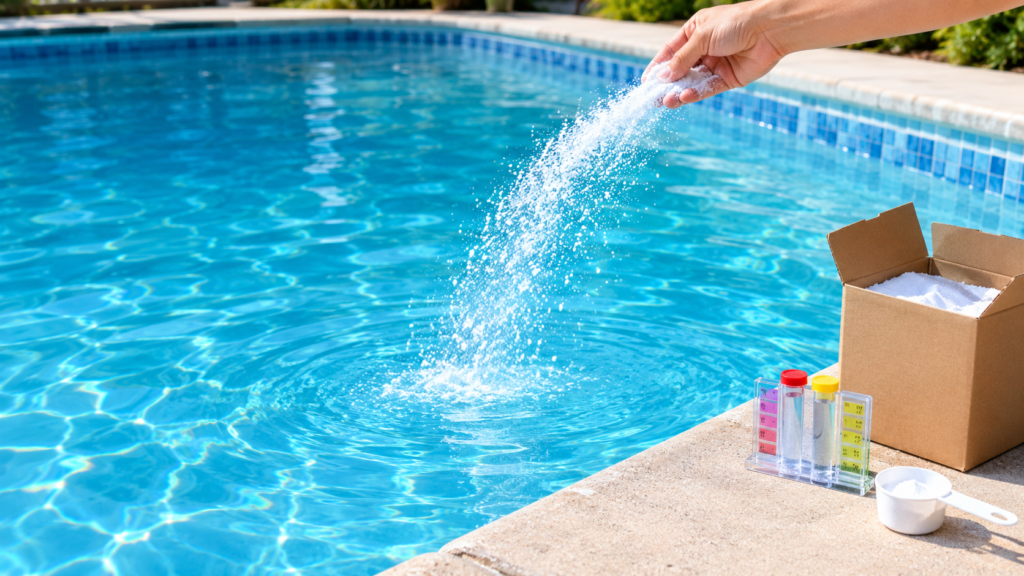
Baking soda in pool water is the fix everyone mentions the moment a test strip shows low alkalinity. It works, but only for the right reading and in the right amount.
This guide gives you the dose, the steps, and the readings where baking soda is the wrong move.
Quick Answer: Baking soda in pool water raises total alkalinity and lifts pH only slightly. Add about 1.5 pounds per 10,000 gallons to raise alkalinity 10 ppm, but only when a test shows alkalinity below 80 ppm. Broadcast it with the pump running, wait at least six hours, then retest.
Table of Contents
What You Need to Know
- Baking soda in pool water raises total alkalinity. Its effect on pH is small.
- Test first. If alkalinity is already in range, baking soda makes things worse.
- The standard dose is 1.5 lb per 10,000 gallons for each 10 ppm increase.
- Split large doses, run the pump, and retest after at least 6 hours.
- It does not sanitize water, kill algae, or clear a green pool.
What Does Baking Soda in Pool Water Do?
Baking soda in pool water raises total alkalinity, which helps pH stay put. Its main job is buffering, not changing pH directly.
Total alkalinity (TA) is a measure of the carbonate and bicarbonate dissolved in pool water, used to keep pH from swinging. Baking soda is sodium bicarbonate, so adding it increases that buffer. According to iGarden’s pool-care guide, it raises pH only slightly.
Here is what that buys you:
- Steadier pH after rain, acid additions, and top-offs with fresh water
- Less risk of corrosion and etched surfaces from low alkalinity
- Easier sanitizer management, since chlorine works best in a stable pH range
Here is what it does not do. It doesn’t sanitize, kill algae, remove calcium, or clean a dirty filter.
The surprising part: the branded “alkalinity increaser” on the pool-store shelf is, in most cases, the same chemical. Both iGarden and True Blue Pools make that point. The only differences are the branding and the cost.
Do You Need Baking Soda in Pool Water? Match Your Test Strip
Add baking soda only when total alkalinity is low. If TA is already in range, baking soda is the wrong chemical.
Most pool-care references use 80–120 ppm as the target for total alkalinity and 7.2–7.8 for pH. The Pool & Hot Tub Alliance offers professional guidance that helps pool owners understand appropriate water-balance targets. Match your readings below.
| Your TA | Your pH | What to do |
|---|---|---|
| Below 80 ppm | 7.2–7.8 | Add baking soda (use the dosage table below) |
| Below 80 ppm | Below 7.2 | Add baking soda first, retest, then address pH if needed |
| 80–120 ppm | Below 7.2 | Don’t use baking soda. Use soda ash or borax |
| Above 120 ppm | Above 7.8 | Don’t use baking soda. Lower with acid and aeration |
| In range | In range, water looks bad | Don’t use baking soda. Check chlorine and filter |
Save or screenshot this Test Reading → Action table. It tells you whether baking soda is the right fix before you buy or pour anything.
A pool whose pH keeps falling back down is a classic low-alkalinity sign. For the broader process, see our guide on how to raise alkalinity in your pool. If your readings point the other way, read how to lower pH in a pool.
How Much Baking Soda in Pool Water Do You Add?
Use 1.5 pounds of baking soda in pool water per 10,000 gallons to raise alkalinity about 10 ppm. Scale that to your pool size and the number of ppm you need.
Arm & Hammer, iGarden, and True Blue Pools provide similar advice for calculating baking soda quantities based on pool size and the desired alkalinity increase. Treat it as an estimate. Results vary with your actual pool volume, existing chemistry, and test accuracy.
Baking Soda Dosage Chart
| Pool size | Raise TA 10 ppm | Raise TA 20 ppm | Raise TA 30 ppm | Raise TA 40 ppm |
|---|---|---|---|---|
| 5,000 gal | 0.75 lb | 1.5 lb | 2.25 lb | 3 lb |
| 10,000 gal | 1.5 lb | 3 lb | 4.5 lb | 6 lb |
| 15,000 gal | 2.25 lb | 4.5 lb | 6.75 lb | 9 lb |
| 20,000 gal | 3 lb | 6 lb | 9 lb | 12 lb |
| 25,000 gal | 3.75 lb | 7.5 lb | 11.25 lb | 15 lb |
| 30,000 gal | 4.5 lb | 9 lb | 13.5 lb | 18 lb |
Save or screenshot this Baking Soda Dosage Chart. It covers the six most common residential pool sizes.
Worked example: a 12,000-gallon pool
Your TA reads 60 ppm, and you want 90 ppm. That is a 30 ppm increase.
Formula: (gallons ÷ 10,000) × (ppm increase ÷ 10) × 1.5 lb
(12,000 ÷ 10,000) × (30 ÷ 10) × 1.5 = 1.2 × 3 × 1.5 = 5.4 lb
Don’t add all 5.4 lb at once. Add about 2.7 lb, circulate, retest, and decide on the rest.
[EMAIL CAPTURE POINT: Want this chart on your phone? Get the printable baking soda dosage cheat sheet when you join the Pool Owner Guide newsletter. [SIGNUP LINK]]
How Do You Add Baking Soda in Pool Water Step by Step?
Add it slowly across the surface with the pump running, then retest. Never dump the whole amount in one spot.
- Test total alkalinity, then pH. Use a reliable kit or strips. Confirm TA is below your target before you buy anything. Write both numbers down.
- Calculate the dose. Use the dosage chart or the formula above. Measure by weight, not by bag size or by eye.
- Split large corrections. If the total is more than about 5–6 lb in an average residential pool, add half first, according to iGarden’s guide. A 6 lb dose becomes 3 lb now and a retest.
- Turn the pump on. Run it before you add anything so the water is moving. Good circulation spreads the powder evenly.
- Broadcast it across the surface. Walk the deep end and sprinkle in wide arcs. Skip windy days, since the powder can blow away. Avoid the skimmer, and avoid piles on the floor.
- Wait, then retest TA first. Operate the pump for a minimum of six hours. Retest alkalinity before touching pH, because pH often settles once TA is corrected.
How long until I can retest or swim?
Retest after at least 6 hours, or the next day after a large dose. Testing too early gives a false low reading.
The guides disagree slightly: Arm & Hammer says 6–24 hours, iGarden says 4–6 hours, and True Blue Pools says 6–8 hours, with many professionals preferring about 24. Six hours is the safe floor, and 24 is the safe ceiling after big doses.
You can swim once the powder has fully dissolved and circulated, with no cloudy patches left in the water.
Can I Shock My Pool and Add Baking Soda at the Same Time?
Don’t. Fix alkalinity first, let the water circulate, then shock once readings are stable.
iGarden’s guide recommends making one balance change at a time. Stacking shock, baking soda in pool water, and acid in the same window makes it impossible to tell which one moved your numbers.
The order is simple:
- Correct TA with baking soda
- Run the pump and retest.
- Shock when readings are steady
For how shock relates to your chlorine readings, see free chlorine vs. total chlorine.
Baking Soda vs. Soda Ash vs. Borax: Which Should You Use?
Baking soda raises alkalinity. Soda ash raises pH faster. Borax lifts pH with less effect on alkalinity. Pick based on which reading is low.
| Chemical | Best for | Effect on TA | Effect on pH |
|---|---|---|---|
| Baking soda (sodium bicarbonate) | Low TA | Raises it | Slight increase |
| Soda ash (sodium carbonate) | Low pH, or low pH and low TA | Raises it | Raises it significantly |
| Borax | Low pH with TA in range | Little effect | Mild increase |
Quick rule from iGarden: low TA means baking soda, low pH with fine TA means borax, and both low means soda ash.
Many pool owners mistakenly believe that adding baking soda will reduce the water’s pH level. True Blue Pools addresses this directly: it does not. It nudges pH up slightly. When pool pH rises above the ideal range, use an appropriate acid rather than baking soda to bring it down.
What Are the Effects of Adding Excess Baking Soda to Your Pool?
Too much pushes total alkalinity high. High TA makes pH drift upward and encourages scale.
Watch for:
- pH that keeps climbing back up
- Dull or cloudy water
- Scale on tile, heaters, and salt cells
- More acid needed to hold your pH down
If the reading goes beyond your target, test the water again before making further adjustments. Reduce total alkalinity gradually using muriatic acid or dry acid, checking the levels after each treatment. Aerating the water can raise pH without increasing total alkalinity.
Avoid making a major correction all at once. Follow our complete guide to reducing pool pH for step-by-step instructions.
Can You Use Baking Soda to Adjust Water Chemistry in a Saltwater Pool?
Yes, but do so more conservatively. Saltwater pools already drift toward higher pH, so overshooting TA makes them harder to control.
According to iGarden’s guide, many references suggest keeping TA toward the lower end of the range in salt pools, around 80–100 ppm, to reduce scale pressure on the cell and heater. Targets vary by equipment, so check your salt system manual.
When total alkalinity falls below the recommended range, baking soda can help restore it. Calculate the amount needed to bring TA into the lower end of the ideal range. For more on how salt systems differ, see saltwater vs. chlorine pools.
Common Mistakes With Baking Soda in Pool Water
A frequent error is using baking soda before checking the water chemistry. It is beneficial only when insufficient total alkalinity needs to be corrected.
Avoid these:
- Treating it as a cure-all. It won’t clear a green pool or kill algae.
- Fixing everything at once. Changing TA, pH, and sanitizer together hides the cause of any result.
- Adding too much in one go. Split large doses and retest.
- Pouring it in one spot. Broadcast it instead.
- Retesting too soon. Wait at least 6 hours.
- Confusing it with a stabilizer. Cyanuric acid is the chemical used to stabilize pool chlorine, not baking soda. If your stabilizer level is excessive, read our guide to correcting high cyanuric acid levels.
When Should You Call a Pool Professional?
Call one when the numbers won’t stay put. Recurring problems usually point to a cause baking soda can’t fix.
Consider professional testing if:
- Alkalinity won’t hold after two or three corrections.
- Water stays cloudy despite balanced readings
- Scale or staining keeps returning
- You aren’t sure of your pool’s volume.
A wrong gallon estimate throws off every dose in this article. For general pH and disinfection guidance, the CDC’s Healthy Swimming resources are a solid reference.
FAQ
Can I shock my pool and add baking soda at the same time?
It’s better not to. Correct alkalinity first, let the water circulate, retest, and then shock once readings are stable. Making one balance change at a time lets you see what each chemical actually did. If both are needed, space them apart rather than dosing in the same window.
How much baking soda to add to a 5000-gallon pool?
You need 0.75 lb to raise alkalinity 10 ppm, and 1.5 lb to raise it 20 ppm. Small pools react quickly to chemical changes, so iGarden suggests starting with half the calculated amount. Circulate the water, retest, and add more only if alkalinity is still low.
Can Adding Baking Soda Reduce Chlorine Levels in Pool Water?
No. Baking soda doesn’t remove or reduce chlorine. It raises alkalinity, which can indirectly help chlorine work better by keeping pH stable. If chlorine is too high or low, adjust it separately based on your test results, not with baking soda.
What does baking soda do in a pool?
Baking soda in pool water raises total alkalinity, which stabilizes pH. It nudges pH up only slightly. It does not sanitize, kill algae, or clear cloudy water by itself. Use it only when a test shows alkalinity below range, and dose it by pool volume rather than by guess.
Is household baking soda the same as a pool alkalinity increaser?
In most cases, yes. Both are sodium bicarbonate, and household baking soda works the same way at residential doses. Branded versions sometimes use a finer grain that dissolves more evenly. Make sure the baking soda is plain, with no added cleaners, scents, or additives.
Is baking soda the same as pool stabilizer?
No. Pool stabilizer is cyanuric acid, which protects chlorine from sunlight. Baking soda is sodium bicarbonate, which raises total alkalinity. They are different chemicals with different jobs, and one cannot substitute for the other. Test both levels separately.
How long after adding baking soda can I swim?
Swim once the powder has fully dissolved, the water has circulated, and no cloudy patches remain. Running the pump for several hours typically gets you there. Wait the full 6 hours before retesting, and longer after large doses, so you can confirm chemistry is balanced.
What to Do Next
Baking soda in pool maintenance is one step in a larger balance. Here is where to go from here:
- Alkalinity still off? Follow our full guide on how to raise alkalinity in a pool.
- pH too high or unstable? Read how to lower pH in a pool.
- Chlorine readings confusing? See free chlorine vs. total chlorine.
[CONTENT GAP: “Best pool test kits” page, where the commercial bridge link will go once it exists]
