
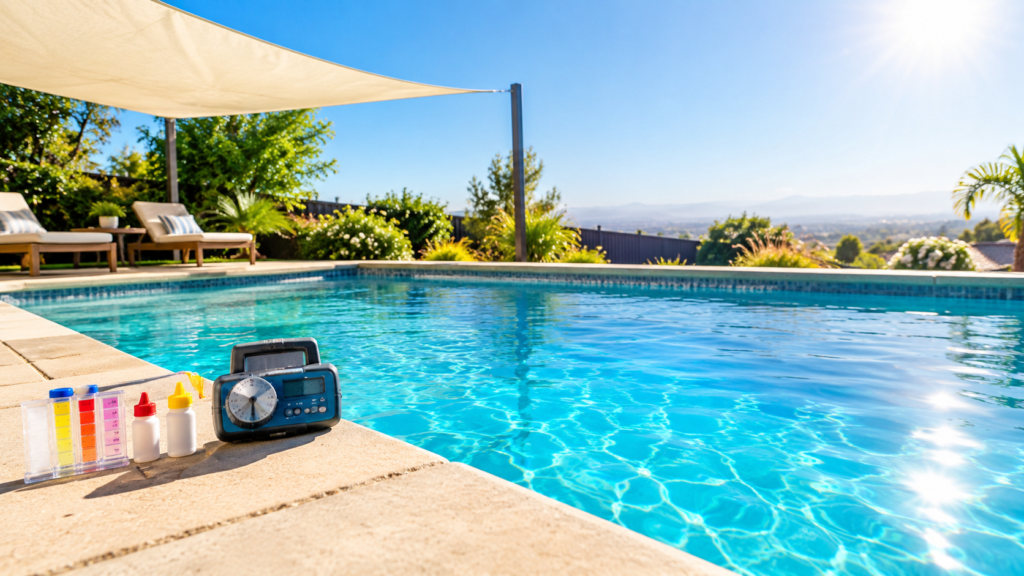
Your pool care heat wave plan starts today: the forecast says 98°F all week, and your water already looks a little dull. Heat can knock pool chemistry off balance within days, but a short daily routine and a few target numbers prevent most of the damage. This pool care heat wave guide gives you the full plan in order.
Quick Answer: A solid pool care heat wave routine means testing water at least twice a day, keeping free chlorine at 2 ppm or higher with stabilizer, holding CYA at 30–50 ppm, running the pump 12–24 hours, keeping water mid-skimmer, brushing daily, and adding shade. Heat burns chlorine, speeds evaporation, and feeds algae within days.
Table of Contents
What You Need to Know
- Every task for pool care during a heat wave comes back to two numbers: free chlorine and pH.
- CDC guidance for home pools calls for testing both at least twice a day and more often with many swimmers.
- With stabilizer (cyanuric acid) in the water, CDC sets the free chlorine floor at 2 ppm.
- A typical uncovered pool loses about a quarter inch of water a day in summer, and wind matters as much as heat.
- That sharp “chlorine smell” usually means chloramines, not too much chlorine.
Pool Care Heat Wave Checklist: 7 Steps to Follow
Protect three things: your sanitizer, your water level, and your circulation. Check chlorine and pH first, because every other step depends on those two readings. These seven steps form the core of any checklist for pool care during a heat wave.
- Test free chlorine, pH, and stabilizer. If possible, check it twice daily, but test at least once each day. Heat changes your numbers faster than a normal week does.
- Raise free chlorine to match your stabilizer level. The minimum is 2 ppm with stabilizer. The table in Step 1 shows what higher stabilizer levels require.
- Run the pump 12 to 24 hours a day. Clean out the skimmer and pump baskets daily.
- Maintain the water level around the center of the skimmer opening. Examine it every morning and top off as needed.
- Brush the walls and floor daily. Vacuum if you see settled debris or dull spots.
- Shock after sunset when needed. Shock after heavy swimming, storms, or hazy water, and dose by the product label.
- Shade the pool and block wind. Shade sails, a pergola, or windbreaks cut both heat and evaporation.
What Does Extreme Heat Do to a Pool?
Extreme heat speeds up four problems at once: chlorine loss, evaporation, algae growth, and equipment load. Heat does not create new problems. It compresses weeks of normal wear into a few days.
- Chlorine burns off faster. Sunlight destroys free chlorine, the active chlorine in water that kills germs and algae.
- Water evaporates faster. Heat, sun, and wind all pull water off the surface.
- Algae grows faster. A pool that looked perfect on Monday can turn cloudy or develop green spots after several extremely hot days.
- Equipment works harder. More swimmers and debris keep the pump and filter busy, and vinyl liners can fade or wrinkle with prolonged sun and chemical swings.
The Three C’s Behind Every Pool Care Heat Wave Routine
Pool care revolves around three essentials: circulation, cleaning, and water chemistry. Every pool care heat wave routine adjusts all three, not just chemistry.
| The C | What it covers | Heat-wave adjustment |
|---|---|---|
| Circulation | Pump, filter, skimmers, returns | Run 12–24 hours; empty baskets daily |
| Cleaning | Skimming, brushing, vacuuming | Brush daily; skim twice a day if debris is heavy |
| Chemistry | Sanitizer, pH, stabilizer | Test twice a day; raise free chlorine to match stabilizer |
Pool Care Heat Wave Cheat Sheet
This table holds every number in your pool care heat wave plan. Free chlorine and pH are the two readings that cannot slip.
| What to check | Target | Heat-wave frequency |
|---|---|---|
| Free chlorine | At least 1 ppm, or 2 ppm if the pool uses stabilizer (CDC) | Twice a day |
| pH | 7.2–7.8 (CDC’s home-pool page allows down to 7.0) | Twice a day |
| Stabilizer (CYA) | 30–50 ppm ideal; stay under 90 ppm | Weekly |
| Combined chlorine | 0.4 ppm or lower (California public pool standard) | After heavy use or storms |
| Water level | Middle of the skimmer opening | Every morning |
| Pump run time | 12–24 hours (retailer guidance) | Check baskets daily |
| Brushing | Walls and floor | Daily |
| Water temperature | 104°F maximum under Minnesota’s public pool rule | Daily |
Save or screenshot this Pool Care Heat Wave Cheat Sheet. It covers every number you need on one screen.
Want it as a one-page printable for the pump shed? Join the Pool Owner Guide newsletter, and we’ll send it with our seasonal pool reminders.
Step 1: Test Twice a Day and Protect Your Chlorine
Test free chlorine and pH at least twice a day, because heat changes both within hours. CDC’s home-pool guidance sets a minimum of 1 ppm free chlorine, rising to 2 ppm when the pool uses cyanuric acid or products that contain it. Pool care heat wave testing is only realistic with a kit you trust.
A DPD drop-style kit reads free chlorine in 0.1 ppm steps, which matches the accuracy Minnesota requires of public pool test kits. [AFFILIATE LINK: DPD pool test kit]
For the full routine, see our step-by-step guide on how to test pool water.
Why does heat make chlorine disappear faster?
Sunlight breaks chlorine apart. According to NSW Health, about 65% of free chlorine remains after an hour of strong sun without stabilizer, and with 30 mg/L of stabilizer, only about 3% is lost.
Cyanuric acid (CYA) is a chlorine stabilizer, used to shield free chlorine from ultraviolet light.
Does more stabilizer mean more protection?
No. NSW Health reports little added benefit above roughly 40 mg/L, and the stabilizer also slows chlorine’s kill rate for bacteria, viruses, and algae.
Research from the Council for the Model Aquatic Health Code suggests a maximum CYA-to-free-chlorine ratio of 20 to 1. That gives these working minimums:
| CYA level | Minimum free chlorine |
|---|---|
| 30 ppm | 2 ppm (CDC floor) |
| 40 ppm | 2 ppm |
| 50 ppm | 2.5 ppm |
| 60 ppm | 3 ppm |
| 90 ppm | 4.5 ppm |
This ratio is a research recommendation, not a legal limit. Use it as a cushion, and follow your product label.
How Long Should a Pool Pump Run During a Heat Wave?
During extreme heat, run the pump for 12–24 hours daily to circulate sanitizer throughout the entire pool. The pump is the engine of any pool care heat wave routine. Retailer guidance varies: Water Tech suggests at least 12 hours and up to 16, while one Wisconsin dealer’s service manager recommends up to 24 during an extended heat wave.
You can check your own turnover time with simple math: pool gallons ÷ pump gallons per minute ÷ 60 = hours per full turnover. A 15,000-gallon pool with a 50 GPM pump turns over in 5 hours.
Clear out the skimmer and pump baskets once each day. Clean the filter when flow drops. Our guide to cleaning a pool filter cartridge walks through it.
Step 3: How Much Water Does a Pool Lose in a Heat Wave?
A normal uncovered pool loses about a quarter inch a day in summer, and heat waves can push that higher. Water level is the most overlooked part of pool care heat wave work. Wind often matters more than heat. In one water district’s example, a baseline 0.20 inches per day rose to 0.62 inches at a 5 mph wind and 1.06 inches at 10 mph.
Keep the water at mid-skimmer. Water below the skimmer opening reduces circulation and strains the pump.
Gallons lost per inch of water = surface area (sq ft) × 0.623, the standard evaporation formula.
| Pool surface | Square feet | Gallons per inch |
|---|---|---|
| 12×24 ft rectangle | 288 | ~180 |
| 15×30 ft rectangle | 450 | ~280 |
| 16×32 ft rectangle | 512 | ~320 |
| 18 ft round | ~254 | ~160 |
| 24 ft round | ~452 | ~280 |
| 18×36 ft rectangle | 648 | ~405 |
Save or screenshot this Gallons-Per-Inch Chart. It shows how much water a drop in level really means.
Worked example: A 15×30 ft pool losing a quarter inch a day loses about 70 gallons daily, or about 560 gallons in a 2-inch week.
Is it a leak? A drop of more than a couple of inches a week with no obvious cause points to a leak. Run a bucket test: place a bucket on a pool step, match the water levels inside and outside, and compare after 24 hours.
A solar cover nearly eliminates evaporation, but it also traps heat. Choose according to the issue that causes the most trouble.
Step 4: How Can You Prevent Algae During a Heat Wave?
Brush daily and keep free chlorine up, because algae starts in warm water when sanitizer slips. Algae prevention is where pool care heat wave effort pays off most. Brush the walls and floor every day, even when the water looks clear. Our guide to vacuuming a pool covers debris removal.
Shock after sunset, when sunlight can’t burn the chlorine off. Shock after heavy swimming, after storms, or when the water turns hazy. Dose by the product label, and never mix chemicals.
Storms add to the load. Swimmers plus summer thunderstorms introduce nitrogen and ammonia that feed chloramine formation. [CONTENT GAP: pool shock guide]
At What Temperature Does a Pool Become Too Hot?
Public pool codes cap water at 104°F, and about 79–82°F is comfortable for most swimmers. Above roughly 86°F, chlorine works less effectively and microorganisms thrive. Water Tech notes that water above 30°C (86°F) encourages evaporation and microbial growth.
What’s the Most Effective Way to Cool a Pool Quickly?
There is no fast way to cool a pool. You can only reduce heat buildup or release excess warmth overnight.
- Add shade. Shade sails or a pergola above the pool help minimize heat from sunlight.
- Run a water feature at night. It can take the edge off through evaporation, at the cost of more water loss.
- Skip the drain-and-refill. It weakens your water chemistry and works only when the added water is cooler than the pool.
Is Swimming Safe When Temperatures Reach 100 Degrees?
A properly sanitized pool is generally fine at 100°F air temperature, but the risk is heat illness from sun and long exposure, not the water. You can still lose fluids while swimming, so keep drinking water even if you feel refreshed.
CDC describes heat illness as what happens when the body can’t cool itself. Heat stroke begins when body temperature passes 104°F, and symptoms of stroke or exhaustion call for 911 and moving the person somewhere cooler.
- Swim early or late, and take shade breaks.
- Reapply sunscreen.
- Check the chlorine reading before kids get in.
After the Heat Wave (and the Storms That Follow)
Finishing your pool care heat wave work takes about a day if you go in order. Test first, because every later step depends on your current numbers.
- Test free chlorine, pH and stabilizer.
- Rebalance pH into the 7.2–7.8 range.
- Shock after sunset if the water is hazy or combined chlorine is above 0.4 ppm.
- Clean the filter and baskets.
- Top off the water level.
Extra pump time and chemicals add up. Our pool maintenance cost breakdown shows what a heat wave does to your budget.
Common Pool Care Heat Wave Mistakes
The most common mistake is treating a strong chlorine smell as too much chlorine. Pool service pros warn about these habits:
- Judging chlorine by smell. That smell means chloramines, so test and shock instead.
- Adding more stabilizer. Above about 40 ppm you gain little protection and weaken sanitizing.
- Shocking at noon. Sunlight burns off much of the dose.
- Letting water fall below the skimmer. The pump can suck air and strain.
- Skipping the brush on clear water. Algae forms before it shows.
When Should You Call a Pool Pro?
Some pool care heat wave problems need a professional. Persistent green water or unexplained water loss calls for help, not another chemical. Call when the water won’t clear after you’ve balanced pH, raised free chlorine and filtered for a full day.
- Water stays green or cloudy after a day of filtering? Call a pro. [CONTENT GAP: green pool / algae removal guide]
- Losing more than a couple of inches a week? Run the bucket test, then call for leak detection.
- Pump loses prime, or you hear grinding? Turn the system off and contact a professional for assistance.
- Vinyl liner fading, wrinkling or loose at the seams? Have it inspected.
Pool Care Heat Wave FAQ
At What Temperature Does a Pool Become Too Hot?
Public pool codes cap water at 104°F, and about 79–82°F is comfortable for most swimmers. Above roughly 86°F, chlorine becomes less effective and algae and microorganisms thrive. In a heat wave, shade is your main tool for slowing the climb.
Can I go to the pool in 100-degree weather?
Yes, if the pool is properly sanitized. The danger is heat illness from sun and long exposure. Swim early or late, drink water regularly, take shade breaks, and treat dizziness, nausea or confusion as a reason to get out and cool down.
What is the fastest way to cool down a pool?
There is no fast way. Shade is the most reliable tool, and running a water feature overnight can shave off a few degrees through evaporation. Replacing pool water with tap water weakens the chemistry and works only when the incoming water is cooler.
What are the Three C’s of pool maintenance?
The three C’s are circulation, cleaning and chemistry. Circulation is running the pump and filter, cleaning is skimming, brushing and vacuuming, and chemistry is balancing sanitizer, pH and stabilizer. In a heat wave, all three need more attention.
How Frequently Should You Check Pool Water During a Heat Wave?
If possible, test the water at least two times daily. CDC’s home-pool guidance recommends testing chlorine and pH at least twice a day, and more often with many swimmers. Check stabilizer weekly. Testing only every two or three days is too slow for peak heat.
Does hot weather make chlorine disappear faster?
Yes. Sunlight breaks chlorine apart, and stabilizer slows that loss. NSW Health reports that without stabilizer about 35% of free chlorine can be lost in an hour of strong sun. This is why testing and topping up matter more in a heat wave.
Is it normal for my pool to lose water in hot weather?
Yes. A typical uncovered pool loses about a quarter inch a day in summer, and heat waves can push that higher. A drop of more than a couple of inches a week with no obvious cause points to a leak, so run a bucket test.
What to Do Next
Your pool care heat wave routine is only as good as your testing and your records. Three logical next steps:
- Learn the routine properly with our guide to testing pool water.
- See what the extra pump time and chemicals cost in our pool maintenance cost breakdown.
- Pick a test kit you’ll actually use: [CONTENT GAP: best pool test kits (commercial page)].
