
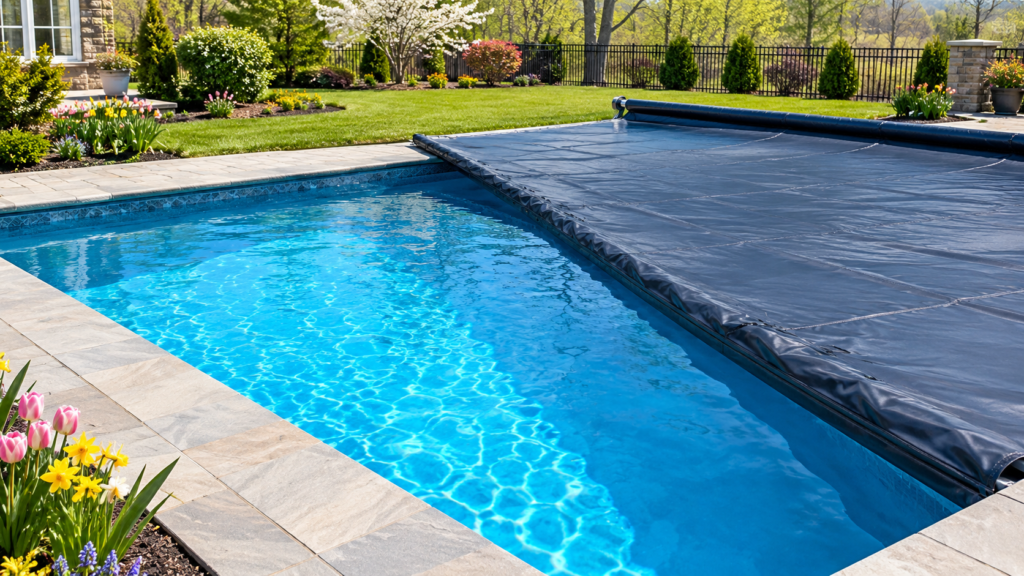
The cover is still on, and the weather just turned warm, so you need to know how to open a pool after winter before the water underneath turns green.
The job takes 12 steps, and the order matters more than any single product. This checklist gives you the sequence, the target numbers, and a chart for fixing whatever you find.
Quick Answer: To open a pool after winter, pump water off the cover, remove and clean it, reinstall plugs and fittings, refill to mid-skimmer, and run the pump. Then balance alkalinity (80–120 ppm), pH (7.2–7.6), calcium and stabilizer, shock, and retest. Swim when free chlorine falls to 1–3 ppm.
Table of Contents
What You Need to Know
- Start once nights are no longer freezing and daytime highs hold near 70°F, before algae gets a head start.
- Knowing how to open a pool after winter comes down to order: physical work first (cover, equipment, fill, pump), then chemistry.
- Balance in order: total alkalinity, pH, calcium hardness, stabilizer, then shock.
- Target numbers: alkalinity 80–120 ppm, pH 7.2–7.6, and free chlorine 1–3 ppm before anyone swims.
- Never drain an inground pool to “start fresh.” An empty shell can be pushed out of the ground.
When Should You Open Your Pool?
Open your pool once freezing nights are over and daytime highs are holding around 70°F. Starting before the water warms up beats starting after algae appears, because green water costs far more chemicals and days than clear water does.
Timing is the first decision in how to open the pool after winter. In cold climates, wait until hard freezes pass before you refill and run the pump, since frozen water can crack plumbing and pump housings.
Guides written for cooler climates sometimes quote 10–15°C (50–59°F) as a start threshold. That number is mainly about frost risk, not about swim-ready water.
What Do You Need Before You Start?
You’ll need a few essential cleaning tools, a dependable water test kit, and several key chemicals. Test the water first, then buy balancers, because dosing without readings wastes money and can push numbers further off.
Tools checklist
- Cover pump and a soft broom
- Telescopic pole, skimmer net, wall brush, vacuum head, and hose
- Garden hose
- Silicone-based lubricant labeled for pools and Teflon tape
- Gloves and splash-proof goggles
What chemicals do I need to reopen my pool?
Most pools need a test kit, shock, and one or two balancers matched to the test results.
| Item | What it does | Buy it when |
|---|---|---|
| Test kit (strips or drop-based) | Measures alkalinity, pH, calcium, stabilizer, chlorine | Always |
| Shock (calcium hypochlorite or liquid chlorine) | Destroys algae, bacteria and organic waste | Always |
| Sodium bicarbonate (baking soda) | Raises total alkalinity | Alkalinity reads under 80 ppm |
| Muriatic acid or sodium bisulfate | Lowers pH and alkalinity | pH reads above 7.6 |
| Soda ash (sodium carbonate) | Raises pH | pH reads under 7.2 |
| Calcium chloride | Raises calcium hardness | Hardness reads low |
| Cyanuric acid (stabilizer) | Shields chlorine from sunlight | Outdoor chlorine pool reads low |
| Algaecide, clarifier | Optional help for algae and haze | Only after balance is correct |
Want the one-page printable version of this checklist, with space to log your readings? Join the PoolOwnerGuide email list, and it lands in your inbox. [EMAIL CAPTURE: printable checklist + chemical log]
How to Open Pool After Winter: The 12 Steps
These 12 steps show how to open a pool after winter in the right order: cover, equipment, water level, pump, cleaning, testing, balancing, shocking, and a final safety check. Skipping ahead to chemicals while the equipment is unchecked is the most common way a simple opening turns into a repair bill.
1. Remove standing water from the cover and sweep away any accumulated debris.
Run a cover pump until the standing water is gone, then sweep leaves toward the edge with a soft broom. Leave the cover in place while you do this.
Every leaf and cupful of dirty water that slides into the pool becomes filter work and chlorine demand later.
2. Remove, rinse, and dry the cover.
Lift the cover with a helper, because wet covers are heavy. Rinse off dirt, scrub stains, and let it dry fully before folding.
A damp cover stored in a bag grows mildew. Store it dry in a sealed bin where rodents can’t reach it.
3. Inspect the pool shell and equipment
Walk the perimeter and look for cracked tile, loose coping, plaster chips, and liner tears. Check the pump, filter, heater, and power cords for rust, cracks, and rodent damage.
Shut off the breaker before touching anything electrical. Replace cracked O-rings now, and write down every defect so safety items get fixed first.
4. Reinstall plugs, fittings, and accessories.
Pull the winter plugs from the skimmer and return lines. Then reinstall return fittings, pump and filter drain plugs, ladders, handrails, and underwater lights.
Lubricate O-rings and ladder bolts with a silicone-based pool lubricant. Use Teflon tape on threaded fittings.
5. Refill to the middle of the skimmer opening.
Fill with a garden hose until water sits halfway up the skimmer opening, or about midway up the tile. A garden hose takes hours, so plan around it.
Walk the edge while it fills and watch for leaks. Then clean the filter: backwash a sand or DE filter until the water runs clear, or rinse a cartridge. This guide explains how frequently you should backwash your pool filter and maintain its regular cleaning routine.
6. Prime the pump and restore power.
With the breaker still off, fill the pump basket with water, seat the lid and O-ring, and open the valves slowly. Turn the power on and check every fitting for leaks.
Record the filter pressure gauge reading when the filter is freshly cleaned. That number is your baseline for step 11. A pump running dry burns out quickly, so confirm it is moving water.
7. Skim, brush, and vacuum
Skim the surface, brush the walls, steps, and floor, then vacuum the pool to remove settled dirt.
If the floor is covered in leaves or dead algae and your valve has a waste setting, vacuum to waste so debris bypasses the filter. Top up the water level afterward.
8. Test the water before adding anything.
Collect a sample about elbow-deep, away from returns and skimmers. Test total alkalinity, pH, calcium hardness, stabilizer (CYA), and free chlorine, and write the numbers down.
Strips give a quick read, but a drop-based kit is more precise when readings are borderline. [AFFILIATE LINK: drop-based pool test kit] [CONTENT GAP: best pool test kits] Check expiration dates on any strips or reagents first.
9. Balance in order: alkalinity, pH, calcium, stabilizer
Adjust total alkalinity first, since it helps keep your pool’s pH levels stable. Then adjust pH, then calcium hardness, then stabilizer.
Add one chemical at a time with the pump running, and retest after several hours of circulation. If pH reads high, follow the steps in how to lower pH in a pool. The chart below outlines the recommended targets along with example dosage amounts.
10. Shock the pool in the evening.
Bring pH to about 7.2–7.4 first, because chlorine works better at lower pH. Dose from the product label, scaled to your pool’s volume.
Add shock at dusk so sunlight doesn’t burn it off, and run the pump overnight. Some granular shocks can bleach a vinyl liner if dumped dry, so follow the dissolving instructions on the label. Wear gloves and goggles, add chemicals to water (never water to chemicals), and never mix products.
11. Run the filter and retest.
Keep the pump running around the clock. Retest the next morning and brush the walls again.
Clean or backwash the filter when pressure climbs roughly 8–10 psi above the clean baseline from step 6. Haze after shocking is common and usually clears with filtering and correct balance.
12. Confirm the pool is safe to swim in.
Swim only when free chlorine reads 1–3 ppm, pH reads 7.2–7.6, and the water is clear enough to see the main drain. Shock labels may add their own wait time, and the label wins.
Check that drain covers have no cracks or missing screws. The CPSC’s Pool Safely campaign explains why a loose, broken, or missing drain cover means nobody should swim. Set out a reaching pole, a throwable life ring, and a first aid kit.
What Should Your Water Read When You Open the Pool After Winter? (Pool Opening Water Chart)
Opening-day water should land inside the ranges below before anyone swims. Fix chemistry in a fixed order, because alkalinity changes pH, and pH changes how well chlorine works.
Total alkalinity is the amount of acid-neutralizing minerals in the water, measured in ppm, used to keep pH from swinging. Cyanuric acid (CYA), also called stabilizer, is a chemical used to shield chlorine from sunlight. Shock is a heavy dose of chlorine used to destroy algae, bacteria, and organic waste.
| Reading | Target | Why it matters |
|---|---|---|
| Total alkalinity | 80–120 ppm | Keeps pH from swinging |
| pH | 7.2–7.6 (aim 7.2–7.4 before shocking) | Comfort, equipment protection, chlorine performance |
| Calcium hardness | 200–400 ppm plaster/concrete; about 175–225 ppm vinyl | Too low corrodes surfaces, too high forms scale |
| Stabilizer (CYA) | Typically 30–50 ppm outdoors with chlorine | Slows sunlight loss of chlorine; check your product label |
| Free chlorine | 1–3 ppm to swim | Sanitizing level for swimmers |
| Saltwater pools | Salt level per cell manufacturer | Cell makes chlorine only within range |
Order of operations
- Total alkalinity
- pH
- Calcium hardness
- Stabilizer (CYA)
- Shock, then retest
Worked example (illustrative, not measured data)
A 20,000-gallon concrete pool tests at alkalinity 60 ppm, pH 7.9, and free chlorine 0, with calcium and stabilizer in range.
- Alkalinity: The target is 100 ppm, so the pool needs +40 ppm. A common rule of thumb is 1.5 lb of baking soda per 10,000 gallons for each +10 ppm. For 20,000 gallons, that is 3 lb per 10 ppm, so 4 × 3 = 12 lb. Add about 6 lb, circulate for several hours, retest, then add the rest if needed.
- pH: Baking soda nudges pH up slightly, so lower it to 7.2–7.4 in small acid doses per the label, retesting between doses.
- Shock: If the label treats 10,000 gallons per 1 lb, the pool needs 2 lb. Heavier algae needs more, and the label sets the ceiling.
- Swim check: Retest next morning. Swim when free chlorine returns to 1–3 ppm.
Save or screenshot this pool opening water chart. It covers every target number and the dosing order you need on opening day.
Guides disagree on small numbers (pH bands of 7.0–7.4 versus 7.2–7.6, for example) because they follow different standards. The CDC’s Model Aquatic Health Code is the public-pool reference many residential guides adapt, and the CDC’s page on preparing for healthy and safe swimming covers pool safety basics. Home pools can differ, so always check your product labels and local code.
How to Open Pool After Winter: Above-Ground, Inground, and Saltwater Pools
Each of the three pool types uses the same 12-step process, plus one extra check for its specific setup. For inground pools, the extra rule is never to drain the pool.
| Pool type | What changes | Watch for |
|---|---|---|
| Above-ground | Reconnect flexible hoses to the skimmer and return | Liner tears and wrinkles; don’t let the water level drop |
| Inground | Inspect plaster, tile and coping | Groundwater can push an empty shell out of the ground |
| Saltwater | Inspect the salt cell and test salt level | Confirm the minimum water temperature in the manual, since many cells pause in cold water |
What If the Water Is Cloudy, Green, or Spotty?
Cloudy or green water is fixable in most cases, and the color tells you where to start. Brush, circulate, and retest before you add more chemicals.
Even when you follow how to open a pool after winter steps exactly, a pool can still arrive green or hazy. Refer to the table to compare and identify the results you observe.
| Water looks | Likely cause | First move |
|---|---|---|
| Clear blue | Healthy start | Continue with steps 8–12 |
| Cloudy or hazy blue | Unbalanced chemistry, dirty filter, or dead algae | Balance in order, run the pump 24/7, clean the filter |
| Green | Algae bloom | Brush, shock at the higher label dose, filter around the clock, retest daily |
| Yellow-green or dusty yellow on shaded walls | Mustard algae | See mustard algae in a pool |
| Dark blue-black spots on plaster | Black algae | See black algae in a pool |
| Brown or rust tint | Metals or organic debris | Take a sample to a pool store for a metals test |
Expect days, not hours, for heavy algae. Retest daily and don’t stack extra chemicals on top of unbalanced water.
What Are the Most Common Mistakes When You Open a Pool After Winter?
Owner forums and pool-store guidance repeatedly flag the same six errors. Shocking before balancing is the one that wastes the most chemicals.
- Draining an inground pool. Groundwater can lift an empty shell and crack it.
- Shocking before balancing. High pH and low alkalinity blunt chlorine.
- Running the pump dry. Prime it with water first.
- Pulling the cover before pumping off the water. Any loose debris eventually falls into the pool.
- Testing at the surface or beside a return. Sample elbow-deep, away from jets.
- Adding chemicals all at once. Dose one at a time, circulate, and retest.
When Should You Call a Professional?
Call a pool professional when the problem is structural, electrical, or stubbornly chemical. A pump that trips the breaker is not a do-it-yourself problem.
Contact a professional for cracked plaster or pool shells, electrical issues, unusually rapid water loss, questionable drain covers, saltwater cell errors, or water that remains unclear. green after two treatments.
How to Open Pool After Winter: FAQ
These answers cover the questions pool owners ask most about how to open a pool after winter.
What chemicals do I need to reopen my pool?
You need a test kit, shock, and balancers matched to your readings: an alkalinity increaser (sodium bicarbonate), a pH reducer (muriatic acid or sodium bisulfate), and a pH increaser (soda ash). Add calcium chloride if the hardness reads low and cyanuric acid if the stabilizer reads low in a sunny outdoor chlorine pool. Algaecide and clarifier are optional extras, not substitutes for correct balance.
How long can a pool sit without circulation?
There is no single safe number, because temperature and sunlight decide how fast algae and bacteria grow. In cold water under a cover, a properly closed pool can sit for months; in warm water, an unbalanced still pool can turn green within days. Running the pump for several hours daily during swim season keeps chlorine mixed and prevents stagnant spots.
Should chlorine still be added to a pool during the winter months?
Usually not, if the pool is closed, covered, and balanced. Cold water slows algae growth, so most closing kits rely on a one-time shock and winter algaecide rather than ongoing chlorine. Pools kept running through winter in mild climates are different: they need regular free chlorine testing. Check your closing product label, because instructions vary by product and climate.
What should you do first when getting your pool ready to open?
Pump the water off the cover and clear leaves before you remove it. This keeps winter debris and dirty water out of the pool, which saves chemicals and filter work later. Once the cover is off and dry, inspect the tile, coping, and equipment for damage before reconnecting anything or turning on power.
How long after shocking can I swim?
Swim when a test shows free chlorine back at 1–3 ppm and pH between 7.2 and 7.6, which commonly takes about a day after a standard shock but longer after a heavy algae treatment. Shock labels state their own wait time, and the label wins over any general rule. Test the water before every swim until readings are stable.
Should I drain my pool after winter?
No. Draining an inground pool can let groundwater push the empty shell up out of the ground, a risk called hydrostatic pressure that can crack the structure. Even above-ground pool liners can wrinkle and tear without water weight. Balance and filter the existing water, and replace water only when a professional diagnoses a chemistry problem draining would fix.
How long should I run the filter after I open the pool after winter?
Keep the pump running continuously until the water becomes clear and chlorine levels remain stable, typically during the first few days after opening. Continuous circulation moves shock and balancers through the whole pool and gives the filter time to catch dead algae and cloudiness. Once readings stabilize, return to a daily schedule of roughly 8 to 12 hours.
What to Do Next
Now that you know how to open a pool after winter, keeping the water clear takes a few weekly habits.
- Keep the filter working by following the guide on how often to backwash a pool filter.
- Prevent debris from accumulating by following a regular pool vacuuming routine.
- Choose equipment that makes weekly testing easy: [CONTENT GAP: best pool test kits].
