
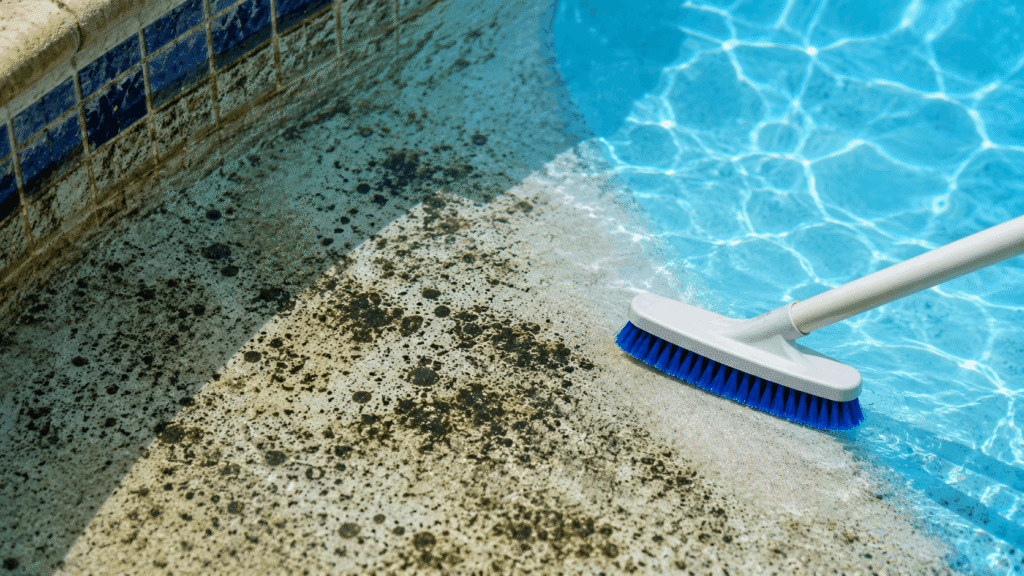
You shocked the pool. You brushed it. A week later, those dark blue-black spots on the floor and walls are still there — maybe even spreading. That’s black algae, and it doesn’t respond to the same treatment that clears up a regular green pool.
Quick Answer: Black algae is killed by scrubbing the spots with a stiff nylon or stainless-steel brush to break its protective outer layer, then shocking the pool with 3–5 times the normal chlorine dose. Repeat brushing daily and run the filter continuously for 3–5 days until every spot is gone and stays gone.
What You Need to Know
- Black algae isn’t killed by normal chlorine levels because it grows a protective root layer that shields it from sanitizer.
- Brushing first is non-negotiable — chlorine can’t reach the algae until that outer layer is broken open.
- Full treatment typically runs 3–5 days, not a single shock-and-done fix.
- A comparison table below shows exactly how black algae differs from green and mustard algae, since the wrong treatment wastes time and chemicals.
- Recurrence is common if you skip the prevention steps after treatment — this article covers those too.
What Is Black Algae (and Why Won’t It Die)?
Black algae is a cyanobacterium (technically not a true algae) that forms dark blue-black to purple spots, usually in rough or shaded areas of a pool like plaster pits, corners, and steps. It survives normal chlorine levels because it builds a protective, root-like layer that anchors it into the pool surface and shields the organism underneath.
That’s the part most pool owners miss. Shocking the water raises the chlorine level in the water, but the chlorine still has to physically reach the algae cells to kill them. If the protective layer is intact, you can shock repeatedly, and the spots barely fade.
This is why black algae has a reputation as “the one that won’t “die”—the process is different, not just stronger.
Black Algae vs. Green and Mustard Algae
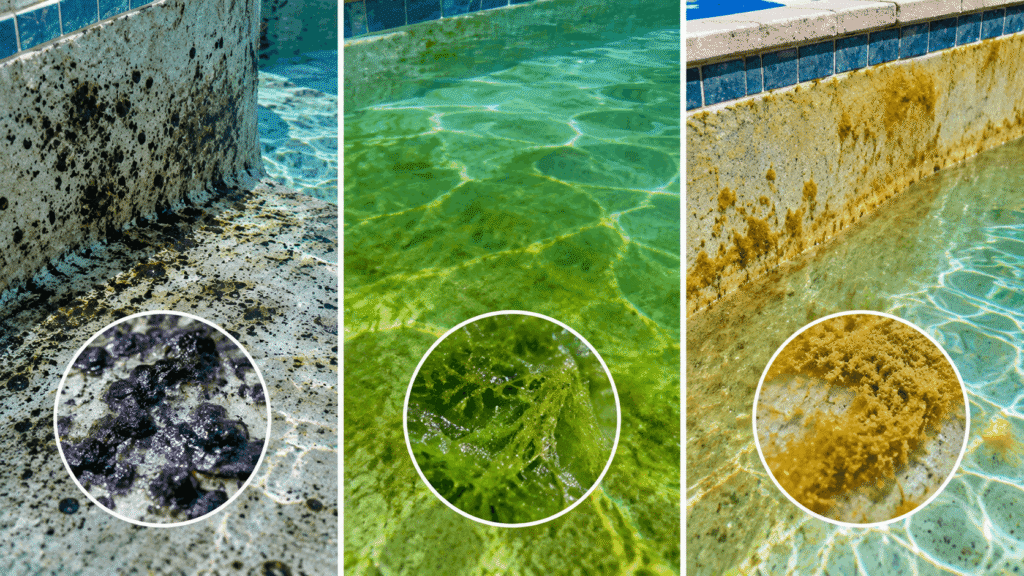
Black Algae vs. Green and Mustard Algae
Not all pool algae responds to the same treatment, and misidentifying it wastes both time and chemicals. Here’s how to tell them apart:
| Feature | Black Algae | Green Algae | Mustard Algae |
|---|---|---|---|
| Color | Blue-black to purple, dark spots | Bright to murky green, clouds water | Yellow-brown, looks like dirt or sand |
| Texture | Hard, raised, root-anchored | Suspended in water, slimy on surfaces | Powdery, brushes off easily |
| Common location | Plaster cracks, corners, steps, shaded walls | Throughout the pool, especially low-circulation areas | Shaded walls, behind ladders, near return jets |
| Resists normal chlorine? | Yes — protective layer | No — clears with standard shock | Somewhat — resistant to low chlorine, not immune |
| Fastest fix | Brush + heavy shock + brush | Shock + filter | Brush + shock + filter cleaning |
Save or screenshot this comparison table — it covers the fastest way to identify which algae you’re actually dealing with before you spend money on treatment.
If your pool is cloudy rather than spotted, you’re more likely dealing with green algae or a filtration issue—see our guide on cloudy pool water and the 7 causes behind it or the full green pool 24-hour fix if the whole pool has turned green rather than just showing dark spots.
How to Kill Black Algae: The Exact Process
Bold claim: brushing before shocking is the single most important step—skip it, and the chlorine never reaches the algae underneath. Here’s the full process:
- Test and balance your water first. Get pH into the 7.2–7.6 range before shocking. Chlorine is far less effective as a sanitizer when pH is off, which is part of why past shock attempts may have failed.
- Brush every visible spot hard with the right brush. A regular nylon pool brush often isn’t stiff enough. Use a stainless-steel bristle brush on plaster, gunite, or concrete surfaces (steel will scratch vinyl and fiberglass—use a stiff nylon brush there instead). Scrub until the spots start to lift or lighten, not just once over lightly.
- Shock the pool at 3–5 times the normal dose. For most residential pools, that’s roughly 1 lb of calcium hypochlorite shock per 10,000 gallons for a normal dose—black algae treatment typically calls for 3–5 lbs per 10,000 gallons or a dedicated black-algae-specific algaecide added alongside the shock. Always check your product’s label for your exact pool volume.
- Run the filter continuously, 24 hours, immediately after shocking. This circulates chlorine to every corner of the pool, including the shaded spots where black algae tends to grow.
- Re-brush the treated spots daily for the next 3–5 days. This is the step most people skip after the first day, and it’s the reason black algae comes back within a week.
- Vacuum any dead algae debris to waste, not through the filter, so it doesn’t recirculate back into the pool.
- Retest chlorine and pH daily until the spots are completely gone and chlorine holds steady rather than dropping fast (a fast drop means the algae is still consuming it).
What to Brush With (and Why Regular Brushes Fail)
A soft nylon brush meant for general pool maintenance usually can’t break through black algae’s protective layer—it slides over the spots instead of scrubbing into them. For plaster, gunite, or concrete pools, a stiff stainless-steel bristle brush does the job in far fewer passes.
Pair that with a black-algae-specific algaecide (labeled for black or blue-green algae, not a general maintenance algaecide) applied after brushing and before or alongside your shock dose—the combination of mechanical scrubbing and a targeted chemical is what actually closes the loop rather than relying on shock alone.
Shock Dosage by Pool Size
| Pool Size (gallons) | Normal Shock Dose | Black Algae Shock Dose (3–5x) |
|---|---|---|
| 10,000 | 1 lb | 3–5 lbs |
| 15,000 | 1.5 lbs | 4.5–7.5 lbs |
| 20,000 | 2 lbs | 6–10 lbs |
| 30,000 | 3 lbs | 9–15 lbs |
Save or screenshot this dosage table—it covers the shock amounts you’ll need at each treatment stage without recalculating every time. Always confirm against your specific shock product’s label, since concentration varies by brand.
Treatment Timeline: What to Expect Day by Day
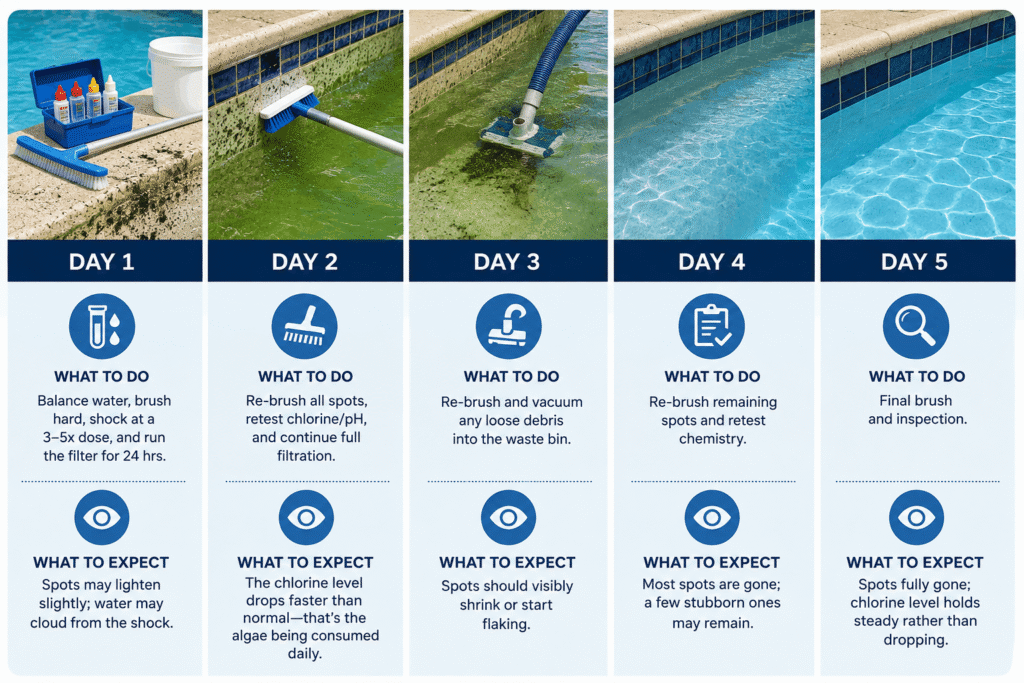
| Day | What to Do | What to Expect |
|---|---|---|
| Day 1 | Balance water, brush hard, shock at 3–5x dose, run filter 24 hrs | Spots may lighten slightly; water may cloud from the shock |
| Day 2 | Re-brush all spots, retest chlorine/pH, continue full filtration | Chlorine level drops faster than normal — that’s the algae being consumed |
| Day 3 | Re-brush, vacuum any loose debris to waste | Spots should visibly shrink or start flaking |
| Day 4 | Re-brush remaining spots, retest chemistry | Most spots gone; a few stubborn ones may remain |
| Day 5 | Final brush and inspection | Spots fully gone; chlorine level holds steady rather than dropping |
Save or screenshot this timeline — it covers what “normal” progress looks like so you know whether your treatment is working or needs another round.
If spots are still present after a full 5-day cycle, repeat the brush-and-shock process rather than assuming the algae is permanent—most cases need one full cycle, but heavily established spots sometimes need two.
Is Your Filter Working Hard Enough?
Black algae thrives in low-circulation spots—corners, shaded walls, and areas the water barely moves through. If your filter isn’t running long enough each day, those areas never get enough chlorine contact time to prevent regrowth, even after a successful treatment.
Check how long your pump actually runs versus how long it should be running for your pool size and season—see our breakdown of how long to run your pool pump by size and season to make sure circulation isn’t quietly working against your treatment.
How to Stop Black Algae From Coming Back
Killing black algae once doesn’t mean it won’t return—the spores can survive in tiny cracks and crevices even after visible spots are gone. A few habits keep it from re-establishing:
- Brush weekly, especially shaded corners and steps, even when the pool looks clean.
- Keep chlorine consistent rather than letting it swing low between shocks—black algae takes hold fastest when sanitizer levels dip for extended periods.
- Maintain full filter run times year-round, not just during algae outbreaks.
- Check pH weekly — chlorine loses effectiveness fast outside the 7.2–7.6 range, which quietly invites algae back in.
If you want a simple weekly routine to keep on top of all of this without guessing, our pool maintenance checklist walks through exactly what to check and when — worth grabbing before the next algae bloom catches you off guard.
Common Mistakes That Let Black Algae Come Back
- Shocking without brushing first. Chlorine alone rarely penetrates the protective layer—this is the single most common reason treatment “doesn’t work.”
- Stopping after one day. A single brush-and-shock cycle often only weakens the algae; skipping the follow-up days lets it recover.
- Using a soft brush on plaster or concrete. It won’t break the algae’s outer layer no matter how many times you scrub.
- Running the filter on a normal schedule instead of continuously during treatment. Reduced circulation slows chlorine contact time right when you need it most.
- Vacuuming through the filter instead of wasting it. This can push algae debris right back into circulation.
FAQ
What kills black algae the best?
The combination of mechanical brushing (stiff nylon or steel bristle, depending on surface) followed by shocking at 3–5 times the normal chlorine dose kills black algae most effectively. Chlorine alone, without brushing first, rarely works because it can’t penetrate the algae’s protective layer.
How can I remove black algae from my pool floor?
Brush the spots hard with a stainless-steel bristle brush (plaster/concrete) or stiff nylon brush (vinyl/fiberglass), then shock the pool at 3–5x the normal dose and run the filter continuously. Re-brush daily for 3–5 days until the spots are completely gone.
Is it safe to swim in a pool with black spot algae?
Swimming isn’t recommended while black algae is present, since the affected areas can be slippery and the pool’s sanitizer levels are typically too imbalanced during an outbreak to be safe. Wait until treatment is complete and chlorine and pH are back in the normal range before swimming again.
Should I drain my pool to get rid of black algae?
Draining is rarely necessary—most cases clear up with proper brushing and shock treatment over 3–5 days. Draining is only worth considering if black algae covers a large portion of the surface or keeps returning after two full treatment cycles, in which case a professional acid wash may be more effective than another drain-and-refill.
Can black algae come back after treatment?
Yes, if the surviving spores in cracks or crevices aren’t disturbed, or if chlorine levels and circulation drop back to normal maintenance levels too quickly. Weekly brushing and consistent chlorine and pH maintenance are what actually prevent recurrence long-term
What to Do Next
- Not sure if your circulation is part of the problem? Check how long to run your pool pump by size and season to rule out an equipment issue before treating again.
- Pool turned fully green instead of just showing spots? That’s a different problem — see the complete green pool 24-hour fix.
- Want a simple weekly routine to prevent this from happening again? Grab our pool maintenance checklist to stay ahead of algae before it starts.
