
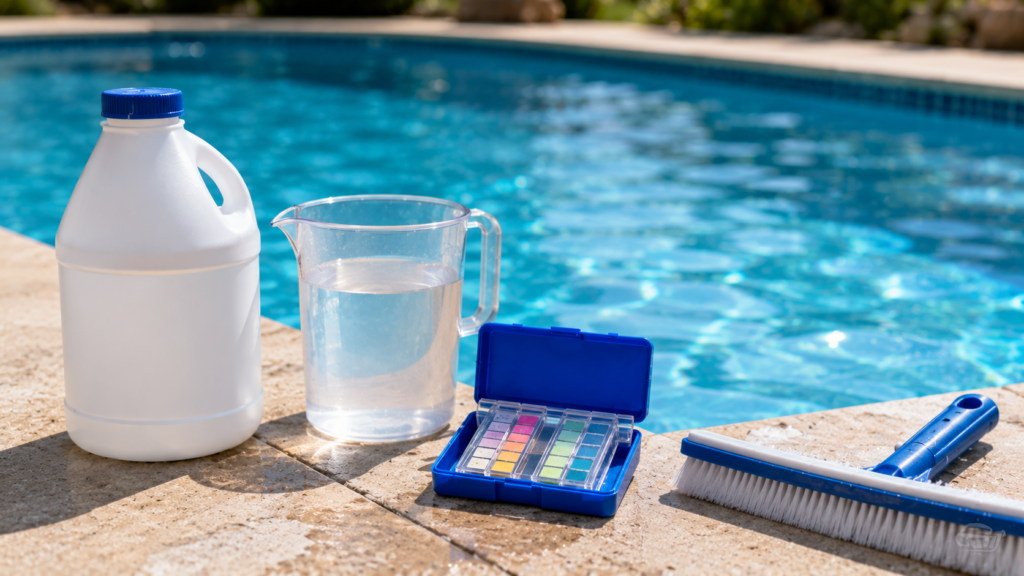
If your pool water is cloudy or your eyes are stinging despite adding chlorine on schedule, it may be due to high pH. That’s a high pH, and it’s fixable in one afternoon with the right chemical and the right amount.
Quick Answer: To lower pool pH, add liquid muriatic acid or granular sodium bisulphate (“dry acid”) directly to the water near the return jets, then run the pump for 4–6 hours before retesting. For a 10,000-gallon pool, roughly 16 oz of muriatic acid (or about 12 oz of dry acid) drops pH by 0.2. Target a final range of 7.2–7.8.
What You Need to Know
- The ideal target range is 7.2–7.8, with 7.4–7.6 being the optimal target range. The sweet spot for comfort and chlorine performance is 7.2–7.8, with 7.4–7.6 being the sweet spot.
- Two chemicals do the job: liquid muriatic acid or granular sodium bisulphate.
- Add chemicals in small doses, wait, then retest — never guess and dump in more.
- Total alkalinity, not just pH, determines whether your fix actually holds.
- Baking soda does the opposite of what you want here — it raises pH; it doesn’t lower it.
What Is Pool pH, and Why Does It Matter?
Pool pH measures how acidic or alkaline your water is, on a 0–14 scale, and it directly controls whether your chlorine actually works. According to the CDC’s guidance on home pool and hot tub water treatment, keeping pH in the 7.0–7.8 range balances chlorine’s germ-killing power against swimmer comfort — once pH climbs above 8.0, chlorine’s ability to kill germs drops off sharply.
High pH doesn’t just mean weaker sanitizer. It also drives cloudy water, scale buildup on tile and equipment, and the eye and skin irritation you’re probably already noticing. If your water has looked hazy lately, that’s often the same root cause behind cloudy pool water — pH pushes calcium and minerals out of solution, and they cloud the water on their way.
What Causes Pool pH to Rise
Pool pH climbs for a handful of predictable reasons, and most of them are things you’re doing correctly for other parts of pool care. Splashing and aeration knock carbon dioxide out of the water, which pushes pH up. Rain, fresh fill water, and hot weather all nudge it further.
Common causes include:
- Liquid chlorine (sodium hypochlorite), which is alkaline and raises pH as it sanitises
- Topping off with tap water high in dissolved minerals
- Heavy swimmer load — more splashing means more aeration
- Debris, leaves, and organic matter breaking down in the water
- Total alkalinity sitting too high, which drags pH up with it
Water that sits out of balance for a while also becomes more hospitable to algae — if you’ve dealt with mustard algae, imbalanced pH is often part of what lets it get a foothold.
How to Reduce Pool pH (Step-by-Step Guide)
Lowering pool pH is a five-step process: test, choose your acid, dilute if needed, add it correctly, then circulate and retest. Here’s the precise way to complete every step.
- Test your water first. Use a liquid test kit or test strips and confirm your reading is actually above 7.8 before you add anything. Test twice if the colour read is borderline — a false high reading means you’re correcting a problem you don’t have.
- Pick your acid. Liquid muriatic acid (hydrochloric acid, typically sold at roughly 31% strength) works fast and costs less per treatment. Granular sodium bisulphate is easier to measure and store safely but costs more per pound of correction.
- Dilute if you’re using muriatic acid. Pour it into a plastic bucket of water first — always acid into water, never the reverse, since adding water to acid can cause dangerous splashing. Dry acid doesn’t need this step; you can pre-dissolve it in a bucket for more even distribution, but it’s not required.
- Add it to the pool correctly. Pour slowly near a return jet with the pump running, working across the deep end rather than dumping it in one spot. Keep it away from skimmers, ladders, and light fixtures, since concentrated acid can damage surfaces on contact. Wear gloves and goggles for this step — the CDC notes that mishandled pool chemicals send about 4,500 people to U.S. emergency rooms every year, and more than a third of those injuries are kids or teens.
- Circulate, then retest. Run the pump for 4–6 hours minimum before you test again — pH doesn’t fully register until the chemical has mixed through the whole system. If it’s still above 7.8, repeat with a smaller dose rather than doubling up.
Muriatic Acid vs. Sodium Bisulphate: Which Should You Use
Muriatic acid corrects pH faster and cheaper per gallon treated, while sodium bisulphate is safer to store and easier to dose precisely — most pool owners pick based on which trade-off matters more to them.
| Factor | Muriatic Acid (Liquid) | Sodium Bisulfate (Dry Acid) |
|---|---|---|
| Form | Liquid, ~31% HCl | Granular powder |
| Cost per treatment | Lower | Higher |
| Storage | Needs a vented, acid-safe container | Stable in original bag/bucket |
| Handling risk | Fumes, splash risk when pouring | Lower fume risk, still corrosive to skin |
| Best for | Larger corrections, experienced handlers | Smaller doses, families with kids near storage |
| Also affects | Lowers total alkalinity along with pH | Lowers total alkalinity along with pH |
If cost is your main concern—a common question pool owners search for directly—muriatic acid is consistently the cheaper option per 0.2 pH-point correction, since you’re paying for a less-processed chemical.
Dosage Chart: How Much pH Reducer to Use by Pool Size
The amount of acid you need scales directly with your pool’s gallon count, and getting the ratio right the first time saves you a second correction trip. These are standard starting doses to drop pH by 0.2—always confirm against your specific product’s label, since concentration varies by brand.
| Pool Size (gallons) | Muriatic Acid (31% liquid) | Sodium Bisulfate (dry acid) |
|---|---|---|
| 5,000 | 8 oz | 6 oz |
| 10,000 | 16 oz | 12 oz (0.75 lb) |
| 15,000 | 24 oz | 18 oz |
| 20,000 | 32 oz (1 qt) | 24 oz (1.5 lb) |
| 30,000 | 48 oz (1.5 qt) | 36 oz (2.25 lb) |
Save or screenshot this dosage chart—it covers the most common residential pool sizes, so you’re not guessing mid-treatment. If your pH needs to drop more than 0.2 total, don’t scale the dose up in one shot; add half, circulate, retest, then repeat.
Why Your pH Keeps Bouncing Back (Total Alkalinity)
If your pH corrects fine but climbs right back up within a day or two, your total alkalinity is almost certainly out of range, not your pH treatment itself. Total alkalinity acts as a buffer—it resists changes to pH, which is great when it’s in range and frustrating when it’s not.
Maintain total alkalinity within the range of 80 to 120 ppm. If it’s sitting above that, it will keep dragging your pH back up no matter how much acid you add, and you’ll end up adding acid over and over for no lasting result. Correcting alkalinity first, then pH, breaks that cycle.
Mistakes to Avoid
The single most common mistake is adding acid all at once instead of in small, tested doses—overcorrecting pushes pH too low and creates a new set of problems.
- Dumping the full calculated dose in one pour. Split it, circulate, and retest instead of trusting the math blind.
- Reaching for baking soda. Baking soda (sodium bicarbonate) raises both pH and total alkalinity—it’s the fix for low pH, not high pH. Using it here moves you the wrong direction.
- Pouring acid near skimmers or steps. Concentrated acid can etch or discolor surfaces it touches directly.
- Skipping the retest window. Testing right after adding acid gives you a false reading—the chemical hasn’t fully mixed yet.
- Ignoring total alkalinity. Treating pH in isolation when alkalinity is also high just means you’ll be back here again in 48 hours.
After Adding the Acid: Pool Circulation & Filtration
Your pump’s job doesn’t stop at mixing the acid in—it also needs to run long enough to push the treated water through your filter before you trust a retest. If you’re not sure how long your pump should run on a normal day versus a treatment day, how long to run your pool pump breaks down the timing for different pool sizes and pump types.
If your pump won’t hold prime or keeps losing suction mid-cycle, the acid won’t circulate evenly, and your retest will be unreliable no matter how precise your dosing was. Fix a pump that won’t prime before you treat pH—otherwise you’re guessing at how much of the pool actually got the correction.
When to Call a Pool Professional Instead
DIY pH correction works for the vast majority of residential pools, but a couple of situations are worth handing to a professional. If you’ve corrected pH twice in a week and it keeps spiking back to 8.0+, or if your total alkalinity, calcium hardness, and pH are all out of range simultaneously, a professional water test can catch an underlying issue—a leak pulling in fresh fill water, a heater scaling up, or a filter that’s no longer doing its job—that repeated chemical dosing won’t solve on its own.
FAQ
What is the cheapest way to lower pH in a pool?
Muriatic acid is consistently the cheapest per-treatment option since it’s a less-processed chemical than sodium bisulfate. A gallon of 31% muriatic acid typically costs less than the equivalent pH-correcting weight in dry acid, though dry acid’s easier, mess-free measuring is worth the premium for some owners.
Can Baking Soda Reduce Pool Water pH Levels?
No—baking soda (sodium bicarbonate) raises pH and total alkalinity; it doesn’t lower either one. If your pH is too high, baking soda will make the problem worse, not better. Use muriatic acid or sodium bisulfate instead.
How Should I Fix a Pool With Excessively High pH?
Confirm the reading with a test kit, then add muriatic acid or sodium bisulfate in small doses near the return jets with the pump running. Circulate for 4–6 hours, retest, and repeat with a smaller dose if it’s still above 7.8 rather than adding a large amount all at once.
How long should I wait to swim after lowering pH?
Most guidance recommends waiting until the pump has circulated for at least 4–6 hours and you’ve confirmed the pH has settled in the 7.2–7.8 range. Swimming in freshly dosed, uncirculated water risks direct skin contact with concentrated acid pockets.
How often should I test my pool’s pH?
Test at least twice a week during regular swim season and daily during heavy use, hot weather, or right after heavy rain. Frequent testing catches small drifts before they turn into a full correction project.
Why does my pool’s pH keep going back up after I correct it?
This almost always points to total alkalinity sitting above the 80–120 ppm range, since alkalinity buffers water against pH change. Correct alkalinity first, then treat pH—otherwise you’ll keep adding acid with no lasting result.
What to Do Next
Once your pH is holding steady in the 7.2–7.8 range, two things are worth checking next: confirm your pump is running long enough each day to keep circulation consistent, and if the water still looks hazy after 24 hours, work through the causes in cloudy pool water. If dosing didn’t hold and you suspect a circulation problem, troubleshoot a pump that won’t prime before your next correction attempt.
