
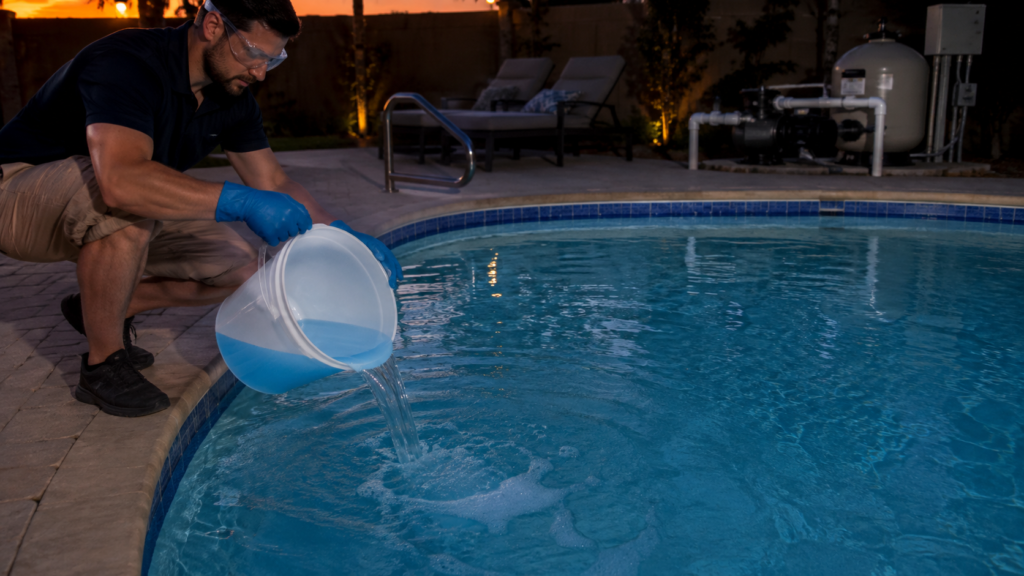
You’re standing next to a bag of pool shock or staring at water that’s gone hazy after a weekend of heavy use, trying to figure out the right amount before you waste money or under-treat it. Here’s the exact math, broken down by pool size and water condition.
Quick Answer: Add 1 pound of granular shock per 10,000 gallons for routine maintenance. Double the dose for light algae, triple it for mustard algae, and quadruple it for black algae. Liquid shock needs about 1 gallon of 10% sodium hypochlorite per 10,000 gallons for the same result. Confirm against your product label.
Table of Contents
What You Need to Know
- Base dose: 1 lb of granular shock (or roughly 1 gallon of 10% liquid chlorine) per 10,000 gallons for routine maintenance
- Algae multiplies the dose: 2x for light green water, 3x for mustard algae, and 4x for black algae.
- The pH level must be between 7.2 and 7.6 before you apply shock; if it is outside this range, a significant portion of the chlorine you add will not be effective.
- Shock at night, then run the pump for 8–12 hours straight
- Wait 8–24 hours before swimming with chlorine-based shock, or 15–30 minutes with non-chlorine shock.
How Much Shock Do You Actually Need?
The standard dose is 1 pound of granular shock per 10,000 gallons of water for routine maintenance, with the amount scaling up directly with how bad the water problem is. Product concentration varies (most granular cal-hypo shock is 65–73% available chlorine), so treat the number below as a planning baseline, then confirm against your specific bag.
Save or screenshot this dosage chart—it covers the four situations you’ll actually run into: routine care, light algae, mustard algae, and black algae.
| Pool Size | Routine Maintenance (1x) | Light Green Algae (2x) | Mustard Algae (3x) | Black Algae (4x) |
|---|---|---|---|---|
| 10,000 gal | 1 lb | 2 lb | 3 lb | 4 lb |
| 15,000 gal | 1.5 lb | 3 lb | 4.5 lb | 6 lb |
| 20,000 gal | 2 lb | 4 lb | 6 lb | 8 lb |
| 25,000 gal | 2.5 lb | 5 lb | 7.5 lb | 10 lb |
| 30,000 gal | 3 lb | 6 lb | 9 lb | 12 lb |
Your pool sits between two rows, round up rather than down. Underdosing means you’re back at this the same time next week.
Granular vs. Liquid Shock — Does the Amount Change?
Yes—liquid shock and granular shock use different math because they’re sold at different chlorine concentrations, not because the underlying chemistry changes. Granular shock (calcium hypochlorite) is typically 65–73% available chlorine. Liquid shock (sodium hypochlorite) usually runs 10–12.5%—much more diluted, so you need a lot more volume to get the same result.
For a routine dose in a 10,000-gallon pool, that works out to roughly 1 gallon of 10% liquid chlorine, compared with 1 pound of granular. For a 20,000-gallon pool, that’s about 2 gallons of liquid versus 2 pounds of granular. Liquid shock also has one real advantage: it doesn’t add calcium hardness or cyanuric acid to your water the way some granular products do, which matters if either is already running high.
Why pH Changes How Much Shock You Actually Need
Chlorine’s ability to kill bacteria and algae drops sharply as pH rises, so shocking a pool with unbalanced pH wastes product no matter how much you add. At a pH of 7.2, chlorine works at close to full strength. Push that to 7.8, and a large share of that same chlorine becomes chemically unavailable to do the job—it’s still in the water, just not working.
That’s why doubling your shock dose in a pool sitting at 7.9 pH can still leave you with cloudy water the next morning. Test your pH first and adjust it into the 7.2–7.6 range—see our guide on how to lower pH in a pool if you’re running high—before you open a single bag of shock.
How to Add Shock to Your Pool (Step by Step)
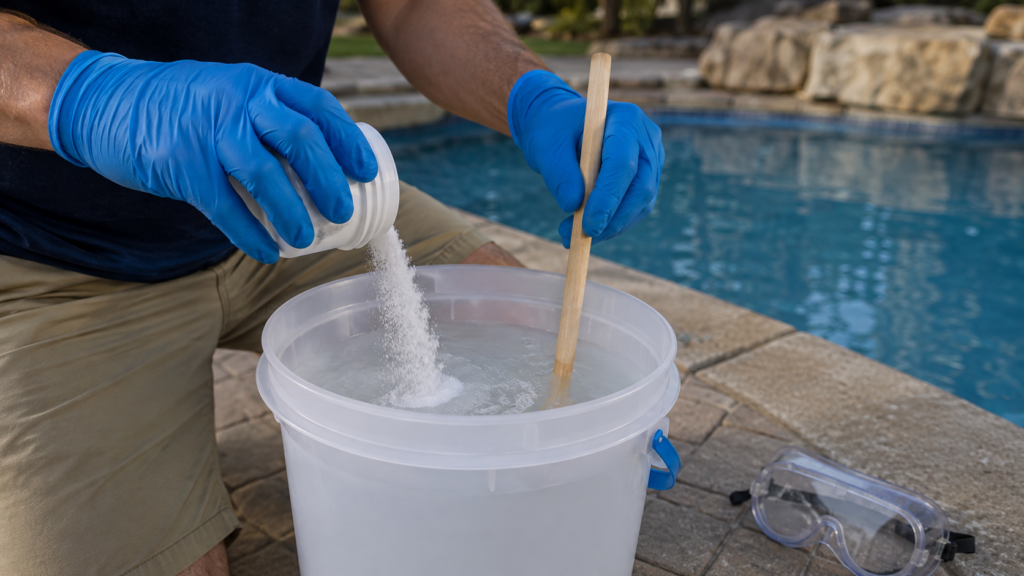
- Test your water first. Test free chlorine, combined chlorine, and pH levels. If combined chlorine reads 0.5 ppm or higher, or pH sits outside 7.2–7.6, fix pH before you do anything else.
- Wait until after sunset. Sunlight breaks down unstabilized chlorine (cal-hypo has no built-in UV protection) fast enough that a large portion of a daytime dose is gone before it does any work.
- Dissolve granular shock in a bucket of water first. Never pour powder directly into the pool—it can stain vinyl liners and plaster. Wear goggles and chemical-resistant gloves while you mix.
- Pour the mixture slowly around the pool’s edges with the pump already running. Avoid dumping it in one spot, and never add shock through the skimmer—that can damage equipment.
- Run the pump and filter for 8–12 hours minimum. This circulates the shock through the entire volume of water instead of leaving it concentrated near the surface.
- Retest the next morning. Free chlorine should read somewhere between 5 and 10 ppm right after shocking, dropping to a safe swimming range of 1–4 ppm as it works through the water overnight.
- Confirm that free chlorine is below 4 ppm before anyone swims. That reading matters more than a fixed waiting period—test it; don’t just guess based on the clock.
Is It Possible to Over-Shock a Pool?
It’s genuinely difficult to add a dangerous amount of shock by accident, and rounding up your dose is the recommended default, not a mistake. Overshooting the routine dose by a pound or two wastes product and money, but it won’t damage your pool.
The real risk shows up only with extreme, repeated overdosing—that can cause skin, eye, and hair irritation and, in rare cases, push chlorine to levels that require a longer wait before swimming. Test your water before getting back in, and if free chlorine reads unusually high, give it another day and retest rather than swimming through it.
How Long to Run Your Pump After Shocking
Run your pump continuously for 8–12 hours after adding shock, not just the usual daily cycle. If you’re unsure how long to run your pump the rest of the week, our guide on how long to run a pool pump covers normal circulation schedules outside of a shock treatment.
If You’re Dealing With Algae, Adjust Your Dose
A shock treatment that clears routine haze won’t touch an established algae problem—the dose has to match what’s actually growing. If you’re seeing dark spots embedded in plaster with a slimy coating, that’s black algae, and it needs the full 4x dose plus aggressive brushing to break through its protective layer. Yellowish sediment collecting in shaded, low-flow corners is usually mustard algae, which needs the 3x dose held for several days, not just a single treatment.
Common Mistakes When Dosing Pool Shock
- Shocking before fixing pH. Adding double the shock to a pool at 7.9 pH still underperforms a single normal dose at 7.4 pH.
- Shocking in daylight. A midday treatment can lose a significant portion of its chlorine to sunlight before it ever reaches the water fully.
- Guessing pool volume instead of calculating it. A rough guess of “probably 15,000 gallons” on a pool that’s actually 20,000 means a consistent, invisible underdose every single time.
- Adding algaecide and shock at the same time. Let the shock work first—adding algaecide within the same 24 hours can reduce both products’ effectiveness. Wait about a day between the two.
- Stopping after one treatment for algae. Algae dosing often needs to be held for several days, not applied once and forgotten.
Frequently Asked Questions
Can I put too much shock in my pool?
It’s difficult to genuinely overdose a pool with shock — rounding up is standard practice, not a risk. The real concern is skin, eye, or hair irritation from very high chlorine levels after repeated overdosing, not a single slightly-heavy treatment. Test free chlorine before swimming, and if it reads unusually high, wait another day and retest rather than getting in.
How much does 1 bag of shock raise pool chlorine level?
It depends on the bag’s concentration and your pool’s volume, but as a planning baseline, 1 pound of 65–73% calcium hypochlorite typically raises free chlorine by roughly 6–8 ppm in 10,000 gallons of water, according to state public health pool-chemistry guidance. Always check your specific product’s label, since concentration varies between brands.
What’s the correct method for adding shock to a swimming pool?
Dissolve granular shock in a bucket of pool water first, then pour it slowly around the pool’s perimeter with the pump running — never straight into the skimmer. Do this after dark to protect the chlorine from UV breakdown, and keep the pump running for 8–12 hours afterward so it circulates fully.
How much chlorine do I need to shock a 50,000 litre pool?
50,000 litres converts to roughly 13,200 gallons. At the standard rate of 1 pound of granular shock per 10,000 gallons, that’s approximately 1.3 pounds for routine maintenance — round up to 1.5 pounds, and multiply by 2, 3, or 4 if you’re treating algae rather than doing routine care.
Does liquid shock need a different amount than granular shock?
Yes. Liquid shock (sodium hypochlorite) is diluted to around 10–12.5% available chlorine, compared with 65–73% for granular cal-hypo, so you need substantially more volume of liquid to hit the same chlorine increase — roughly 1 gallon of 10% liquid per 10,000 gallons for a routine dose.
Can you shock a saltwater pool?
Yes, though saltwater pools generally need less frequent shocking since the salt cell generates chlorine continuously. When you do need a manual shock treatment — after heavy rain or a big pool party — use a shock product labeled for saltwater systems and dose it the same way you’d dose a chlorine pool by volume.
What to Do Next
Once your water’s clear and your chlorine reading is stable, the next thing worth checking is your pump schedule — see how long to run a pool pump to make sure you’re circulating enough between shock treatments. If you’re still seeing algae after a properly dosed treatment, go straight to the specific type: black algae in a pool or mustard algae in a pool both need a different approach than routine shocking. And if your pH keeps drifting before you can even get to the shock step, how to lower pH in a pool covers the fix.
