
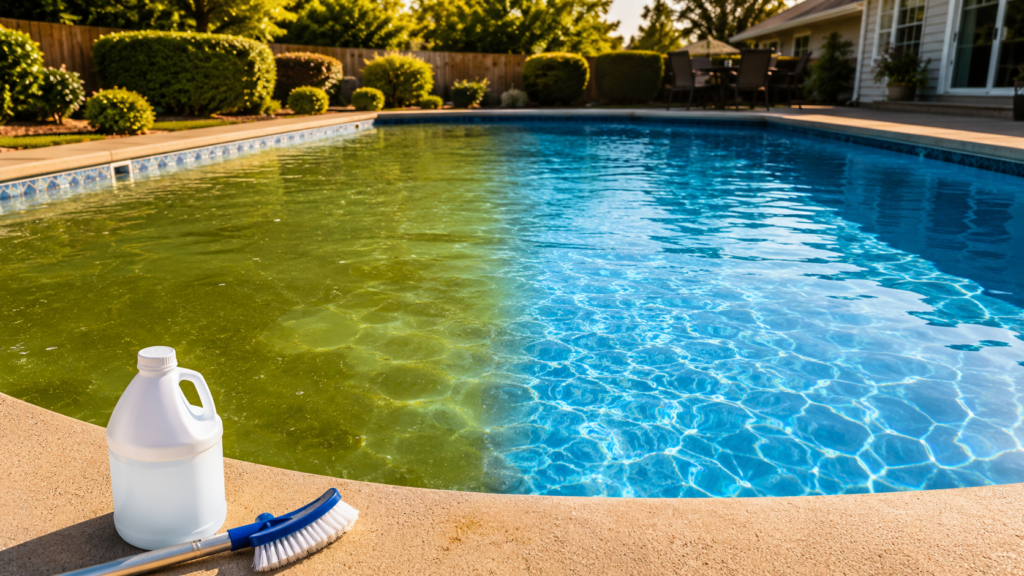
Your pool turned green, and the kids want to swim this weekend. Don’t call the pool service yet — a green pool is an algae bloom, and you can kill it yourself tonight for about $30–$60 in chlorine. I’ve cleared every shade of green in my own backyard pool over ten years of ownership, from a light teal haze to a full post-vacation swamp, and this is the exact process that works every time.
Quick Answer: To fix a green pool: brush the entire pool, lower the pH to around 7.2, then shock heavily with liquid chlorine or cal-hypo (2–4 lbs of cal-hypo per 10,000 gallons for a true green pool), run the pump 24 hours a day, and clean the filter every few hours as it catches dead algae. Light green water can clear in 24 hours; a dark green swamp takes 3–5 days.
What You Need to Know
- Green water = live algae. The fix is always the same: overwhelming chlorine + nonstop filtration + brushing.
- The greener the water, the more shock you need. Underdosing is the #1 reason DIY attempts fail.
- Your filter does half the work. Plan to backwash or rinse cartridges several times during the cleanup.
- Algaecide is optional. Chlorine kills algae; algaecide mostly prevents its return.
- Total cost DIY: $30–$80. Typical pool service “green-to-clean”: $300–$500.
Why Did My Pool Turn Green?
Quick Answer: Your free chlorine dropped below 1 ppm long enough for algae to bloom — usually after heavy rain, a hot week, a party, a clogged filter, or a chlorinator that quietly ran empty. High cyanuric acid (over ~100 ppm) can also cause green water even when tests show “good” chlorine, because the chlorine is too locked-up to kill anything.
Knowing the cause matters for prevention, but the fix below works regardless of how you got here. If you’re brand new to pool chemistry, our beginner’s guide to balancing pool water explains what these numbers mean — but you don’t need it to follow this rescue plan.
Step 1: Assess How Green It Actually Is (5 Minutes)
The shade of green sets your chlorine dose and your timeline:
| Water Condition | Can You See the Bottom? | Shock Needed (per 10,000 gal) | Realistic Timeline |
|---|---|---|---|
| Teal/light green haze | Yes, clearly | 1–2 lbs cal-hypo or 2 gal liquid chlorine | 24 hours |
| Green, murky | Only the first step | 2–3 lbs cal-hypo or 3 gal liquid chlorine | 24–48 hours |
| Dark green “swamp” | No | 3–4+ lbs cal-hypo or 4–5 gal liquid chlorine, possibly repeated | 3–5 days |
If you can’t see the bottom AND there’s heavy debris (a neglected or just-purchased home pool), scoop out leaves and large debris with a leaf rake first — chlorine wasted on rotting leaves is chlorine not killing algae.
Step 2: Remove Debris and Brush Everything (30–45 Minutes)
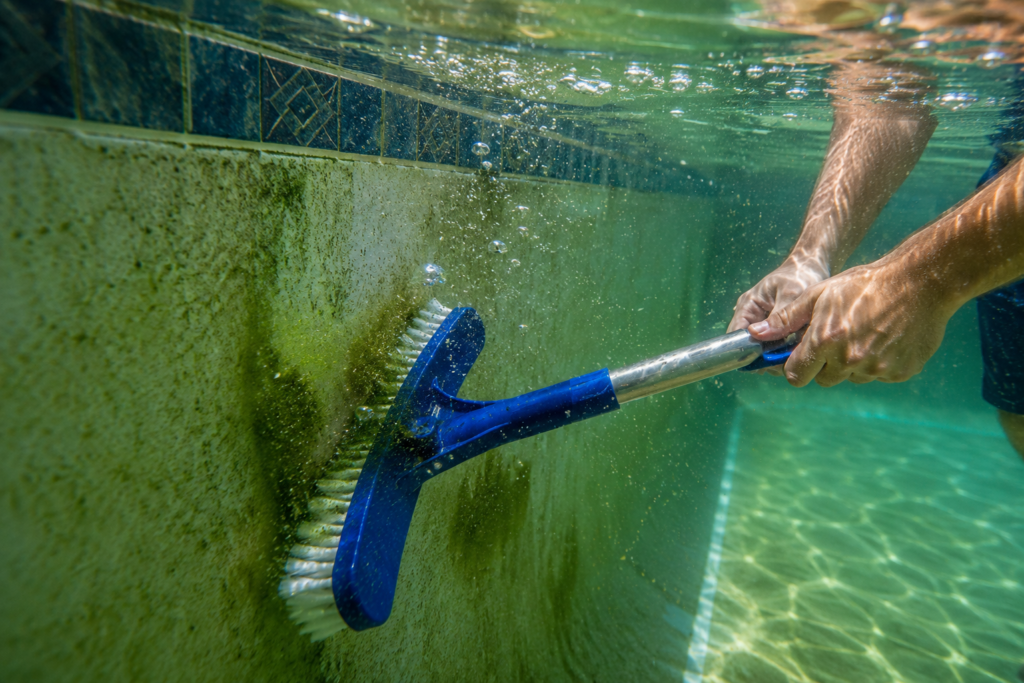
Algae anchors itself to walls, steps, and corners with a protective slime layer. Chlorine can’t penetrate it well until you break it open.
- Skim floating debris and rake the floor if you can reach it.
- Brush every surface — walls, floor, steps, ladders, behind the ladder, the waterline. Use a steel-bristle brush on plaster/concrete, nylon on vinyl or fiberglass.
- Empty skimmer and pump baskets so circulation is at full strength.
This step feels optional. It is not. In my experience, brushed pools clear in half the time — the first time I skipped brushing, my “24-hour fix” took four days.
Step 3: Check pH and Lower It to ~7.2 (15 Minutes)
Chlorine kills fastest in slightly acidic water. At pH 8.0, your shock is roughly half as effective — meaning you’d pay for twice the chlorine.
Test pH (strips are fine here; green water can distort colors, so hold the strip against white paper). If it’s above 7.4, add muriatic acid: roughly 10–12 fl oz per 10,000 gallons lowers pH about 0.2. Pour slowly into the deep end with the pump running, wait 30 minutes, retest.
Don’t obsess over precision today — “somewhere near 7.2” is the goal. Full balancing comes after the water is clear.
Step 4: Shock the Pool — Heavily (15 Minutes, at Dusk)
Quick Answer: Dose by the table in Step 1 based on your water color and gallons. For a typical 20,000-gallon murky-green pool, that’s 4–6 lbs of cal-hypo shock or about 6 gallons of 10% liquid chlorine. Add it at dusk so the sun doesn’t burn off your chlorine while it works.
Two good options:
- Liquid chlorine (10–12.5%): fastest acting, adds nothing else to the water. Pour slowly around the perimeter. [AFFILIATE LINK: Liquid Chlorine 12.5%]
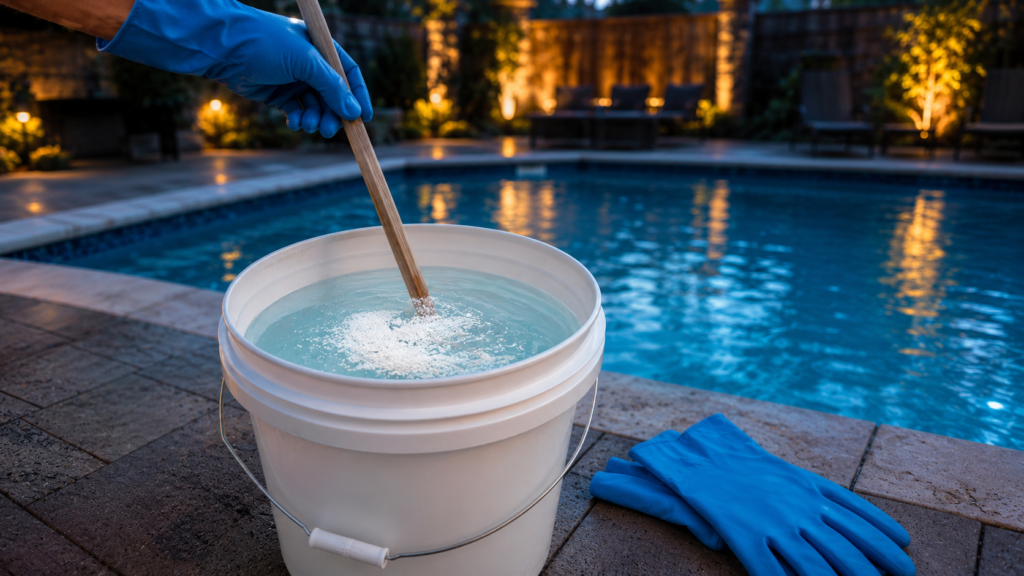
- Cal-hypo shock (65–73%): cheap and powerful. Pre-dissolve each pound in a 5-gallon bucket of pool water (never the reverse — always add chemical to water), stir with a stick, and pour the solution around the pool. Undissolved granules can bleach vinyl liners. [AFFILIATE LINK: Cal-Hypo Pool Shock]
Do not use trichlor tablets to fight a bloom (far too slow), and do not mix Cal-Hypo with trichlor anywhere, ever — including in the same bucket. The combination is genuinely dangerous; the U.S. Consumer Product Safety Commission’s pool chemical safety guidance covers why mixing pool chemicals sends thousands of people to emergency rooms every year.
Brush the pool again right after shocking to stir chlorine into every corner.
Step 5: Run the Pump 24/7 and Babysit the Filter
From now until the water is clear, the pump runs around the clock. The chlorine kills the algae; the filter removes the corpses. This is where most timelines are won or lost.
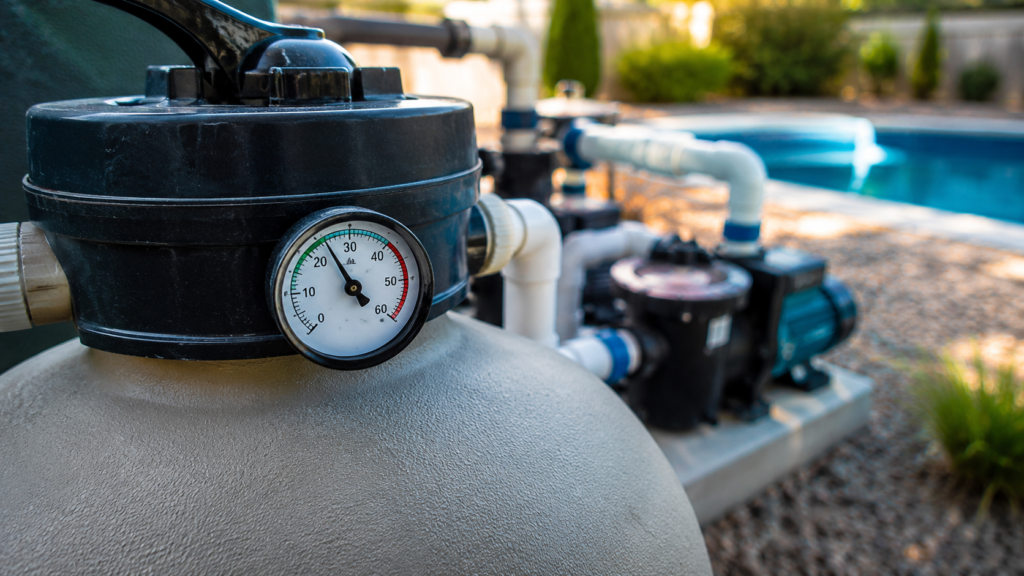
- Sand filter: backwash when the pressure gauge reads 8–10 psi above its clean baseline — during a green cleanup that can be every few hours at first.
- Cartridge filter: pull and hose off the cartridges whenever flow visibly weakens. Expect to do this 2–4 times on day one.
- DE filter: backwash and recharge with fresh DE per your filter’s spec.
If the water turns from green to cloudy gray-blue overnight — congratulations, the algae is dead. Cloudy is the corpse phase; keep filtering. If it stays hazy after 3 days, work through the 7 causes of cloudy pool water.
Step 6: Retest, Re-Shock if Needed, and Clear the Cloud
Next morning, test free chlorine:
- Chlorine still high (10+ ppm) and water cloudy blue: you won. Keep the pump running, keep cleaning the filter, vacuum settled dead algae (to WASTE if you have a multiport valve, so it bypasses the filter).
- Chlorine near zero and water still green: the algae ate your entire dose — this is common with dark green pools. Repeat Step 4 tonight at the same or higher dose. Persistent blooms with “good” chlorine readings usually mean CYA is very high; test it, and if it’s over ~100 ppm, drain 1/3 of the water and refill before shocking again.
- Stubborn last haze after 2–3 days: a clarifier can help the filter capture fine particles, or use a flocculant to sink everything to the floor, then vacuum to waste.
Once the water is clear and free chlorine has drifted back below 3 ppm, rebalance everything properly, and you’re back to normal.
Why Do DIY Green Pool Fixes Fail? (Troubleshooting)
If you’ve shocked once and the pool is still green, one of these five things went wrong — in order of how often we see them:
- Underdosing. A dark green 20,000-gallon pool needs 6–8+ lbs of cal-hypo, not the single 1-lb bag the label calls “shock treatment.” Algae consumes chlorine as it dies; if the bloom is bigger than the dose, the bloom wins and your chlorine reads zero by morning. Redose bigger.
- Shocking in full sun with low CYA. Fresh-fill pools often have near-zero stabilizer, and midday sun destroys unprotected chlorine in 2–3 hours — before it finishes the job. Shock at dusk, and if CYA is under 30, add a modest dose (30 ppm) so daytime chlorine survives.
- CYA is sky-high. The opposite problem: years of trichlor tablets push CYA past 100–150 ppm and effectively handcuff your chlorine. If the test says “chlorine fine” while the pool stays green, test CYA before buying another ounce of shock. Above ~150, partial drain first — it’s the only fix.
- The filter isn’t actually filtering. A torn cartridge, channeled old sand, or a valve stuck on recirculate means you’re killing algae and then stirring the corpses forever. If pressure never rises during a cleanup, the filter isn’t catching anything — inspect it.
- Dead spots never got brushed. Steps, corners, behind ladders, and under the skimmer weir shelter live algae that re-seeds the pool days later. Brush like you mean it, every day of the cleanup.
How Do I Keep My Pool from Turning Green Again?
Quick Answer: Keep free chlorine above 1 ppm at all times, run the pump at least 8 hours a day in summer, brush weekly, and test twice a week. Add a maintenance dose of polyquat algaecide weekly if your pool has bloomed before. Blooms don’t happen to pools with a routine — they happen to pools without one.
The two silent killers to watch: a chlorinator or floater that runs empty while you’re not looking, and CYA creeping up year after year from trichlor tablets until your chlorine stops working. The CDC’s healthy swimming guidelines recommend the same 1–3 ppm free chlorine range we use here — it’s a health standard, not just a clarity one.
If you’re new to all of this, our complete first-time pool owner guide turns prevention into a 15-minute weekly routine.
Frequently Asked Questions
How long does it take to fix a green pool?
Light green water typically clears in 24 hours with proper shocking and nonstop filtration. Murky green takes 24–48 hours, and a dark green swamp takes 3–5 days with repeated shocking. Filter cleaning frequency is the biggest factor in the timeline.
Can I swim in a green pool?
You shouldn’t. Green water means the sanitizer failed, so bacteria may be present along with the algae, and poor visibility is a real drowning hazard — a swimmer in trouble on the bottom can’t be seen. Wait until the water is clear and chlorine is back between 1–5 ppm.
Should I drain my green pool instead?
Rarely. Draining is expensive, and an empty in-ground pool can be structurally damaged or even pop out of the ground with high groundwater. The exceptions: CYA over ~150 ppm, or a years-neglected swamp with more debris than water.
Do I need algaecide to fix a green pool?
No — chlorine is what kills the bloom. Algaecide is a preventative. If you want to use one afterward, choose a polyquat 60 algaecide; cheap copper-based algaecides can stain plaster and turn blonde hair green.
Why is my pool green but my chlorine level is fine?
Usually one of three things: your test is measuring total (not free) chlorine, your cyanuric acid is so high the chlorine is ineffective, or the “green” is actually dissolved metals (copper) that turned the water clear-green after shocking — a metal sequestrant fixes that one, not more chlorine.
What to Do Next
- Once the water is clear, rebalance it correctly: How to Balance Pool Water for Beginners (Step-by-Step).
- Stock the chemicals you’ll need before the next emergency: Pool Chemical Starter Kit: Exactly What to Buy Your First Season.
- Never done any of this before? Start with the complete First-Time Pool Owner Guide.
