
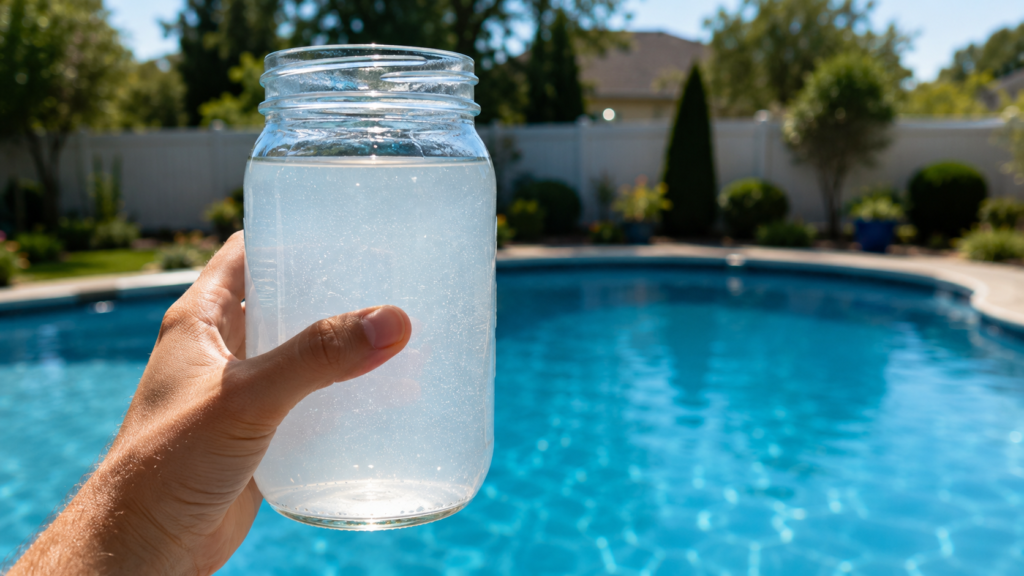
Your pool isn’t green — it’s just… milky. You can see the shallow steps, but the deep end disappears into a white haze, and yesterday it was fine. Cloudy pool water is the most common pool problem, and the good news is it’s usually the cheapest to fix: most cloudy pools clear within 12–24 hours once you treat the actual cause rather than guessing.
Quick Answer: Cloudy pool water has 7 common causes: insufficient filtration time, a dirty or damaged filter, high pH or alkalinity, low chlorine, post-shock cloudiness, high calcium hardness, and environmental load (pollen, dust, sunscreen). Diagnose with a water test first — if chemistry is fine, it’s a filtration problem; if pH is above 7.8 or chlorine below 1 ppm, fix the chemistry and the cloud clears itself.
What You Need to Know
- Cloudiness is billions of suspended particles too small for your filter to catch quickly — the cause determines the cure.
- Test the water before treating anything. Half of cloudy pools are a chemistry problem, half are a filtration problem, and the fixes are completely different.
- Cloudy water after shocking is usually normal and temporary — it’s dead algae, and it filters out.
- A clarifier helps your filter; a flocculant replaces it. Use clarifier for light haze, floc for heavy milk — never both together.
- A cloudy pool is a safety issue, not just ugly: if you can’t clearly see the main drain, nobody swims.
Cloudy Pool Water Diagnosis Chart
Save or screenshot this chart — match your symptom, then jump to that fix below.
| What You’re Seeing | Most Likely Cause | Fix Time |
|---|---|---|
| Cloudy all over, chemistry tests fine | #1 Not enough filtration or #2 filter problem | 12–24 hrs |
| Cloudy + pH tests above 7.8 | #3 High pH / alkalinity | 12–24 hrs |
| Cloudy + dull, chlorine below 1 ppm | #4 Low chlorine (early algae) | 24 hrs |
| Cloudy right after shocking | #5 Post-shock cloudiness (usually normal) | 24–48 hrs |
| Milky white, worse when heater runs | #6 High calcium hardness | Days (dilution) |
| Cloudy after a storm, pollen, or a pool party | #7 Environmental load | 12–24 hrs |
First: Test Before You Treat (10 Minutes)
Quick Answer: Test free chlorine, pH, total alkalinity, and calcium hardness before adding anything. Cloudy water with perfect chemistry is a filtration problem; cloudy water with bad numbers is a chemistry problem — and treating the wrong one wastes days and money.
Take your sample from elbow depth away from the returns. Write the four numbers down; you’ll match them against the causes below. If you only own strips, they’ll do for today, but a drop-count kit reads calcium and chlorine far more accurately — our chemical starter kit guide covers which one to buy.
Cause #1: Your Pump Isn’t Running Long Enough
The most common cause of chronically cloudy water is simply not filtering enough hours per day. Your filter can only remove what passes through it, and a pool’s full volume needs to “turn over” at least once daily — for most residential pools that means 8–12 hours of pump runtime in swim season. Owners running 4–6 hours to save electricity are filtering half the water and leaving the rest to haze up.
The fix: run the pump 24/7 until the water clears, then set the daily schedule to at least 8 hours (10–12 in peak summer heat). If electricity cost is the concern, that’s the case for a variable-speed pump — longer runtime at low speed costs less than short runtime at full speed.
Cause #2: Dirty, Worn, or Damaged Filter
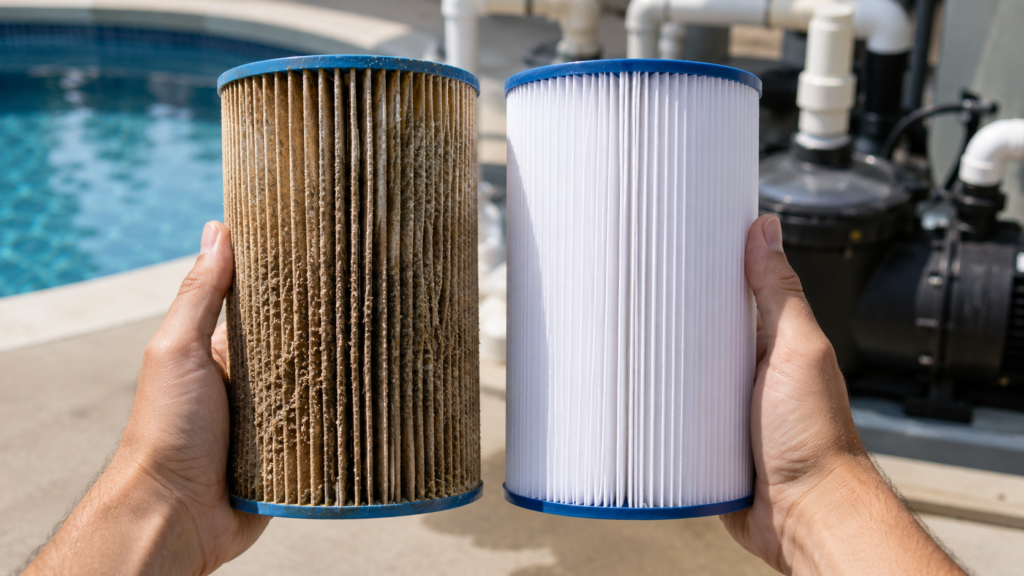
If runtime is fine but water stays hazy, the filter itself is the suspect. Each type fails differently:
- Sand filter: sand over 3–5 years old gets rounded and “channeled” — water tunnels through without touching most of the sand. Backwash first; if pressure won’t stabilize or clarity never improves, replace the sand.
- Cartridge filter: hose the pleats clean; inspect for tears and crushed pleats. A torn cartridge passes particles endlessly — no chemical will out-treat a hole in the filter.
- DE filter: backwash and recharge with fresh DE. A torn grid shows up as DE powder blowing back into the pool (fine white dust settling on the floor).
One counterintuitive tip: a slightly dirty sand filter actually filters better than a freshly backwashed one — don’t backwash daily during a cloudy-water cleanup unless pressure rises 8–10 psi over your clean baseline.
Cause #3: High pH or Alkalinity (The Chemistry Cloud)
Quick Answer: When pH climbs above 7.8, calcium in the water starts falling out of solution as microscopic scale particles — that’s your cloud. Lower pH to 7.4–7.6 with muriatic acid (about 10 fl oz per 10,000 gallons drops pH ~0.2) and the haze typically clears within a day.
High pH clouds are the classic “pool cloudy, but chlorine is fine” case. Bonus problem: chlorine loses roughly half its killing power at pH 8.0, so a high-pH pool is usually a few days from turning green too. Alkalinity above 120 ppm drags pH up persistently — fix both, in the order our water balancing guide walks through (alkalinity first, always).
Cause #4: Low Chlorine — the Pre-Green Warning
Dull, cloudy water with free chlorine under 1 ppm is algae in its opening move. The particles clouding your water are the first wave of a bloom that hasn’t turned visibly green yet — you’ve caught it early, which is lucky.
The fix: shock the pool tonight at 1–2 lbs of cal-hypo per 10,000 gallons, run the pump continuously, and brush the walls. If any green tint appears, switch to the full protocol in our green pool rescue guide — same chemistry, bigger doses.
Why Is My Pool Cloudy After Shocking?
Quick Answer: Cloudiness right after shocking is usually a good sign — it’s dead algae and oxidized contaminants now suspended in the water, waiting for your filter to remove them. Keep the pump running 24/7, and the water typically polishes clear within 24–48 hours. It only becomes a problem if the cloud persists past 3 days.
Three separate things happen under the “cloudy after shock” umbrella (this is cause #5):
- Dead algae haze: the normal one described above. Filter it out; vacuum settled dust to waste if you have a multiport valve.
- Cal-hypo residue: calcium hypochlorite shock adds calcium, and in hard water some of it stays visible briefly. Pre-dissolving each pound in a bucket before adding largely prevents this.
- Shocking already-unbalanced water: shock added at pH 8.0+ pushes calcium out of solution — you get the Cause #3 cloud triggered by the shock. Test pH; if it’s high, correct it, and the haze follows.
Cause #6: High Calcium Hardness (The Milky White Cloud)
Calcium hardness above roughly 400–500 ppm gives water a persistent milky-white character that worsens when the water warms — heater on, sunny week, hot tub attached. You’ll often see white scale crusting on the waterline tile as confirmation.
The fix is dilution, not chemicals: no product removes dissolved calcium from pool water. Drain one-quarter to one-third and refill with softer water (test your fill water first — in hard-water regions like Arizona and Texas, fill water itself can read 300+ ppm, and a hose-end prefilter is worth using). Then hold pH at the lower end of the range (7.4) to keep the remaining calcium dissolved.
Cause #7: Environmental Load — Pollen, Dust, Storms, and Swimmers
Sometimes the cloud came from outside: spring pollen fine enough to sail through a sand filter, dust storms, rain washing deck dirt in, or a weekend pool party’s worth of sunscreen and body oils. According to the CDC’s healthy swimming guidance, swimmer-introduced contaminants are a major consumer of free chlorine — which is why the pool clouds the day after the party: the chlorine got spent, and cause #4 followed.
The fix: shock lightly (1 lb cal-hypo per 10,000 gallons) after any heavy-use day or storm, run extended filtration, and skim aggressively. For fine pollen that keeps passing through the filter, this is the one scenario where a clarifier genuinely earns its money — see below.
Clarifier vs Flocculant: Which One Do You Need?
Quick Answer: Clarifier clumps fine particles into filter-catchable sizes — use it for light haze with the pump running normally. Flocculant sinks everything to the floor in one heavy blanket that you vacuum to waste — use it for heavy milk-white water when you need clarity in 24 hours. Never use both together.
| Clarifier | Flocculant | |
|---|---|---|
| Best for | Light to moderate haze | Heavy, milky cloud |
| How it works | Clumps particles for the filter | Sinks particles to the floor |
| Your effort | None — pump does the work | Vacuum entire floor to waste |
| Speed | 2–3 days | 12–24 hours |
| Requires | Any filter | Multiport valve (waste setting) |
Neither is a routine chemical — they’re occasional tools. A bottle of clarifier is worth keeping on the shelf for pollen season; buy floc only when facing a milk pool with a deadline.
Common Mistakes That Keep Pools Cloudy
- Adding chemical after chemical without testing. Clarifier on top of shock on top of pH-up, all in one afternoon — now the water has five problems instead of one. Test, treat one cause, wait, retest.
- Backwashing obsessively. Every backwash throws away the “pre-coat” of trapped particles that makes a sand filter effective. Only backwash at +8–10 psi.
- Running clarifier with a broken filter. Clarifier makes bigger clumps — a torn cartridge passes those too. Fix the filter first.
- Ignoring the safety line. If you can’t see the main drain clearly, the pool is closed to swimmers — cloudy water is the leading visibility factor in pool drowning incidents.
- Draining a cloudy pool. Seldom necessary (high calcium is the exception) and risky for the shell. Filtration and chemistry fix the rest.
Frequently Asked Questions
How long does it take for cloudy pool water to clear?
With the cause correctly treated and the pump running continuously: chemistry clouds (high pH, low chlorine) clear in 12–24 hours, post-shock haze in 24–48 hours, and filtration-limited clouds in 1–3 days depending on filter condition. If nothing improves after 72 hours, re-test the water and inspect the filter — something was misdiagnosed.
Can I swim in a cloudy pool?
Not recommended, and if you can’t clearly see the main drain at the deep end, absolutely not. Cloudy water hides swimmers in distress from anyone above the surface, and the same conditions that cloud water often mean sanitization has failed. Clear the water first — most fixes take a single day.
Why is my pool cloudy but chlorine is fine?
Perfect chlorine with cloudy water points to one of three causes: pH above 7.8 pushing calcium out of solution, insufficient filtration hours, or a worn filter passing fine particles. Test pH first — it’s the 2-minute check. If pH is 7.4–7.6, the answer is filtration.
Will shock clear a cloudy pool?
Only if the cloud is biological — low chlorine, early algae, or post-party contamination. Shock does nothing for high pH clouds, calcium clouds, or filter problems, and shocking high-pH water can actually make the cloud worse. That’s why the diagnosis test comes before any treatment.
Does baking soda clear cloudy pool water?
No — this is a persistent myth. Baking soda raises alkalinity, and since high pH/alkalinity is a leading cause of cloudiness, adding it to an already-cloudy pool usually makes things worse. Baking soda belongs in pools with low alkalinity readings, cloudy or not.
Why is my pool cloudy after rain?
Rain dilutes your chlorine, washes dust and organic debris into the water, and often lowers pH. After heavy rain, test everything, expect to add chlorine, and run extended filtration for a day. A light shock after major storms prevents the cloud from becoming a bloom.
What to Do Next
- Chemistry numbers off? Fix them in the right order with How to Balance Pool Water for Beginners.
- Seeing a green tint in that cloud? Move fast: Green Pool? Here’s How to Fix It in 24 Hours.
- Pump not circulating at all? That’s the cause behind many cloudy pools — see Pool Pump Not Priming.
