
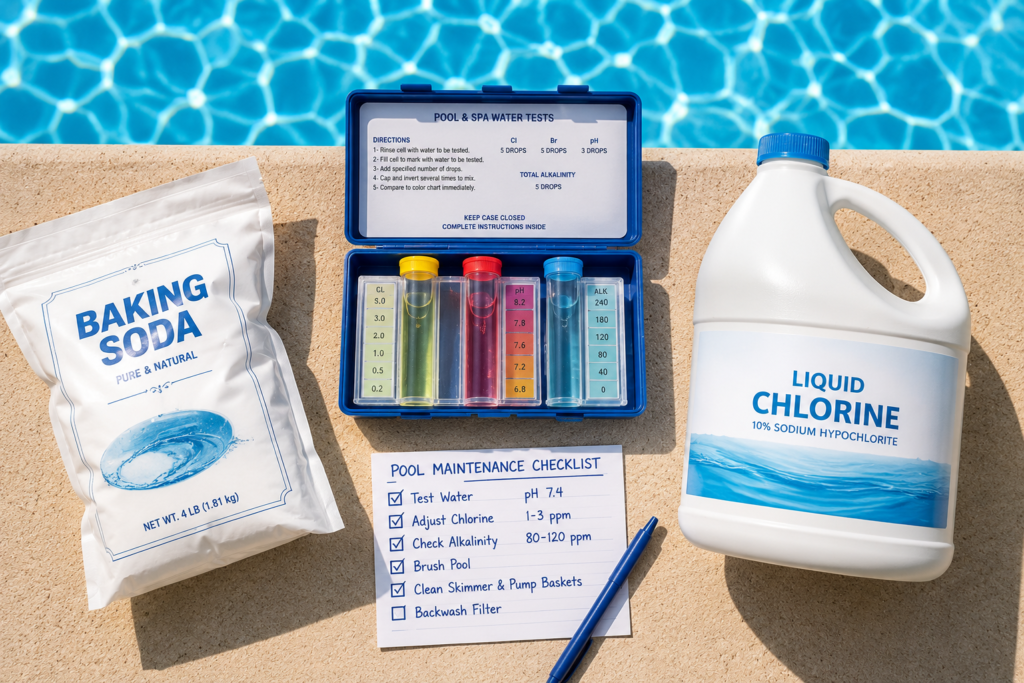
You’re standing in the pool aisle holding a test strip that turned three different colors, and you have no idea what any of it means. Take a breath — balancing pool water is a 15-minute routine once you know the order, and this guide gives you every number and every dose.
Quick Answer: Balance pool water in this order: total alkalinity first (target 80–120 ppm), then pH (7.4–7.6), then cyanuric acid (30–50 ppm), then free chlorine (1–3 ppm). Fix alkalinity before pH because alkalinity controls how much pH swings. Test first, add one chemical at a time, run the pump, and retest after 4–6 hours.
What You Need to Know
- Only 4 numbers run your pool day to day: free chlorine, pH, total alkalinity, and cyanuric acid (CYA).
- Always adjust alkalinity before pH — it’s the stabilizer that stops pH from bouncing.
- Never mix chemicals or add them at the same time. One chemical, then circulate, then the next.
- All doses depend on your pool’s gallons. Calculate it once: length × width × average depth × 7.5.
- A liquid drop-count test kit is dramatically more accurate than strips. It’s the best $70 you’ll spend on your pool.
What Are the Correct Pool Water Levels?
Quick Answer: Free chlorine 1–3 ppm, pH 7.4–7.6, total alkalinity 80–120 ppm, cyanuric acid 30–50 ppm, and calcium hardness 200–400 ppm. Hit those five ranges and your water will be clear, safe, and gentle on equipment. These match the CDC’s healthy swimming recommendations for residential pools.
| Reading | Ideal Range | Too Low Causes | Too High Causes |
|---|---|---|---|
| Free chlorine | 1–3 ppm | Algae, bacteria, cloudy water | Faded suits, strong odor, irritation |
| pH | 7.4–7.6 | Eye sting, corroded metal, etched plaster | Cloudy water, scale, weak chlorine |
| Total alkalinity | 80–120 ppm | pH swings wildly | pH stuck high, cloudiness |
| Cyanuric acid (CYA) | 30–50 ppm | Sun burns off chlorine in hours | Chlorine becomes sluggish |
| Calcium hardness | 200–400 ppm | Water attacks plaster/grout | Scale on tile and equipment |
Step 1: Find Out How Many Gallons Your Pool Holds
Every dose on every chemical label is “per 10,000 gallons,” so this number is your foundation.
For a rectangular pool: length × width × average depth × 7.5 = gallons. A 16×32 ft pool averaging 5 ft deep is 16 × 32 × 5 × 7.5 = 19,200 gallons. For round pools, use diameter × diameter × average depth × 5.9. Write the number in your phone — you’ll use it every week.
Step 2: Test the Water Properly
Quick Answer: Take your water sample from elbow depth (about 18 inches down), away from returns and skimmers, with the pump running. Surface water gives false readings.
Test strips are fine for quick daily checks, but for your weekly balancing session, use a drop-count kit like the Taylor K-2006 — it measures free chlorine, pH, alkalinity, CYA, and calcium accurately for years on one kit. [AFFILIATE LINK: Taylor K-2006 Test Kit]
Write down all five readings before touching any chemical. You’re going to fix them in a specific order.
Step 3: Fix Total Alkalinity First (80–120 ppm)
Alkalinity is pH’s shock absorber. If you adjust pH while alkalinity is wrong, the pH will drift right back within a day, and you’ll think you’re bad at this. You’re not — the order was wrong.
To raise alkalinity: add baking soda (sodium bicarbonate — the pool store’s “alkalinity increaser” is the same thing). Dose: 1.5 lbs of baking soda raises alkalinity by 10 ppm in a 10,000-gallon pool. So if your 20,000-gallon pool reads 60 ppm and you want 90 ppm, you need 30 ppm of increase: 1.5 lbs × 3 × 2 = 9 lbs. Broadcast it across the deep end with the pump running.
To lower alkalinity: add muriatic acid slowly to the deep end (see safety rules in Step 7). Roughly 26 fl oz of muriatic acid lowers alkalinity 10 ppm per 10,000 gallons, but it also drops pH — lower alkalinity in stages over several days, letting pH recover with aeration between doses.
Retest after 6 hours of circulation before moving on.
Step 4: Adjust pH (7.4–7.6)
Quick Answer: If pH is below 7.4, add soda ash (pH increaser); about 6 oz raises pH by 0.2 in 10,000 gallons. If pH is above 7.6, add muriatic acid; about 10 fl oz lowers pH by 0.2 in 10,000 gallons. Add to the deep end with the pump running, retest in 4 hours.
pH matters more than most beginners realize: at pH 8.0, your chlorine is only about half as effective as it is at 7.5. If your water is “sanitized” but still going dull, high pH is usually the reason.
Dose conservatively. It’s always easier to add a second small dose than to overshoot and correct in the other direction.
Step 5: Check Cyanuric Acid (30–50 ppm)
CYA (also called stabilizer or conditioner) is sunscreen for chlorine. Without it, direct sun destroys most of your chlorine within a couple of hours. With too much of it, chlorine gets locked up and stops killing algae effectively.
- Below 30 ppm: add cyanuric acid. 13 oz raises CYA by 10 ppm per 10,000 gallons. Add it via a sock hung in front of a return jet — it dissolves slowly and can damage surfaces if dumped directly.
- Above 80–100 ppm: the only practical fix is a partial drain and refill. This usually happens when a pool has run on trichlor tablets for years, because every tablet adds CYA.
Step 6: Bring Chlorine to 1–3 ppm
Now — and only now — dose your sanitizer, because chlorine works best in balanced water.
Liquid chlorine (10–12.5%): roughly 10 fl oz raises free chlorine 1 ppm per 10,000 gallons. Pour slowly around the perimeter in the evening.
Trichlor tablets: 3-inch tablets in a floater or inline chlorinator maintain chlorine slowly. Remember every tablet also raises CYA and lowers pH over time.
Cal-hypo shock: for weekly boosts or after heavy use — about 1 lb per 10,000 gallons raises chlorine sharply. [AFFILIATE LINK: Cal-Hypo Pool Shock]
If your free chlorine reads noticeably lower than your total chlorine, you have combined chloramines — that’s the “chlorine smell” — and the fix is to shock, not to add less chlorine.
Step 7: Add Chemicals Safely (Non-Negotiable Rules)
- Always add chemicals to water, never water to chemicals — especially acid.
- One chemical at a time. Circulate at least 30 minutes (ideally 4–6 hours) between different chemicals.
- Never mix trichlor and cal-hypo, even in the same bucket residue — the combination can ignite. The CPSC’s pool chemical safety guide covers safe storage and handling in detail.
- Wear safety glasses and gloves for muriatic acid; pour it downwind, close to the water surface.
- Store chlorine and acid in separate, ventilated areas, off the ground, out of the sun.
Step 8: Check Calcium Hardness Monthly (200–400 ppm)
Calcium hardness is the slow-moving fifth number — it drifts over months, not days, so a monthly test is plenty.
- Below 200 ppm in a plaster/concrete pool: soft water pulls calcium out of your pool’s surfaces, slowly etching plaster and grout. Add calcium chloride: 1.25 lbs raises hardness 10 ppm per 10,000 gallons. Dissolve it in a bucket of water first (it gets hot as it dissolves — that’s normal) and pour around the pool.
- Above 400–500 ppm: you’ll see white scale forming on tile and inside the heater. No chemical removes calcium; the fix is partial drain-and-refill with softer water, plus keeping pH on the low side of range to slow scaling.
- Fiberglass and vinyl pools: calcium matters much less. Keep it above ~150 ppm so the water isn’t aggressive toward metal parts, and don’t stress beyond that in your first year.
What Are the Most Common Beginner Balancing Mistakes?
Quick Answer: The five classics: adjusting pH before alkalinity, adding multiple chemicals at once, dosing without knowing the pool’s gallons, testing right after adding chemicals, and chasing “perfect” numbers daily instead of keeping ranges weekly.
A few more that cost real money:
- Trusting the pool store printout blindly. Free store tests are useful, but their software is designed to sell products. Cross-check against your own kit before buying $90 of “needed” chemicals.
- Shocking in the morning. Sunlight destroys unstabilized chlorine within hours. Shock at dusk so it works all night.
- Adding stabilizer through the skimmer. CYA is acidic and dissolves slowly; sitting in your filter it can damage internals. Use the sock method in front of a return.
- Ignoring CYA on tablet pools. Trichlor tablets quietly push CYA up all season. When CYA passes 100 ppm, “normal” chlorine levels stop working and the water dulls — and no bottle fixes it, only dilution.
How Often Should You Test and Balance Pool Water?
Quick Answer: Test chlorine and pH twice a week (daily in a heat wave or after a party). Test alkalinity weekly. Test CYA and calcium hardness monthly. Full rebalancing is rarely needed more than once a week once the water is stable.
Consistency beats intensity. A pool tested for two minutes every Wednesday and Saturday rarely turns green. A pool tested “when it looks off” always eventually does — and then you’re following our green pool rescue guide instead of enjoying your weekend.
Skipping tests shows up as haze before it shows up as green — here’s what cloudy water is telling you.
Frequently Asked Questions
What order should I add pool chemicals?
Alkalinity first, then pH, then cyanuric acid, then chlorine, with circulation time between each. Calcium hardness can be adjusted any time it’s low. Never add two chemicals in the same hour.
Can I swim right after adding chemicals?
After balancing doses (pH, alkalinity, small chlorine additions), wait until the pump has circulated for 30–60 minutes and chlorine reads 3 ppm or lower. After shocking, wait until free chlorine falls back below 3–5 ppm — usually 8–24 hours.
Why does my pH keep going up?
Rising pH is normal in most pools — aeration from waterfalls, jets, and swimmers drives off carbon dioxide, which raises pH. Saltwater pools drift upward even faster. If it climbs fast, check that alkalinity isn’t above 120 ppm.
Are test strips accurate enough?
Strips are fine for a quick daily chlorine/pH glance, but they’re poor at alkalinity and nearly useless for CYA. Use a drop-count kit for your weekly session and keep strips for spot checks.
What happens if I swim in unbalanced water?
Low chlorine risks bacteria and algae; you may not see the problem for a day or two. Low pH stings eyes and skin quickly. High pH is more subtle — dull water, less effective chlorine, scale. One swim in slightly off water won’t hurt most people, but don’t let it become the norm.
What to Do Next
- Just bought your first test kit and chemicals? Follow the full Start Here: First-Time Pool Owner Guide for your complete weekly routine.
- Not sure which chemicals to buy in the first place? See the Pool Chemical Starter Kit: Exactly What to Buy Your First Season.
- Water already green? Balancing comes later — first read Green Pool? Here’s How to Fix It in 24 Hours.
