
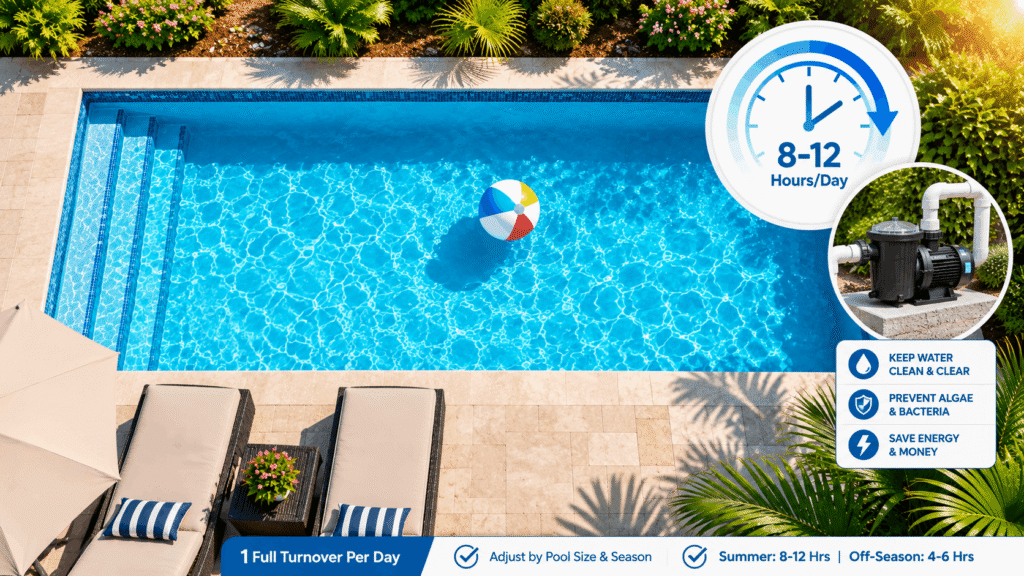
Your electric bill jumped last month and you’re staring at the pool pump timer, wondering if it’s running too much — or if cutting it back is what’s turning your water cloudy. Both problems trace back to the same setting, and getting it right is simpler than the range of answers online makes it look.
Quick Answer: Most residential pools need the pump running 8–12 hours per day in summer and 4–6 hours per day in the off-season, enough to filter the entire pool volume (one full “turnover”) at least once daily. The exact number depends on your pool’s gallon volume and your pump’s flow rate (GPM) — not a flat rule that fits every pool.
What You Need to Know
- Run time is a math problem: pool volume ÷ pump flow rate (GPM) ÷ 60 = hours needed for one full turnover.
- Summer heat and bather load push that number up; off-season, you can cut it roughly in half.
- A 10,000-gallon pool with a typical residential pump needs about 8 hours a day in peak season.
- Running too little causes cloudy water and algae; running too much just burns electricity for no added benefit.
- Variable-speed pumps change the math — they can run longer at lower speeds for less cost than a single-speed pump running short and hard.
How Long Should You Run Your Pool Pump?
The standard guideline is one full water turnover per day, which lands most residential pools at 8–12 hours daily in summer and 4–6 hours in cooler months. A turnover means every gallon in the pool has passed through the filter at least once. Pools with heavy use, high heat, or algae history often need to push toward the higher end of that range.
This isn’t a number you should just copy, though — it’s a starting point. The next section shows you how to calculate your pool’s actual number in under two minutes.
Understanding Pool Turnover Rate
Turnover rate is the time it takes your pump and filter to circulate a volume of water equal to your entire pool once. It’s the foundation every run-time recommendation is built on, because a pump that’s too small or run too briefly never gets a full turnover in a day — and that’s when water starts turning cloudy or green regardless of how much chlorine you add.
Most home pools are designed around a single daily turnover. Commercial and public pools are often required to turn over water multiple times per day under local health codes — a good reminder that “how long should I run my pump” doesn’t have one universal answer.
How to Calculate Your Exact Run Time
The formula is straightforward, and doing it once means you’ll never have to guess again.
- Find your pool’s volume in gallons. Check your pool builder’s paperwork, or calculate it: length × width × average depth × 7.5 (for rectangular pools).
- Find your pump’s flow rate in GPM (gallons per minute). This is on the pump’s spec plate or manufacturer manual — typical residential pumps run 40–100 GPM.
- Divide pool volume by GPM, then divide by 60. That gives you the hours needed for one full turnover.
Example — 10,000-Gallon Pool
A 10,000-gallon pool with a pump moving 60 GPM needs roughly 2.8 hours for one mathematical turnover (10,000 ÷ 60 ÷ 60). In practice, pool professionals generally recommend running well beyond the bare mathematical minimum — closer to 8 hours in summer — because real-world circulation is never perfectly efficient, and heat and bather load add contaminant load faster than one clean turnover can handle.
Pool Pump Run Time Reference Chart
Use this chart to find your number by pool size and pump flow rate. These are peak-season (summer) recommendations.
| Pool Volume (gallons) | 40 GPM Pump | 60 GPM Pump | 80 GPM Pump | 100 GPM Pump |
|---|---|---|---|---|
| 5,000 | 6 hrs | 5 hrs | 4 hrs | 4 hrs |
| 10,000 | 10 hrs | 8 hrs | 6 hrs | 5 hrs |
| 15,000 | 12 hrs | 10 hrs | 8 hrs | 7 hrs |
| 20,000 | — | 12 hrs | 10 hrs | 8 hrs |
| 30,000 | — | — | 12 hrs | 12 hrs |
Save or screenshot this reference chart — it covers most residential pool sizes and common pump flow rates so you can set your timer without doing the math yourself.
Run Time by Season
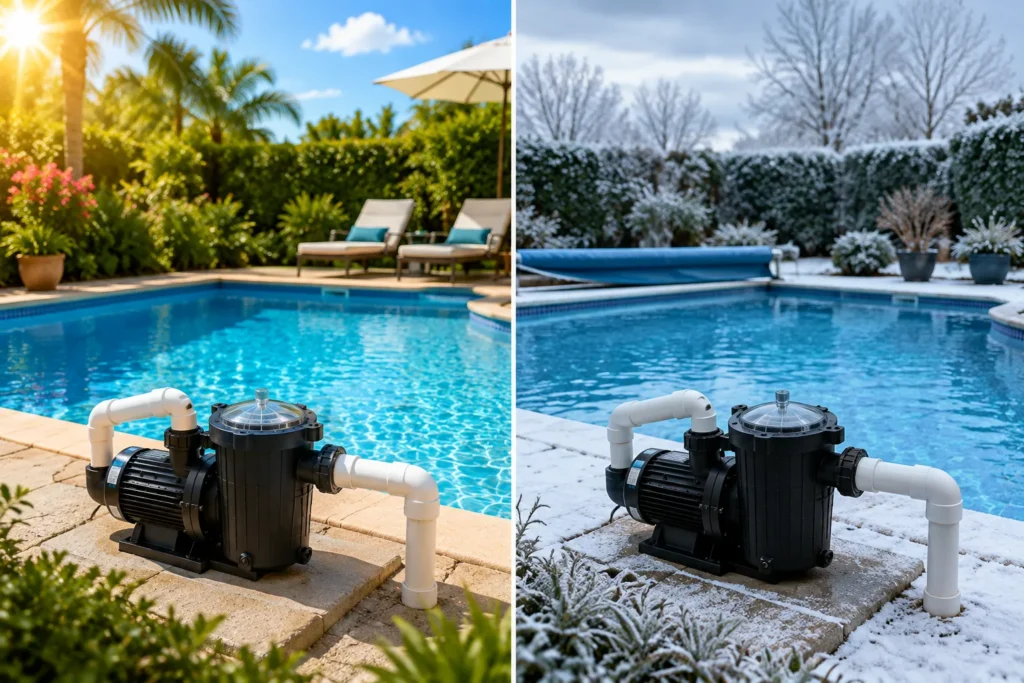
Summer months require the longest run times because heat and sunlight accelerate algae growth and chlorine burn-off. Plan for 8–12 hours daily from late spring through early fall, especially during heavy pool use or after heavy rain.
Off-season run time can drop to 4–6 hours daily, since lower water temperatures slow both bacterial growth and chemical breakdown. Never shut the pump off completely unless the pool is fully winterized — stagnant water invites algae even in cold weather.
Single-Speed vs. Variable-Speed Pumps
A single-speed pump runs at one fixed speed, so cutting your hours is the only way to save electricity — but shorter run times risk incomplete turnover. A variable-speed pump lets you run longer at a much lower speed, hitting your turnover target while using a fraction of the electricity a single-speed pump draws.
According to the U.S. Department of Energy, variable-speed pool pumps can cut pump energy costs significantly compared to single-speed models, because pumping speed and energy use scale together — running at half speed uses roughly one-eighth the energy, not half.
Can You Run a Pool Pump 24/7?
Yes, you can run a pool pump continuously, but for most residential pools it’s unnecessary and expensive. Once you’ve hit your daily turnover target, additional run time offers diminishing returns on water clarity while adding directly to your electric bill. The exception is pools actively fighting an algae bloom or a recent contamination event, where 24-hour circulation for a few days can help.
What Happens If You Under-Run or Over-Run Your Pump
Under-running your pump is the more common — and more damaging — mistake. Skipping turnovers lets debris, bacteria, and algae spores settle and multiply faster than your filter can clear them, which is one of the most frequent causes behind cloudy pool water. Over-running wastes electricity without meaningfully improving clarity once you’ve already hit full turnover.
Best Time of Day to Run Your Pump
Running your pump during off-peak electricity hours — typically overnight or early morning — cuts your cost without changing water quality, since turnover math doesn’t care what time the water gets filtered. Many utility companies offer lower rates outside 4–9 PM, and some pool owners split their run time into two blocks (early morning and late night) to also help combat algae growth that tends to spike during peak afternoon sun.
If you’re finding that even a well-timed schedule isn’t controlling your electric bill, that’s usually a sign your current single-speed pump is oversized or aging — a variable-speed pump run on this same schedule typically costs noticeably less to operate over a season.
[Interested readers can grab our free printable Pool Pump Run Time Chart — sign up below and we’ll send it straight to your inbox, along with our other pool maintenance guides.]
FAQ
How long should a pool pump run per day in summer?
Most residential pools need 8–12 hours of pump run time daily during summer. This covers one full turnover plus extra circulation to handle higher bather load, heat, and faster chlorine breakdown. Pools in especially hot climates or with heavy daily use should lean toward the higher end of that range.
How long should a pool pump run for a 10,000-gallon pool?
A 10,000-gallon pool typically needs about 8 hours daily in summer with a standard 60 GPM residential pump, based on achieving one full turnover with margin for real-world inefficiency. Off-season, that number can drop to around 4 hours.
How long to run a pool pump in the off-season?
In the off-season, 4–6 hours of daily run time is usually enough, since cooler water temperatures slow algae growth and chemical breakdown. Never turn the pump off entirely unless the pool has been properly winterized.
How long can you continuously run a pool pump?
A pool pump can run continuously without damage — pumps are built for extended operation. Most owners don’t need to run 24/7 unless actively treating an algae bloom, since additional hours past your turnover target add cost without meaningfully improving clarity.
Does a bigger pool always need a longer pump run time?
Not necessarily — run time depends on the ratio between pool volume and pump flow rate (GPM), not volume alone. A large pool with a high-GPM pump can need less run time than a smaller pool with an undersized pump.
What to Do Next
Once your run-time schedule is dialed in, the next place cloudy water usually comes from is chemical imbalance, not circulation — check our guide on how to balance pool water for beginners to rule that out. If your water is already cloudy despite a correct schedule, our cloudy pool water guide walks through the 7 most common causes and exact fixes for each.
