
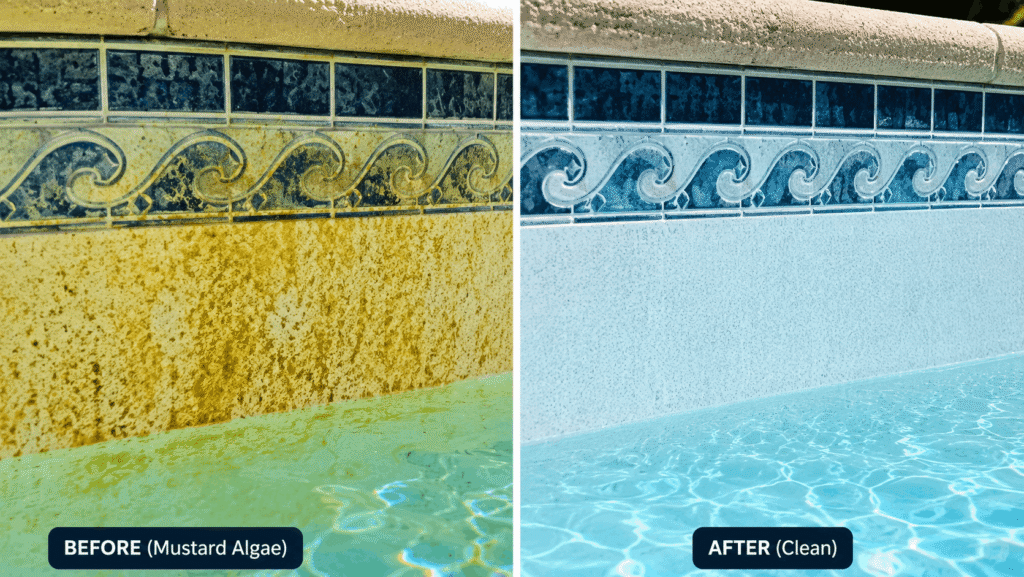
You’ve shocked the pool, brushed the walls, and the yellow patches are back within two days. That’s the calling card of mustard algae, and it behaves nothing like the green stuff — but it’s absolutely beatable once you treat it correctly.
Quick Answer: Mustard algae is a yellow-tan, powdery algae that clings to shaded pool surfaces and resists normal chlorine levels. Kill it by shocking the pool to 20-30 ppm free chlorine, brushing aggressively, adding a chelated copper or mustard-specific algaecide, running the filter continuously, and decontaminating every toy, brush, and swimsuit that touched the water.
What You Need to Know
- Mustard algae is chlorine-resistant, not chlorine-proof — it needs a much higher shock dose than standard maintenance levels
- It’s often mistaken for sand or dirt because it brushes off easily and settles on shaded, low-circulation surfaces
- Toys, pool brushes, ladders, and swimsuits can reinfect a treated pool within days if not decontaminated
- Full elimination typically takes 3-7 days of consistent treatment, not one shock cycle
- It’s not classified as a health hazard, but it signals sanitation and circulation problems worth fixing
What Is Mustard Algae?
Mustard algae is a yellow-to-tan, powdery algae strain that clings to pool walls, steps, and shaded areas, brushing off easily but returning within a day or two. It’s often called yellow algae or tan algae for the same reason.
Genetically, mustard algae is closer to green algae than most owners assume. Behaviorally, it’s a different animal entirely — it resists the chlorine levels that would flatten a green algae bloom, which is exactly why standard shock treatment so often fails against it.
Mustard algae is not sand or dirt, even though it looks and behaves like both at first glance. Dirt and sand settle in low spots and stay put. Mustard algae recolonizes the same surfaces you just brushed clean, usually in shaded corners, behind ladders, or along north-facing walls that get less direct sun.
What Causes Mustard Algae in a Pool?
Mustard algae almost always enters a pool on contaminated equipment or swimwear, not through the air like some algae spores. It’s commonly tracked in on pool toys, inflatables, brushes, vacuum heads, or bathing suits that were previously used in an infected pool or natural body of water.
Once introduced, three conditions let it establish itself:
- Low or inconsistent chlorine levels, especially in shaded zones where sanitizer breaks down unevenly
- Poor circulation, letting algae settle in corners, steps, and behind ladders where flow is weakest
- Warm water combined with high phosphate or nutrient levels, which mustard algae feeds on
Above-ground pools are somewhat more prone to visible outbreaks because their smaller water volume concentrates contamination faster than an inground pool of the same use pattern.
Is Mustard Algae Harmful to Swim In?
Mustard algae itself is not classified as a health hazard, and swimming in a pool with it isn’t inherently dangerous. It’s unattractive and a sign your sanitizer levels have gaps, but it doesn’t carry the same risk profile as bacterial contamination.
That said, an algae outbreak of any kind usually means your chlorine residual has been inconsistent, which is the real concern — inconsistent sanitizer levels are what let genuinely harmful pathogens gain a foothold too. Treat the outbreak as a signal to audit your whole sanitation routine, not just a cosmetic nuisance.
How to Get Rid of Mustard Algae (Step-by-Step)
Killing mustard algae for good requires shocking well above normal levels, brushing daily, and running your filter continuously until the water clears completely. Here’s the sequence that works:
- Test and record your current chlorine and pH levels. You need a baseline before shocking, and pH should sit between 7.2 and 7.6 for the shock to work efficiently.
- Brush every pool surface aggressively, focusing on shaded walls, steps, corners, and behind ladders. This physically breaks up the algae’s protective layer so chemicals can actually reach it.
- Shock the pool to 20-30 ppm free chlorine — roughly double or triple a standard algae shock dose. Use the table below to calculate the right amount for your pool size.
- Add a chelated copper algaecide or a product labeled specifically for mustard/yellow algae. Standard algaecides are frequently ineffective against this strain, so read the label before buying.
- Run the filter continuously (24 hours) for the first 2-3 days instead of your normal cycle. Circulation is doing as much work here as the chemicals.
- Brush again daily until you stop seeing yellow film reappear after brushing — this usually takes 3-5 days.
- Backwash or clean your filter once the water clears, since dead algae and debris will have loaded it heavily.
- Retest chlorine daily and maintain shock-level residual until two consecutive brushings show nothing returning.
Mustard Algae Shock Dosage & Treatment Timeline
Save or screenshot this treatment table — it covers dosage by pool size and what to expect day by day.
| Pool Size (Gallons) | Shock Dose (to reach 20-30 ppm) | Day 1-2 | Day 2-3 | Day 4-7 |
|---|---|---|---|---|
| 10,000 gal | ~4-6 lbs cal hypo shock | Shock, brush, run filter 24 hrs | Re-brush, retest chlorine | Maintain shock level until clear |
| 15,000 gal | ~6-9 lbs cal hypo shock | Shock, brush, run filter 24 hrs | Re-brush, retest chlorine | Maintain shock level until clear |
| 20,000 gal | ~8-12 lbs cal hypo shock | Shock, brush, run filter 24 hrs | Re-brush, retest chlorine | Maintain shock level until clear |
| 30,000 gal | ~12-18 lbs cal hypo shock | Shock, brush, run filter 24 hrs | Re-brush, retest chlorine | Maintain shock level until clear |
Dosages are general estimates based on calcium hypochlorite shock at 65-70% available chlorine. Always confirm exact amounts against your specific shock product’s label.
Don’t Forget to Decontaminate Your Equipment
Mustard algae survives on pool toys, brushes, ladders, vacuum heads, and swimsuits, which is the single biggest reason it comes back after a “successful” treatment. This step gets skipped constantly, and it’s why owners end up re-treating the same outbreak two or three times.
Before you consider the pool clear:
- Soak brushes, vacuum heads, and hoses in a diluted chlorine solution for at least 30 minutes
- Run swimsuits through a hot wash cycle, or soak them in diluted chlorine water before anyone wears them in the pool again
- Wipe down ladders, rails, and hard toys with a chlorine solution rather than just rinsing
- Discard soft, porous toys (foam noodles, inflatables with fabric surfaces) that can’t be reliably decontaminated
Skipping this step is the most common reason mustard algae “keeps coming back” even after chemicals technically did their job.
How Long Does It Take to Fully Get Rid Of?
Most mustard algae outbreaks clear within 3-7 days of consistent shock treatment, daily brushing, and continuous filtration. Stubborn cases where equipment wasn’t decontaminated can drag on for weeks because the pool keeps getting reinfected from the same source.
The clearest sign you’re done: two consecutive days of brushing where no yellow film reappears, combined with a chlorine residual that’s holding steady rather than dropping fast overnight.
Mustard Algae vs. Green Algae — What’s Different?
Mustard algae resists standard chlorine shock levels that would eliminate green algae within a single treatment cycle. Green algae typically clears with a standard shock dose and 24-48 hours of brushing and filtration, covered in detail in our green pool fix guide.
Mustard algae needs roughly double the shock concentration, a specialized algaecide, and — critically — equipment decontamination that green algae treatment doesn’t require. Treating mustard algae like green algae is the number one reason owners think their “algaecide doesn’t work.”
How to Prevent Mustard Algae From Coming Back
Preventing recurrence comes down to consistent sanitizer levels, strong circulation, and never introducing untreated equipment or swimwear into your pool. Once you’ve cleared an outbreak, these habits keep it from returning:
- Maintain chlorine at 2-4 ppm consistently, checking shaded areas of the pool specifically since sanitizer breaks down unevenly there
- Brush the pool weekly, even when it looks clean, to disrupt any algae trying to establish
- Confirm your filtration run time matches your pool size and season — our pool pump run-time guide breaks down the right duration by pool size
- Keep pH and overall water balance in range, following our beginner’s water balancing guide, since imbalanced water lets sanitizer work less efficiently
- Rinse or chlorine-soak any toys, floats, or gear that came from another pool, lake, or river before they touch your water
[CONTENT GAP: no dedicated algaecide comparison/review page exists yet — recommended next build for this site]
Common Mistakes When Treating Mustard Algae
- Using a standard shock dose. Mustard algae needs 20-30 ppm, not the 10-12 ppm that clears green algae.
- Skipping equipment decontamination. This is the top reason “cured” pools get reinfected within a week.
- Stopping treatment as soon as the water looks clear. Yellow film can return within 24 hours if chlorine residual isn’t maintained through the full cycle.
- Reducing filter run time too early. Circulation needs to stay maxed out for the first 2-3 days minimum, not just during the shock itself.
Want a printable version of the treatment steps and dosage table to keep poolside? Our weekly pool care newsletter includes downloadable checklists like this one for common outbreaks and maintenance routines.
FAQ
Is it harmful to swim in a pool with mustard algae?
No, mustard algae isn’t classified as a health hazard on its own. It’s more of a warning sign that your sanitizer levels have gaps somewhere in the pool. That said, it’s best to hold off swimming until treatment is complete, since you’ll be adding shock-level chlorine that’s too strong for comfortable swimming anyway.
Will mustard algae ever go away on its own?
No, mustard algae won’t clear without active treatment. Because it resists normal chlorine levels, a pool left on standard maintenance dosing will keep the outbreak indefinitely, or it will worsen as warm weather continues feeding it.
How long does it take to get rid of mustard algae in a pool?
Most outbreaks clear in 3-7 days with consistent shocking, brushing, and continuous filtration. Cases that drag on longer are almost always caused by reinfection from untreated toys, brushes, or swimsuits rather than the treatment itself failing.
Where do mustard algae come from in a pool?
It’s typically introduced on contaminated pool toys, brushes, vacuum equipment, or swimwear that previously touched an infected pool or natural water source. It doesn’t spread through the air the way some algae spores do.
Can I use a regular algaecide on mustard algae?
Standard algaecides are frequently ineffective against mustard algae. Look specifically for chelated copper algaecides or products labeled for mustard or yellow algae, since the strain has more resistance built in than typical formulas account for.
What to Do Next
Once your chlorine residual is holding steady and no algae returns after brushing, shift your attention to prevention. Start with balancing your pool water correctly so sanitizer performs consistently, then confirm your pump is running long enough for your pool’s size and the current season. If your water clouds up during the shock process, our cloudy pool water guide covers exactly why that happens and how to clear it fast.
