
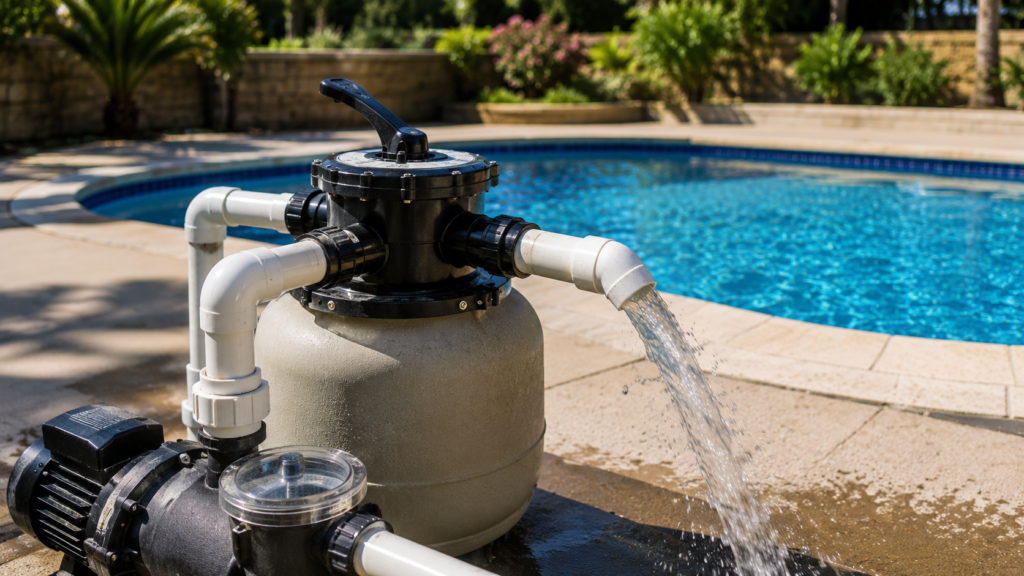
How often should you backwash a pool filter? Your pressure gauge climbed a few PSI since last week, and now you’re standing at the equipment pad trying to decide: is today the day, or did you just backwash and this is too soon? There’s a real number that settles the question, and it has nothing to do with the calendar.
Quick Answer: How often should you backwash a pool filter? Backwash a sand or DE pool filter when the pressure gauge reads 8–10 PSI above its clean baseline — not on a fixed schedule. If you’re not yet tracking baseline pressure, a rough fallback is every 1–2 weeks during swim season. Cartridge filters aren’t backwashed at all.
Table of Contents
What You Need to Know
- The trigger is pressure, not a date — 8–10 PSI above your filter’s clean baseline
- No baseline habit yet? Backwash roughly every 1–2 weeks as a fallback during peak season
- Heavy rain, high bather load, and pollen season all shorten the interval for backwashing your pool filter.
- Backwashing a pool filter too often strips a beneficial sediment layer that actually improves filtration.
- Cartridge filters Skip backwashing entirely — you rinse the cartridge instead.
How Often Should You Backwash a Pool Filter? The Real Trigger
Your filter tells you exactly how often you should backwash a pool filter — you just have to read the gauge, not the calendar. As dirt, oils, and debris build up inside a sand or DE filter, water has a harder time pushing through the media, and the pressure gauge on top of the tank climbs.
Here’s the part most owners never get told: the number that matters is a difference, not an absolute PSI. Note your filter’s clean baseline pressure once, right after you backwash it, by writing the PSI on a piece of tape stuck to the gauge. From then on, once the reading climbs 8–10 PSI above that baseline, it’s time to backwash your pool filter again.
If you haven’t started tracking a baseline yet, don’t stress about it today. A reasonable fallback while you build that habit is backwashing every 1–2 weeks during active swim season, then switching to pressure-based timing once you know your filter’s normal range.
According to the CDC’s Model Aquatic Health Code, backwashing should be performed at a differential pressure increase over the initial clean filter pressure, as recommended by the filter manufacturer — the same pressure-based logic that applies to home pools.
Backwash Trigger Table by Filter Type
Sand, DE, and cartridge filters each hit their limit differently, so how often you should backwash a pool filter changes by filter type. Sand and DE filters both rely on the pressure differential. Cartridge filters never get backwashed—they get pulled out and hosed down.
| Filter Type | Backwash When | Fallback Without a Gauge Habit | Also Act If |
|---|---|---|---|
| Sand | Pressure 8–10 PSI above clean baseline | Every 1–2 weeks in season | Flow visibly weakens, or water stays cloudy despite balanced chemicals |
| DE | Pressure 8–10 PSI above clean baseline | Every 1–4 weeks depending on bather load | Same as sand; recharge with fresh DE powder after every backwash |
| Cartridge | N/A — never backwashed | Rinse every 4–6 weeks | Pressure rises or flow weakens — remove and hose the cartridge instead |
Save or screenshot this trigger table—it covers sand, DE, and cartridge filters in one reference. The 8–10 PSI rule of thumb lines up with EPA WaterSense guidance for commercial pool equipment, which recommends filter cleaning once pressure rises 5–10 PSI above baseline. Want a printable version you can tape to your equipment pad, with space to log your baseline PSI? That’s exactly the kind of thing our newsletter sends out—sign up and we’ll get it to you.
Factors that influence your backwash frequency include bather load, weather, and debris.
The same filter can need backwashing every 10 days one month and every 3 weeks the next, depending on what’s landing in your pool. Pressure buildup isn’t a fixed rate—it responds to whatever your filter is actually catching.
A few conditions that speed things up:
- Heavy bather load—pool parties and daily family swims add body oils, sunscreen, and sweat that clog media faster than a lightly used pool
- Heavy rain—storms wash dirt, pollen, and yard debris into the water, spiking the sediment load overnight
- Windy conditions—pools near open yards or construction sites pick up dust and leaves that clog filters faster than usual.
- Pollen season—a heavy spring pollen drop can cut your backwash interval in half for a few weeks.
Run time matters too. If your pump isn’t running long enough each day, water isn’t cycling through the filter enough to actually trap debris in the first place, which throws off how you should read your gauge.
Can You Backwash a Pool Filter Too Much?
Yes, and it actually works against you. As sediment builds up inside a sand filter, it forms a fine layer that helps trap even smaller particles than the sand alone can catch. Backwash before the gauge tells you to, and you flush out that beneficial layer along with the junk, leaving the filter less effective at catching fine debris until it rebuilds. If you find yourself backwashing every few days out of habit or anxiety rather than a real pressure reading, dial it back and let the gauge make the call.
How Long Should a Backwash Cycle Be?
A full backwash cycle typically runs 5 to 7 minutes from start to finish. Here’s the breakdown:
- Turn off the pump and set the valve to “Backwash.”
- Run the backwash for 2–3 minutes until the water in the sight glass runs clear instead of cloudy.
- Turn off the pump again, then switch the valve to “Rinse.”
- Run the rinse for 1–2 minutes to settle the media and keep debris from washing back into the pool.
- Switch back to “Filter” and turn the pump on to resume normal operation.
DE filters need one extra step: mix fresh diatomaceous earth powder into a slurry and add it to the skimmer once the system is back in filter mode, since the old DE gets flushed out during the backwash.
Signs Your Pressure Gauge Is Lying to You
A pressure-based schedule only works if your gauge is telling the truth, and a stuck or broken gauge can quietly throw off how often you backwash your pool filter. Watch for a reading that never moves regardless of how dirty the filter actually is, a needle that sits at zero even while the pump runs, or a reading that jumps around erratically instead of climbing steadily. Any of those point to a faulty gauge rather than an actual pressure problem, and a bad gauge means you’re either backwashing blind or ignoring a filter that genuinely needs attention. Replacing a stuck gauge is a small fix that restores confidence in the whole system.
Common Mistakes When Backwashing a Pool Filter
- Backwashing on a fixed schedule instead of by pressure—wastes water and strips the beneficial sediment layer early
- Never establishing a baseline PSI—without it, “8–10 PSI above normal” is impossible to judge accurately
- Stopping the backwash before the sight glass runs clear—leaves debris in the system that clouds the pool again within hours
- Skipping the rinse cycle—sends loosened debris straight back into the pool instead of out through the waste line
- Forgetting to recharge DE filters—running a DE filter without fresh powder after a backwash lets fine particles pass straight through
Still Cloudy After Backwashing? Here’s What That Means
A filter that’s clean and running well should clear the water within a day or two. If your pool is still hazy after a proper backwash, chemical imbalance is usually the real culprit rather than the filter—worth checking your pool water balance basics before assuming the filter needs another cycle. Persistent cloudy pool water that survives both a fresh backwash and balanced chemistry usually points to a filtration or circulation issue rather than a one-time cleaning problem.
FAQ
Can you backwash a pool filter too much?
Yes. Backwashing before the pressure gauge actually calls for it strips out the fine sediment layer that helps trap smaller particles, temporarily making the filter less effective. Let the 8–10 PSI rule dictate timing rather than habit or nerves, and you’ll keep that beneficial layer intact longer.
How long should a backwash cycle be?
A full cycle runs about 5–7 minutes: 2–3 minutes of backwashing until the sight glass runs clear, 1–2 minutes of rinsing, then switching back to filter mode. DE filters need extra time afterward to recharge with fresh powder.
How often should you backwash a pool filter if it’s a sand filter?
Backwash a sand filter whenever the pressure gauge reads 8–10 PSI above its clean baseline. Without a tracked baseline, a rough fallback is every 1–2 weeks during regular swim season, adjusted for weather and bather load.
Do cartridge filters need to be backwashed?
No. Cartridge filters are never backwashed. Instead, remove the cartridge and rinse it thoroughly with a hose every 4–6 weeks, or sooner if pressure rises or water flow weakens.
What PSI means it’s time to backwash?
Most pool professionals point to 8–10 PSI above your filter’s clean baseline reading, not an absolute number. Establish your baseline by checking the gauge right after a fresh backwash, then track the climb from there.
Why is my pool still cloudy after backwashing?
A recent backwash rules out a clogged filter, so lingering cloudiness usually traces back to unbalanced chemistry, low pump run time, or an underlying circulation problem rather than the filter itself needing another cycle.
What to Do Next
Now that you know how often you should backwash a pool filter, if your gauge reading checks out but the water still isn’t clearing, start with your pool water balance basics to rule out chemistry first. If the pump seems to be struggling after you reassemble the system post-backwash, troubleshoot a pump that won’t prime before assuming the filter itself is at fault. And if you’re unsure your pump is even running long enough each day to keep pace with your filter’s needs, check how long to run your pool pump for the daily runtime math.
