
Your pressure gauge just crept up, or your water’s gone slightly hazy even though your chemicals check out fine. Either way, you’re here because you need to know how to clean a pool filter cartridge properly — and the good news is you can do it yourself in about 30 minutes with a garden hose and a bucket.
Quick Answer: To clean a pool filter cartridge, turn off the pump, open the air relief valve, and remove the cartridge. Hose it down top-to-bottom at a 45° angle. If it’s oily or stained, soak it in a commercial filter cleaner or a solution of 1 cup TSP per 5 gallons of water for 12–24 hours, then rinse and reinstall.
Table of Contents
What You Need to Know
- A rinse alone handles routine debris; oily buildup from sunscreen and body oil needs a soak, not just water pressure.
- Never use a pressure washer — garden hoses run around 40–60 PSI, while pressure washers hit 1,200–3,000 PSI and will tear the pleats.
- Cleaning a pool filter cartridge monthly in swim season, and every other month off-season, is the standard rule of thumb — or whenever pressure rises 8–10 PSI above your normal baseline.
- Vinegar works for light scale but won’t touch grease — match your cleaning solution to what’s actually clogging the filter.
- A cartridge that’s still restricting flow after a proper clean, or that shows tears, is due for replacement, not another soak.
Supplies You’ll Need for Cleaning a Pool Filter Cartridge
Gather everything before you shut the system down — nothing kills momentum like a mid-job trip to the pool store.
- Garden hose with a spray nozzle
- Rubber gloves and eye protection
- A large bucket or bin (for soaking)
- A commercial filter cleaner, TSP, or white vinegar
- Replacement O-ring and non-petroleum lubricant (in case yours is worn)
Complete Process for Cleaning a Pool Filter Cartridge
The core process for cleaning a pool filter cartridge is the same across almost every system, though your exact housing hardware may differ slightly by brand.
- Turn off the pump and its breaker. Cutting power at the breaker, not just the timer, prevents the system from kicking back on mid-job.
- Open the air relief valve. Turn it slowly until the pressure gauge reads 0 PSI. This releases built-up air and water pressure so the housing doesn’t fight you when you open it.
- Drain the tank. Many systems have a drain plug or waste line at the bottom of the housing — open it and let the water empty out.
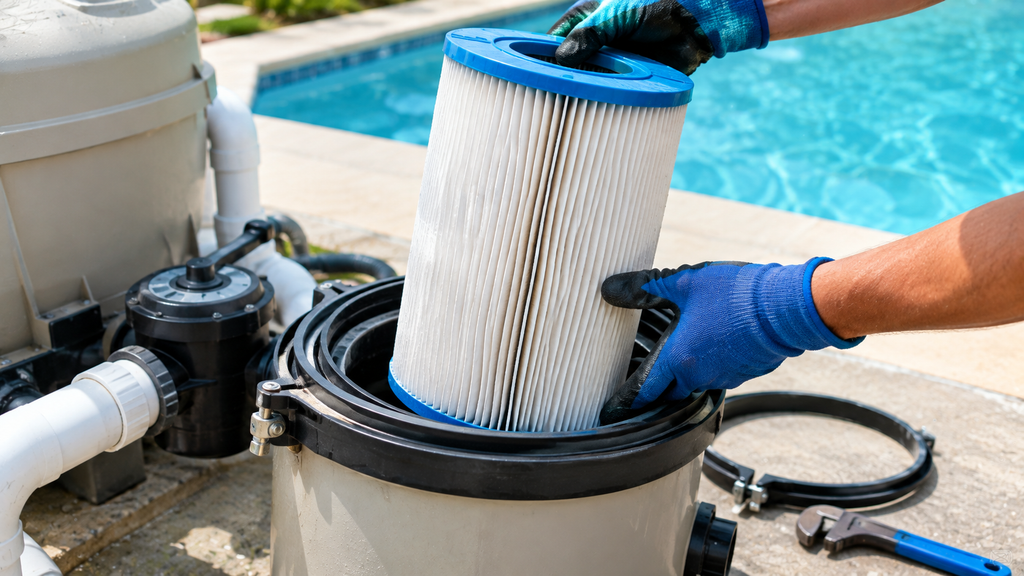
- Release the clamp or lock ring and lift off the lid. Depending on your model, this is a tension clamp, a locking knob, or screws. Set small hardware in a container so nothing rolls into the grass.
- Lift out the cartridge and inspect it. Check for tears, cracked end caps, or a pleat pattern that’s collapsed on one side — any of those means replacement, not cleaning.
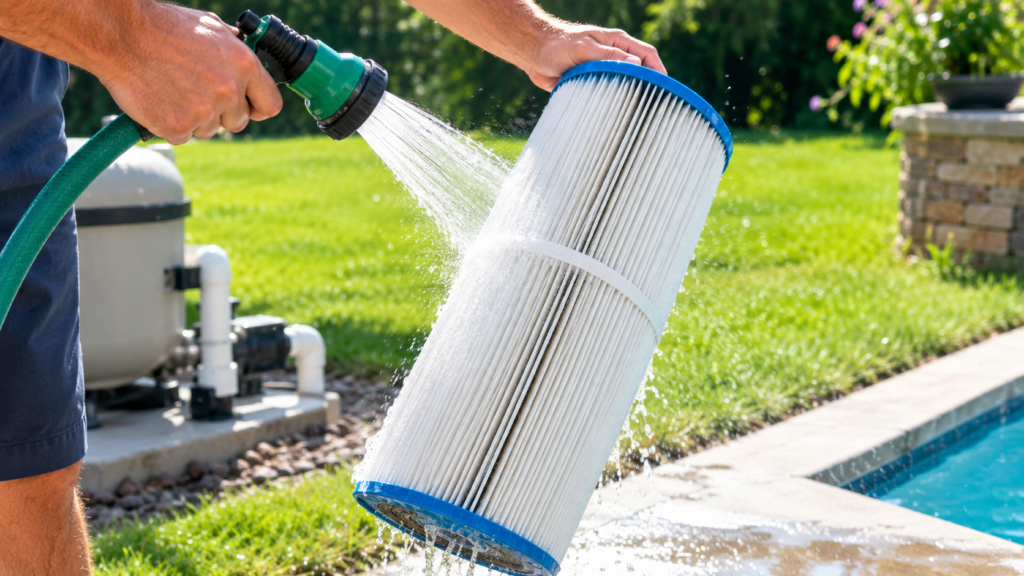
- Hose it down at a 45° angle, top to bottom. Rotate the cartridge as you go so every pleat gets a pass. Skip the pressure washer entirely — the pleated paper or polyester media tears easily under high-PSI spray.
- Soak it if it’s oily, stained, or scaled. A rinse alone won’t remove sunscreen and body-oil film. Match your soak solution to the buildup type using the chart below.
- Rinse thoroughly after soaking. Spray from the top down again until no suds or cleaner residue remains, especially deep between the pleats.
- Lubricate the O-ring with a silicone-based, non-petroleum lubricant before reassembly. Petroleum-based substances can damage rubber O-rings gradually over time.
- Reassemble and restart. Replace the cartridge, close the housing, and turn the pump back on with the air relief valve open until a steady stream sprays out — then close it. Note the new PSI reading as your fresh baseline.
What Solution Should You Use? (Ratio & Soak-Time Chart)
Different buildup types need different chemistry — this is where most cleaning guides get vague, and where most cartridge damage happens from using the wrong solution too aggressively.
| Solution | Mix Ratio | Soak Time | Best For | Safety Note |
|---|---|---|---|---|
| Plain water rinse | Hose only, no additive | N/A | Leaves, hair, silt, loose debris | None |
| Commercial filter cleaner | Per product label | 15 min – overnight | Sunscreen and body-oil film | Wear gloves; some formulas are corrosive |
| TSP solution | 1 cup TSP per 5 gallons water | 1–24 hrs (overnight for heavy buildup) | Grease and stubborn body oils | Toxic — gloves, goggles, and ventilation required |
| Diluted muriatic acid | 1 part acid to 10–20 parts water (check label) | 5–15 minutes, no longer | Calcium and mineral scale | Highly corrosive; always add acid to water, never the reverse; never mix with chlorine |
| White vinegar soak | Equal parts vinegar and water | 1 hour minimum; overnight for heavy scale | Light mineral scale | Gentle but weak on grease; rinse fully before reinstalling |
Save or screenshot this chart—it covers the exact ratio and timing for whatever’s actually clogging your filter, so you’re not guessing at dilution or soak time.
Muriatic acid and TSP are both genuinely hazardous chemicals, not just “strong cleaners”—the EPA’s alert on swimming pool chemical hazards is worth a skim if you’re using either for the first time, since mishandling them is a real cause of chemical burns and toxic vapor exposure.
Common Mistakes When Cleaning a Pool Filter Cartridge
Scrubbing hard instead of soaking longer is the single biggest way people damage a cartridge. Cartridge filters trap debris on the surface of the pleats rather than deep within a media bed—that’s what makes them “surface filters” rather than “depth filters” like sand. A stiff brush or aggressive scrubbing can tear that thin surface layer or push debris deeper between the folds instead of removing it, which restricts flow worse than before you started.
Two other frequent errors:
- Using a pressure washer “just this once.” Even a brief blast at 1,500+ PSI can puncture pleats you won’t see fail until your next PSI spike.
- Skipping the soak and just rinsing repeatedly. If your filter smells musty or feels slippery, that’s oil, not dirt—water alone won’t strip it no matter how long you spray.
How Frequently Should You Clean a Cartridge Filter?
Clean on a schedule, not just when something looks wrong—waiting for visible clogging means your pump has already been working harder than it should.
A good baseline is monthly during swim season and every other month in the off-season if you’re still running the pump. The more precise signal is your pressure gauge: once it reads 8–10 PSI above your normal clean-filter baseline, it’s time. Heavy pool traffic, sunscreen use, nearby trees, and recent rain will all shorten that interval.
Regular filter maintenance isn’t just about water flow, either—filters physically trap bacteria along with dirt, and a CDC study of filter backwash from metro Atlanta public pools found Pseudomonas aeruginosa in 59% of samples tested, which is exactly the kind of buildup a neglected filter recirculates instead of removing.
Why Your Cartridge Keeps Clogging Fast
Water chemistry is often the hidden cause of frequent clogging, not just debris load. High pH or high alkalinity encourages calcium to come out of solution and coat your filter pleats in scale, restricting flow the same way oil does—but no amount of soap will fix it if the water itself is out of balance. If you’re cleaning more than once a month and your water tests fine for sanitizer but tends to run high on pH or alkalinity, that’s worth checking directly: see our guides on how to raise alkalinity in a pool and how to lower pH in a pool. Persistently high cyanuric acid can also push you toward heavier chlorine dosing to compensate, which indirectly increases the debris and byproduct load your filter has to catch—our breakdown of cyanuric acid too high covers how to bring that back in range.
Cartridge vs. Sand Filter Cleaning—What’s Different?
Cartridge filters never get backwashed—that’s the core difference from sand. A sand filter clears itself by reversing water flow through the media bed; a cartridge has to be physically removed and hosed off by hand, which is more labor per cleaning but uses far less water overall. If you’re weighing which system fits your pool, our guide to backwashing a sand filter walks through that process for comparison. Whichever filter type you run, the CDC’s guidance for operating pools is a useful baseline for how consistent filtration and disinfectant levels work together to keep water safe.
Cleaning frequency and buildup type can also shift slightly if you’re on a saltwater system versus traditional chlorine—see saltwater vs. chlorine pools if you’re not sure which category your setup falls into.
When to Clean vs. When to Replace
A cartridge that’s clean but still won’t hold pressure needs replacing, not another soak. Most cartridges last 1–5 years depending on pool use and how consistently they’re cleaned—2–3 years is typical for a well-maintained backyard pool. Rips, permanently flattened pleats, or a PSI reading that remains elevated immediately after a complete cleaning are clear signs the filter media itself needs replacement, regardless of how effectively you clean it.
If cleaning and retesting your water balance doesn’t resolve frequent clogging, a checklist can help you track what’s actually changing between cleanings—that’s exactly what we built our free pool filter cleaning schedule for if you want one to print and keep by the pump.
FAQ
What is the best way to clean a pool cartridge filter?
Turn off the pump, remove the cartridge, and hose it down top-to-bottom at a 45° angle without a pressure washer. If it’s oily or stained rather than just dusty, soak it in a commercial filter cleaner or a TSP solution (1 cup per 5 gallons of water) for several hours to overnight before rinsing again and reinstalling.
Can I use vinegar to clean my pool filters?
Yes, but only for light mineral scale, not oil or grease. Combine equal amounts of white vinegar and water, then soak the cartridge for at least one hour. Vinegar won’t remove sunscreen or body-oil film—for that, use a commercial filter cleaner or TSP solution instead.
Are cartridge filters washable?
Yes—that’s their main advantage over sand filters. Cartridge filters are designed to be removed, hosed down, and reused many times before replacement, typically for 1–5 years depending on care and pool use. They should never go through a washing machine or dishwasher.
How Long Should You Soak a Cartridge in Vinegar?
Soak for a minimum of 1 hour for light scale. For heavier calcium buildup, an overnight soak works better. Always rinse the cartridge thoroughly with a hose afterward to clear any residue before reinstalling it.
How often should you clean a pool filter cartridge?
Clean it monthly during swim season and every other month in the off-season as a baseline. The more reliable signal is your pressure gauge—clean whenever it reads 8–10 PSI above your normal clean-filter level, regardless of the calendar.
Is foam or suds on the pool surface after cleaning normal?
Yes, a small amount of loose foam for a day or so after reinstalling a cleaned cartridge is common and safe for swimmers. It comes from residual cleaning solution working its way out of the system and typically dissipates on its own within 24 hours.
What to Do Next
Now that you know how to clean a pool filter cartridge, the next thing worth checking is why it’s clogging in the first place. Start with your water balance—check how to raise alkalinity in a pool or how to lower pH in a pool to rule out scale as the cause. If you’re deciding between filter types for a new build or a swap, see how to backwash a sand filter for the comparison. And if your cartridge is past saving, grab our filter cleaning schedule checklist so the next one lasts longer.
