
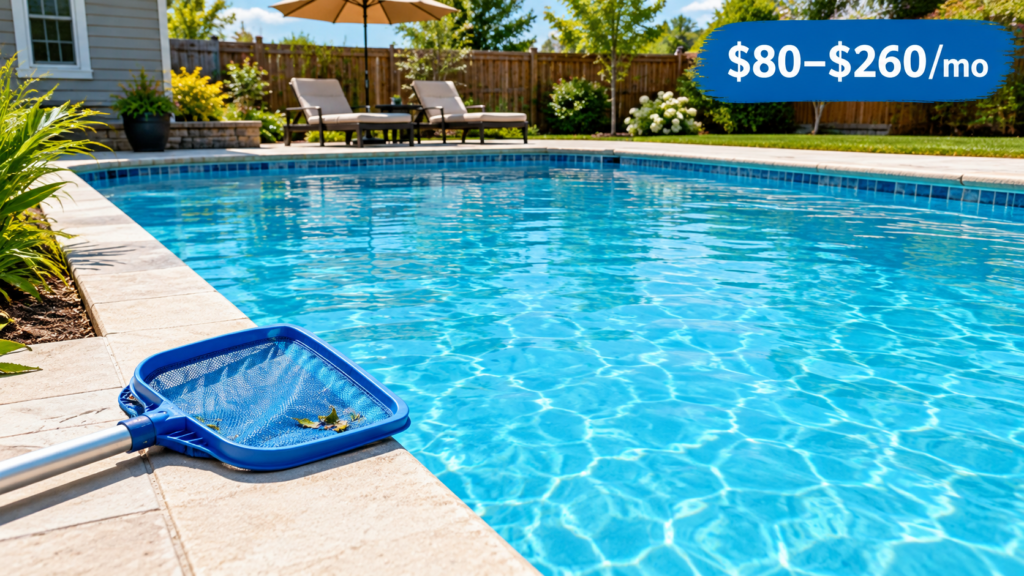
You just got a quote from a pool service company, or you’re staring at your first pool bill after moving into a house with one, and the number doesn’t match anything you can find online. Here’s what pool maintenance actually costs, broken down by size, type, and whether you do it yourself.
Quick Answer: Pool maintenance costs $80–$260 a month, or $1,000–$4,000 a year, depending on pool size, climate, and whether you hire a professional. Chemicals alone run $30–$80 monthly. Professional weekly service adds $80–$300 monthly on top of that, while DIY care can bring your total closer to the low end of the range.
Table of Contents
What You Need to Know
- Monthly costs typically fall between $80 and $260; annual costs land between $1,000 and $4,000.
- Pool size and climate matter more than pool type—a large pool in a hot, dry climate costs A large pool in a hot, dry climate costs 2 to 3 times more than a small pool in a mild climate.
- DIY maintenance can cut your total cost by roughly half, but it takes 2–4 hours a week.
- Electricity for the pump is often the second-biggest line item after chemicals, not an afterthought.
- One-time costs—resurfacing, heater repair, and winterizing—are the ones that actually blow up a budget.
How Much Does Pool Maintenance Cost?
Most pool owners spend $80 to $260 a month on maintenance, or $1,000 to $4,000 a year. That range covers chemicals, routine cleaning, and basic equipment upkeep—not major repairs.
The gap between $80 and $260 isn’t random. It’s almost entirely explained by three variables: how big your pool is, how hot and dry your climate is, and whether you’re paying someone else to do the work or doing it yourself. A small above-ground pool in a mild climate that you maintain yourself can sit near the bottom of that range. A large in-ground pool in Arizona with weekly professional service will sit at the top of it, or above.
Pool Maintenance Cost by Size and Type
Pool size changes your chemical volume, your pump’s electricity draw, and how much water you lose to evaporation—which is why cost estimates that ignore size aren’t useful. Here’s a realistic breakdown.
| Pool Size & Type | Monthly Cost (DIY) | Monthly Cost (Professional) | Annual Total (Typical) |
|---|---|---|---|
| Small above-ground (≤15,000 gal) | $40–$80 | $80–$150 | $700–$1,400 |
| Medium in-ground, chlorine (15,000–20,000 gal) | $60–$120 | $120–$220 | $1,200–$2,600 |
| Large in-ground, chlorine (20,000+ gal) | $90–$160 | $180–$300 | $1,800–$3,600 |
| Saltwater system (any size) | $50–$110 | $110–$260 | $1,000–$3,200 |
Saltwater pools generate chlorine from salt through electrolysis, so you spend less on chlorine but more upfront on the salt cell (which typically needs replacing every 3–5 years) — the monthly number looks similar to chlorine pools, but the expense shifts from a recurring purchase to a periodic equipment cost.
Save or screenshot this size-and-type table — it covers most residential pool configurations and gives you a realistic monthly target before you get a quote.
DIY vs. Professional Pool Maintenance Cost
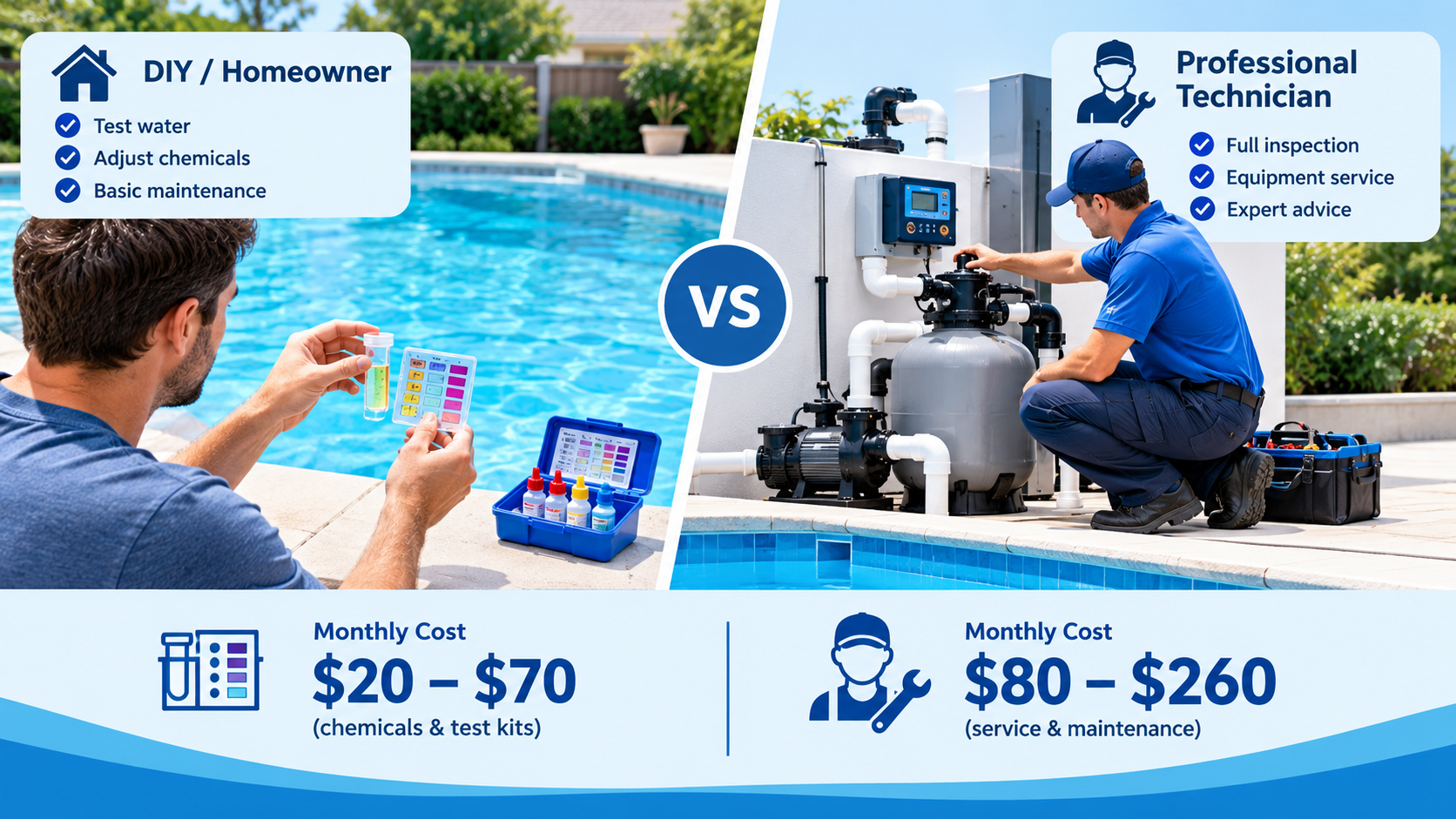
Doing your own pool maintenance typically saves $40–$150 a month compared to hiring a service, but it costs you 2–4 hours a week. The dollar gap isn’t just labor — it’s also that professionals often buy chemicals in bulk at lower per-unit prices than you will at a pool supply store.
| Line Item | DIY Monthly Cost | Professional Monthly Cost |
|---|---|---|
| Chemicals (chlorine, pH balancers, algaecide) | $30–$80 | Included in service fee |
| Weekly cleaning/skimming labor | Your time (2–4 hrs/week) | Included in service fee |
| Equipment checks (pump, filter, skimmer basket) | Your time | Included in service fee |
| Testing supplies (strips or liquid kit) | $10–$20/month | Included in service fee |
| Base cost | $40–$100 | $80–$300 |
If you’re new to balancing your own water chemistry, learning the basics of pool water balance before you commit to DIY will save you from the most expensive mistake beginners make — over-shocking or under-treating the water, which leads to algae blooms that cost far more to fix than to prevent.
How Frequently Should a Pool Professional Visit?
Most residential pools need a professional visit once a week during swim season, though pools with heavy bather load, tree cover, or automated chemical systems can stretch that to every other week. Weekly visits are the industry standard because chlorine and pH drift enough within 7 days to need rebalancing.
A typical weekly visit includes skimming the surface, emptying skimmer and pump baskets, brushing the walls, testing and adjusting chemicals, and a quick equipment check. That’s what you’re paying the $80–$300 monthly fee for — not just chemical dosing, but the labor of catching small problems (a clogging filter, a slow leak) before they become expensive ones.
What Affects Your Pool Maintenance Cost
Three variables explain almost all of the difference between a $90-a-month pool and a $250-a-month pool.
Pool Size and Type
Bigger pools cost more to maintain because every gallon needs the same chemical concentration, so total chemical volume scales directly with water volume. A pool with twice the gallons doesn’t just need twice the chlorine — it also needs a stronger pump to filter that volume, which raises your electricity bill too.
Climate and Location
Hot, dry, and sunny climates raise costs through faster chlorine breakdown and higher evaporation, sometimes adding $20–$500 a season just in refill water. Sunlight breaks down chlorine directly (which is why cyanuric acid stabilizer exists — it’s a UV shield for your chlorine), so pools in sunnier regions burn through more chemical per week than identical pools in cloudier climates.
According to the EPA’s WaterSense program, an uncovered residential pool can lose between 12,000 and 31,000 gallons of water a year to evaporation alone, and a pool cover can cut that loss by up to 95% — a cheap way to bring a hot-climate pool’s water costs back down toward the average.
If you’re in a region with a true winter, seasonal opening and closing service typically runs $300–$600 per event, and skipping proper winterization risks cracked pipes that cost far more to repair than the service itself.
Chlorine, Salt, or Mineral System
The sanitizing system you choose shifts costs between recurring chemical purchases and periodic equipment replacement, rather than eliminating costs outright. Traditional chlorine pools have lower equipment costs but higher month-to-month chemical spend; saltwater systems flip that ratio.
According to the CDC, residential pools should hold free chlorine at a minimum of 1 ppm and pH between 7.0 and 7.8 — staying inside that range is what keeps your weekly chemical spend predictable, since drifting outside it usually means a costlier shock treatment to correct the imbalance afterward.
Electricity and Pump Running Costs
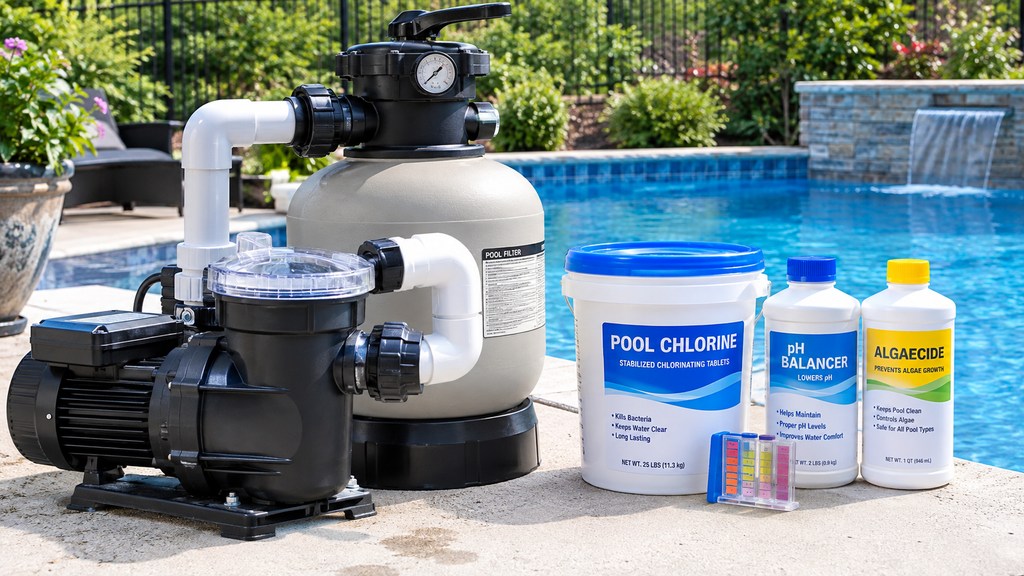
Running your pool pump typically costs $8 to $98 a month depending on pump type and runtime, with older single-speed pumps sitting at the high end and variable-speed pumps at the low end. This is the cost most new pool owners underestimate, because it doesn’t show up as a separate bill — it’s buried in your electricity statement.
The goal isn’t to run your pump as little as possible — under-filtering leads to cloudy water and algae, which costs more to fix than the electricity you saved. Instead, match your runtime to your pool’s turnover rate (the time it takes to filter your entire pool volume once), which for most residential pools means running the pump roughly 8 hours a day in peak season, less in cooler months.
According to ENERGY STAR, certified variable-speed pumps use about 70% less energy than standard single-speed models, which often pays back the higher upgrade cost within two to three years and can save owners thousands of dollars over the pump’s lifetime.
Extra and One-Time Pool Costs
The costs that actually break a maintenance budget aren’t monthly — they’re the infrequent, large repairs that most cost estimates leave out. Budgeting only for chemicals and cleaning, then getting hit with a $5,000 resurfacing bill, is the single most common way pool owners feel blindsided.
- Pump replacement: averages around $440 when a pump fails outright rather than being repaired
- Heater repair: typically $160–$730 depending on the issue
- Resurfacing: $5,000–$10,000, needed roughly every 10–15 years
- Liner replacement (above-ground): around $3,000
If your pump won’t prime — meaning it’s not pulling water through the system — that’s often a fixable issue rather than a replacement, and troubleshooting a pool pump that won’t prime before calling a technician can save you a service call.
Common Mistakes That Quietly Raise Your Pool Costs
The most expensive mistake isn’t neglecting your pool outright — it’s inconsistent maintenance that lets small chemical imbalances compound into algae or equipment strain. A pool tested twice a week costs less over a season than a pool tested “whenever you remember,” because catching a pH drift early is a $10 fix; catching it late is a $150 algae treatment.
Other cost-inflating mistakes worth naming: running the pump on a fixed schedule regardless of season (wasting electricity in cooler months), ignoring a slowly clogging filter until it strains the pump motor, and buying chemicals in small containers at retail markup instead of bulk from a pool supply store.
When Pool Problems Turn Into Extra Costs
A well-maintained pool rarely needs emergency intervention — but when water chemistry gets away from you, the cost jumps fast. If your water has already turned green, fixing a green pool within 24 hours is both cheaper and faster than letting an algae bloom sit, since established algae requires more chemical (and sometimes a professional visit) to clear.
Cloudy water is the earlier warning sign, usually catchable before it becomes a full algae problem. Diagnosing cloudy pool water early typically costs you a bag of shock and a day of extra filtration — not a service call.
How to Lower Your Pool Maintenance Cost
The two highest-leverage changes are switching to a variable-speed pump and testing water chemistry consistently, both of which prevent the expensive problems rather than just cutting the cheap ones. A pool cover also cuts evaporation and chemical loss meaningfully, especially in hot, dry climates.
Want a simple way to track this against your own pool? Grab our free downloadable pool cost calculator and maintenance checklist — it walks through the exact line items in this guide so you can plug in your pool’s size and see where your money should actually be going.
FAQ
How much does it cost to keep maintenance on a pool?
Most owners spend $80–$260 a month, or $1,000–$4,000 a year, covering chemicals, cleaning, and routine equipment checks. The exact number depends heavily on pool size, climate, and whether you DIY or hire a professional — a small DIY pool in a mild climate sits near the bottom of that range, a large professionally-serviced pool in a hot climate sits at the top.
How Frequently Should a Pool Service Professional Visit?
Weekly during swim season is standard for most residential pools, since chlorine and pH levels drift enough within seven days to need rebalancing. Pools with lower bather load, automated chemical feeders, or mild climates can sometimes stretch to biweekly visits without water quality suffering.
What Is the Cost of Keeping a Pool Operating?
Running the pump — the equipment cost of “keeping it running” day to day — typically costs $8–$98 a month in electricity, depending on pump type and how many hours a day it runs. Add chemicals ($30–$80/month) and you’re looking at $40–$180 monthly just to keep the water safe and circulating, before any cleaning labor or service fees.
What should weekly pool service include?
A standard weekly visit covers skimming debris off the surface, emptying skimmer and pump baskets, brushing pool walls to prevent algae buildup, testing and adjusting chemical levels, and a quick visual check of the pump and filter. Anything beyond that — like filter deep-cleaning or equipment repair — is usually billed separately.
Is Maintaining a Saltwater Pool Less Expensive Than a Chlorine Pool?
Not necessarily cheaper overall — it shifts costs rather than eliminating them. You’ll spend less on chlorine purchases month to month, but the salt cell that generates chlorine typically needs replacement every 3–5 years, which is a larger periodic expense that chlorine pools don’t have.
Why is my pool costing more than the average I see online?
Averages usually assume a mid-size in-ground pool in a moderate climate. If you’re in a hot, dry region, have a larger-than-average pool, or use professional weekly service, your real cost will land above the commonly-cited $80–$260 range — that’s expected, not a sign you’re being overcharged.
What to Do Next
If you’re deciding whether to DIY or hire out, start by learning how to balance pool water as a beginner — it’s the skill that determines whether DIY actually saves you money. If your water is already having problems, jump straight to fixing a green pool fast or diagnosing cloudy water before it gets more expensive to treat.
