
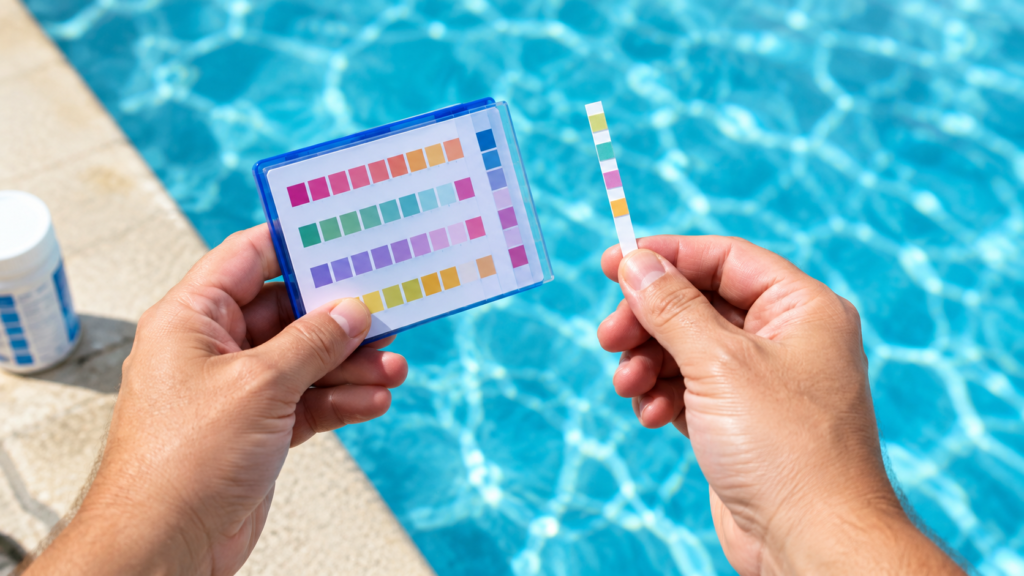
Testing pool water is the first thing to do when your water looks slightly hazy or when you’ve just bought your first bottle of chlorine and have no idea what number you’re aiming for. Either way, you’re about to learn exactly what to check, how to test pool water correctly, and what your numbers mean.
Quick Answer: To test pool water, dip a test strip for 2 seconds or use a liquid test kit, then compare the color to the chart within 15–30 seconds. Check free chlorine (target 1–3 ppm), pH (7.2–7.8), and total alkalinity (80–120 ppm) at minimum 2–3 times per week.
Table of Contents
What You Need to Know
- Testing pool water takes under two minutes once you know the routine.
- Free chlorine and pH are the two numbers that matter most for swimmer safety—check these 2–3 times a week.
- Pull your water sample from at least 18 inches below the surface, away from skimmers and return jets, for an accurate reading.
- Total alkalinity, calcium hardness, and cyanuric acid (CYA) matter too, but they shift more slowly and only need weekly-to-monthly checks.
- A reading that’s “off” isn’t an emergency—it just tells you what to adjust next.
What You’re Testing For When You Test Pool Water
Testing pool water measures five core parameters, and each one protects something different—your health, your equipment, or your wallet. Free chlorine kills bacteria and algae. pH controls how comfortable the water feels and how well your chlorine actually works.
Total alkalinity helps prevent your pH from changing dramatically. Calcium hardness protects your pool surfaces and plumbing from corrosion. Cyanuric acid (CYA) protects chlorine from the sun’s harmful effects.
According to the CDC’s home pool water treatment and testing guidance, pH should stay between 7.0 and 7.8 with a free chlorine concentration of at least 1 ppm—because as pH rises above 8.0, chlorine’s ability to kill germs drops sharply. Skip testing, and you won’t know which of these five is out of range until you’re already dealing with the symptom.
How to Test Your Pool Water (Step by Step)
Testing pool water takes under two minutes once you know the routine, and the process is nearly identical whether you use strips or a liquid kit. Here’s the exact sequence.
- Turn your pump on first. Chemicals and readings both work better in circulating water—testing still (stagnant) water can give you a skewed number, especially near the surface where chlorine off-gasses faster.
- Collect your sample the right way. Reach at least 18 inches below the surface and away from any skimmer, jet, or return line. Surface water and water near equipment read differently from the bulk of your pool.
- Dip or fill. For strips, submerge for 2 seconds and pull straight out—don’t swirl it. For a liquid kit, fill the test vial to the marked line and add the reagent drops exactly as the kit instructs.
- Wait the full time; don’t rush it. Strips need about 15 seconds before reading; liquid reagents typically need a full color-development window (verify your kit, usually 15–30 seconds). Reading early or late skews the color match.
- Compare and record. Match your strip or vial color against the chart in good natural light—fluorescent lighting can distort reds and oranges. Write the numbers down; a single reading means nothing without a pattern to compare it to over time.
Test Strips vs. Test Kits vs. Digital Testers
Test strips are the fastest way to test pool water, liquid kits are the most precise at low chlorine levels, and digital testers add convenience at the cost of accuracy and price.
- Test strips change color when they contact chemically reactive pads, giving you a fast read against a printed chart. Best for routine twice-weekly checks.
- Liquid test kits use reagent drops and a titration-style color match. They tend to be more accurate, particularly for pinpointing exact free chlorine and pH values.
- Digital testers connect to an app or screen, removing the guesswork of reading color charts by eye. They cost more upfront, and accuracy varies by brand and how well-calibrated the sensor stays over time.
If you’re testing pool water twice a week for routine maintenance, strips are enough. If you’re troubleshooting a persistent problem, a liquid kit will get you a more reliable number.
Pool Water Testing Cheat Sheet
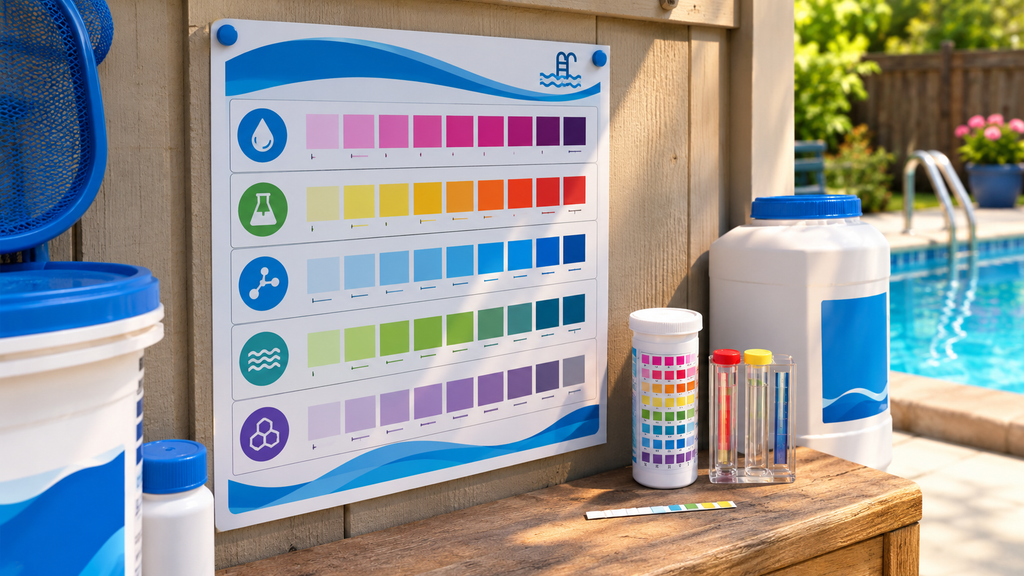
One table covering the ideal range, test frequency, and what to do is the single reference most pool owners end up screenshotting and referring back to all season.
| Parameter | Ideal Range | Test Frequency | If Too Low | If Too High |
|---|---|---|---|---|
| Free Chlorine | 1–3 ppm | 2–3x/week | Bacteria/algae risk rises; add chlorine or shock | Skin/eye irritation, faster equipment wear; let it off-gas or dilute |
| pH | 7.2–7.8 | 2–3x/week | Corrosion, liner damage, eye irritation; add soda ash | Cloudy water, reduced chlorine effectiveness; add muriatic acid |
| Total Alkalinity | 80–120 ppm | Weekly | pH swings unpredictably; add sodium bicarbonate | pH resists adjustment, cloudy water; add muriatic acid |
| Calcium Hardness | 200–400 ppm | Monthly | Corrosive water, surface/equipment damage; add calcium chloride | Scaling, cloudy water; partially drain and refill |
| Cyanuric Acid (CYA) | 30–50 ppm | Every 2–4 weeks | Chlorine burns off fast in sunlight; add stabilizer | Chlorine becomes less effective above ~90 ppm; dilute with fresh water |
Save or screenshot this cheat sheet—it covers everything you need to check for a season of routine maintenance in one place. Want it as a printable PDF you can tape inside the pool shed? That’s exactly what our maintenance newsletter sends out each spring.
How Often Should You Test Pool Water?
Free chlorine and pH need checking 2–3 times a week, while alkalinity, calcium hardness, and CYA can be checked weekly to monthly since they shift more slowly.
Heavy pool use, hot weather, and rainstorms all speed up how fast your numbers drift. Bump up testing frequency after a pool party, a heat wave, or a storm.
A pool that sits mostly unused in mild weather can sometimes stretch to twice a week for everything without trouble.
When to Test (Timing & Conditions)
Test pool water in the morning before swimmers get in, and always retest after rain, heavy use, or adding any chemical.
Morning testing avoids the sunlight-driven chlorine loss that happens through the day, giving you a cleaner baseline reading. Rain dilutes your water and can shift pH and alkalinity within hours.
A pool party can drop free chlorine noticeably within a single afternoon from sunscreen, sweat, and body oils reacting with it—testing the next morning tells you whether you need to shock before the next swim session.
What to Do With Your Results
Once you test pool water and have your numbers, the fix is almost always one of three moves: adjust chlorine, adjust pH/alkalinity, or shock the pool.
If your free chlorine reads low, our guide on how much shock to add to a pool walks through dosing by pool size. If your chlorine and pH readings don’t seem to line up with what you’d expect, check the difference between free chlorine and total chlorine—a gap between the two usually points to chloramines, not a testing error.
If your pH reading runs high repeatedly, see how to lower pH in a pool for exact dosing. And if your CYA number keeps climbing above range, our breakdown of cyanuric acid too high explains when to dilute versus drain.
Common Mistakes and Troubleshooting
The single most common mistake when you test pool water is reading the strip or vial too early or too late—both give you a false number. A few others worth watching for:
- Testing right after adding chemicals. Give the pool at least a few hours (ideally overnight) of full circulation before you test—a fresh dose of chlorine or acid hasn’t distributed evenly yet.
- Touching the strip pads. Oils from your fingers can alter the color reaction. Hold strips by the unpadded end only.
- Reading strips under artificial light. Fluorescent and LED bulbs shift how reds and yellows appear—read outdoors or under natural daylight when possible.
- Assuming a stable reading means you can stop testing. Chlorine loss accelerates in direct sun and heavy bather load, so a “fine” Monday reading can be a “low” Friday reading without any warning.
- Testing near the return jet or skimmer. These spots don’t represent the bulk of your pool water and can throw off every reading by a noticeable margin.
When to Call a Professional Instead
DIY testing covers routine maintenance, but a suspected contamination event or persistently abnormal readings call for professional help.
If someone had a fecal incident in the pool, the CDC’s fecal incident response guidelines recommend closing the pool and following a formal hyperchlorination protocol rather than relying on a home strip reading.
Chlorine itself is also a chemical that demands respect—the CDC’s chlorine chemical fact sheet notes that high exposure can irritate the eyes, throat, and lungs, which is one more reason to keep levels in range rather than overcorrecting.
If your readings stay out of range after two or three correction attempts, a pool professional with a more precise testing setup can rule out equipment issues, like a failing salt cell or a miscalibrated feeder, that a home kit won’t catch.
FAQ
How can I test my pool water myself?
Use a test strip or liquid test kit from any pool supply store. Dip the strip for 2 seconds or fill the kit’s vial with a water sample from at least 18 inches deep, wait the recommended time, then match the color to the chart. It takes under two minutes and no special equipment beyond the kit itself.
How can I test the quality of my pool water?
Check free chlorine, pH, total alkalinity, calcium hardness, and cyanuric acid using a test strip or kit. These five readings together tell you whether the water is sanitized, balanced, and safe to swim in—a single reading like chlorine alone doesn’t give you the full picture.
How often should you test pool water?
Check free chlorine and pH levels 2–3 times weekly. Check total alkalinity weekly and calcium hardness and cyanuric acid every few weeks to monthly, since these shift more slowly. Increase frequency after heavy use, rain, or hot weather.
How do I get my pool water crystal clear?
Start by testing and correcting your chlorine, pH, and alkalinity into range, since cloudiness is almost always a symptom of one of these being off. If the water stays cloudy after balancing, a phosphate remover or clarifier can help, and running the filter longer clears out fine particles faster.
Can I test pool water without owning a kit?
Not accurately—you need a strip, liquid kit, or digital tester to get real numbers. Many pool supply stores will test a water sample for free if you bring one in, which works as a one-time check while you decide which kit to buy for ongoing testing.
Do saltwater pools test differently?
The core parameters—chlorine, pH, alkalinity, calcium hardness, and CYA—are tested the same way. Saltwater pools add one extra check: salt level, usually tested with a separate strip or a reading from the salt cell’s control panel, targeting roughly 2,700–3,400 ppm depending on the system manufacturer.
What to Do Next
Once you test pool water and get your numbers, the next step depends on what came back out of range. If chlorine is low, head to how much shock to add to a pool for exact dosing by pool size. If pH keeps creeping high, how to lower pH in a pool walks through the fix step by step. And if you’re unsure whether your chlorine readings actually mean your water is sanitized, free chlorine vs. total chlorine clears up the difference.
