
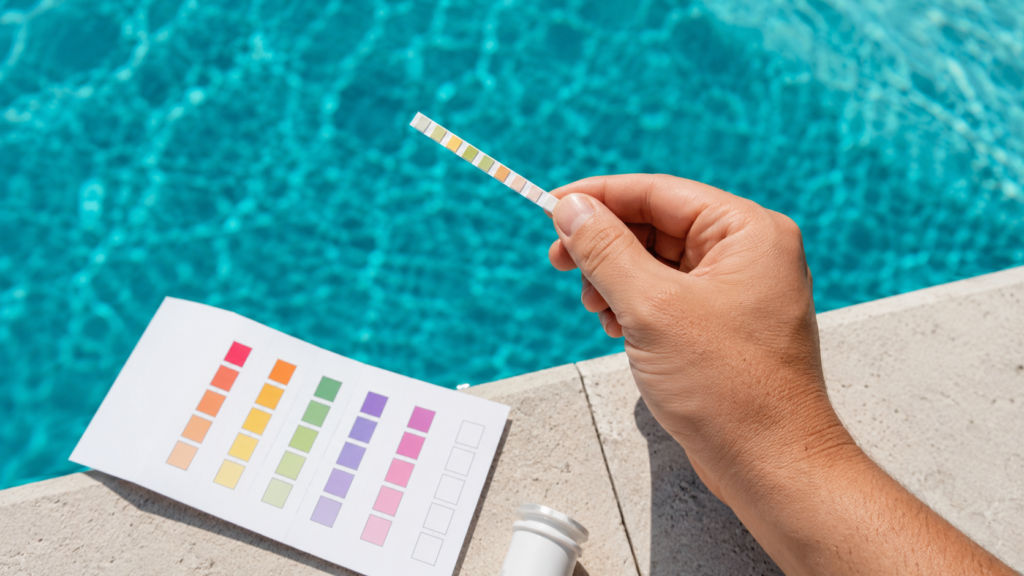
You just tested your pool water, and now you’re staring at two chlorine numbers that don’t match. One says 2 ppm, the other says 4 ppm, and neither test kit explains what that gap actually means. Here’s exactly what free chlorine and total chlorine tell you and what to do about the gap between them.
Quick Answer: Free chlorine is the active chlorine available to kill bacteria and algae right now. Total chlorine is free chlorine plus combined chlorine (used-up chlorine, also called chloramine). The formula is Free Chlorine + Combined Chlorine = Total Chlorine. If the two numbers are far apart, your pool needs to be shocked.
What You Need to Know
- Free chlorine is your pool’s active sanitizer—aim for 1–3 ppm in a standard residential pool, per the CDC’s Model Aquatic Health Code.
- Total chlorine should sit close to your free chlorine reading. A gap of more than 0.5 ppm means combined chlorine (chloramine) is building up.
- Combined chlorine, not fresh chlorine, causes the sharp “chlorine smell” and eye irritation people associate with pools.
- Free chlorine can never legitimately read higher than total chlorine—if it does, retest.
- Your ideal free chlorine target actually depends on your cyanuric acid (CYA) level, not a flat number.
What Is Free Chlorine vs. Total Chlorine?
Free chlorine is the chlorine still available to sanitize your water; total chlorine is that same free chlorine plus whatever chlorine has already been used up to fight contaminants. When you add liquid chlorine, granules, or tablets to your pool, it dissolves into hypochlorous acid and hypochlorite ion—together, these make up your free chlorine reading.
As free chlorine reacts with sweat, sunscreen, ammonia, and other organic waste in the water, it converts into combined chlorine (chloramine). Total chlorine is essentially the combined amount of both:
Free Chlorine + Combined Chlorine = Total Chlorine
A pool with 3 ppm free chlorine and 3 ppm total chlorine has essentially zero combined chlorine—meaning almost none of your sanitizer has been used up yet. That’s a well-balanced pool.
The Chlorine Formula, With Real Numbers
Say your test kit reads 3 ppm free chlorine and 4.2 ppm total chlorine. Subtract: 4.2 − 3 = 1.2 ppm combined chlorine. That’s more than double the 0.5 ppm threshold most pool professionals consider acceptable, which means it’s time to shock.
Compare that to a reading of 3 ppm free chlorine and 3.1 ppm total chlorine—only 0.1 ppm combined chlorine. That pool is clean and doesn’t need any correction.
| Free Chlorine (FC) | Total Chlorine (TC) | Combined Chlorine (TC − FC) | What It Means |
|---|---|---|---|
| 3.0 ppm | 3.1 ppm | 0.1 ppm | Balanced — no action needed |
| 3.0 ppm | 4.2 ppm | 1.2 ppm | Shock the pool |
| 0.5 ppm | 3.0 ppm | 2.5 ppm | Shock immediately, water likely cloudy or smelly |
| 0 ppm | 2.0 ppm | 2.0 ppm | No active sanitizer — unsafe to swim, shock now |
Ideal Free and Total Chlorine Levels for Pools
A residential pool should keep free chlorine between 1 and 3 ppm, with total chlorine no more than 0.5 ppm above that number. The CDC’s Model Aquatic Health Code sets a minimum of 1 ppm free chlorine for pools and 3 ppm for spas and hot tubs, capping both at 10 ppm maximum.
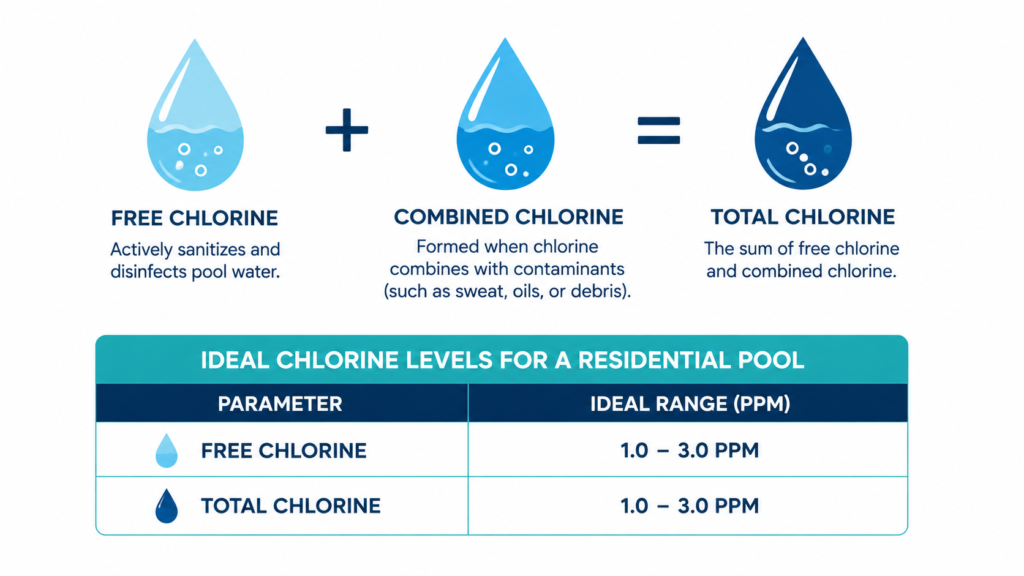
| Water Type | Minimum Free Chlorine | Target Range | Maximum |
|---|---|---|---|
| Residential pool | 1 ppm | 1–3 ppm | 10 ppm |
| Spa / hot tub | 3 ppm | 3–5 ppm | 10 ppm |
| Combined chlorine (any) | — | Under 0.5 ppm | — |
Please save or take a screenshot of this ideal-levels table, as it includes the ranges you will refer to each time you test your water.
Does Total Chlorine Equal Free Chlorine?
No. Total chlorine and free chlorine will only show the same reading when combined chlorine is completely absent. In practice, that means a perfectly clean, freshly balanced pool. The moment your chlorine starts working—killing bacteria, breaking down sweat and sunscreen—combined chlorine appears and total chlorine climbs above free chlorine.
What It Means When Your Readings Don’t Match
This is the part most articles skip, and it’s the part you actually came here for. Below is a decision table for the four reading combinations pool owners run into most often.
| Your Reading | Likely Cause | What to Do |
|---|---|---|
| FC and TC are roughly equal | Water is balanced, sanitizer is fresh | No action — retest in 24–48 hours |
| TC is 0.5+ ppm higher than FC | Combined chlorine (chloramine) has built up from swimmers, sweat, or debris | Shock the pool with an unstabilized chlorine like calcium hypochlorite or liquid chlorine |
| FC reads 0, TC reads high | All your chlorine has converted to combined chlorine — water is not sanitized | Shock immediately; retest before letting anyone swim |
| FC reads higher than TC | Not chemically possible — this is a testing error | Discard the sample, rinse the test vial, and retest with a fresh sample |
Save or screenshot this troubleshooting table—it covers every reading combination you’re likely to see on a home test kit.
Total Chlorine Higher Than Free Chlorine
This is the most common mismatch pool owners report. It means your chlorine is doing its job—reacting with contaminants—faster than you’re replacing it. A gap under 0.5 ppm is normal daily fluctuation. A gap over 0.5 ppm calls for a shock treatment to burn off the combined chlorine and push free chlorine back into range.
Zero Free Chlorine, High Total Chlorine
If your free chlorine reads at or near zero while total chlorine is elevated, your pool has no active sanitizer left. This is the reading combination most associated with cloudy water, a strong chemical smell, and algae risk. Shock the pool with an unstabilized chlorine source, since your cyanuric acid may already be high enough without adding more.
Free Chlorine Reading Higher Than Total Chlorine
Mathematically, free chlorine can never exceed total chlorine, since total chlorine already includes it. If your kit shows this, it’s a testing error almost every time—old reagents, a dirty test vial, or steps read out of order are the usual culprits.
How to Raise Free Chlorine
- Test your cyanuric acid (CYA) level first. Your free chlorine target should sit around 7.5% of your CY. A reading—a pool with 40 ppm CYA needs roughly 3 ppm free chlorine to sanitize effectively.
- Choose an unstabilized chlorine source for shocking. Calcium hypochlorite or liquid sodium hypochlorite raises free chlorine without adding more CYA, which matters if your stabilizer is already near 50 ppm.
- Dose based on your pool volume, not a flat scoop count—check the product label’s ppm-per-gallon guidance for your specific pool size.
- Run the pump for at least 8 hours after shocking to circulate the chlorine fully. For guidance on how long to run yours, see our guide to how long to run a pool pump.
- Retest 8–24 hours later. Free and total chlorine should be close together again before anyone swims.
How Cyanuric Acid (CYA) Changes Your Free Chlorine Target
Cyanuric acid protects chlorine from breaking down in sunlight, but too much of it weakens chlorine’s ability to sanitize. A pool with CYA at 30 ppm needs roughly 2.25 ppm free chlorine to sanitize effectively; a pool at 80 ppm CYA needs closer to 6 ppm. The CDC’s Model Aquatic Health Code is the standard most U.S. health departments reference for these minimums, and it’s worth checking directly if you manage a public or semi-public pool.
How to Test Free vs. Total Chlorine at Home
Three tools measure these numbers, in order of accuracy:
- Test strips—dip and match color, fastest but least precise, especially for spotting a small gap between free and total chlorine.
- DPD liquid test kits—drops of reagent change the water’s color; you compare it to a printed chart. More accurate than strips and the standard most pool professionals recommend.
- Digital/electronic testers—give a numeric readout with no color-matching guesswork, the most accurate option for catching small combined-chlorine gaps.
Test at least once a week under normal conditions, and immediately after heavy pool use, a storm, or a party.
Common Mistakes Pool Owners Make
- Only testing total chlorine, not free chlorine. Cheap strips sometimes report total chlorine alone — without a separate free chlorine number, you can’t calculate combined chlorine or know if your water is actually sanitized.
- Assuming the “chlorine odor” indicates excessive chlorine. It’s almost always the opposite—a strong smell signals high combined chlorine and low free chlorine, so the fix is adding chlorine, not backing off.
- Ignoring CYA when setting a chlorine target. A flat “keep it at 3 ppm” rule ignores that your real target shifts with your stabilizer level.
- Using stabilized chlorine (dichlor or trichlor) for every shock. This keeps pushing CYA higher, which eventually makes even correct free chlorine levels less effective.
If you’re chasing a chlorine number you can’t get to hold, get our free pool chemistry cheat sheet—it walks through free, combined, and total chlorine targets by CYA level so you’re not doing this math by hand every time.
FAQ
How do I raise free chlorine in my pool?
Add an unstabilized chlorine source like liquid chlorine or calcium hypochlorite, dosed to your pool’s volume, then run the pump for at least 8 hours to circulate it. Retest after 8–24 hours. If your cyanuric acid is already above 50 ppm, stick to unstabilized chlorine so you don’t push it higher.
What should I do if total chlorine is higher than free chlorine?
A gap under 0.5 ppm is normal. Anything above that means combined chlorine has built up, and the fix is shocking the pool with an unstabilized chlorine source, then retesting once the water has circulated for several hours.
Does total chlorine equal free chlorine?
Only when combined chlorine is at zero, which happens in a freshly balanced pool. As soon as chlorine starts reacting with sweat, sunscreen, or debris, total chlorine climbs above free chlorine, since total chlorine includes both.
Why is there total chlorine in my pool but zero free chlorine?
This means every bit of chlorine you added has already reacted with contaminants and converted to combined chlorine, leaving nothing active to sanitize the water. Shock the pool right away and don’t swim until free chlorine registers again.
Can free chlorine read higher than total chlorine?
No—this isn’t chemically possible, since total chlorine is defined as free chlorine plus combined chlorine. A reading like this points to a testing error: an old reagent, a dirty sample vial, or steps performed out of order.
How often should I test free and total chlorine?
Test at least once a week for a residential pool under normal use. Step it up to every 1–2 days after heavy swimmer traffic, a storm, or a pool party, since contaminant load changes fast in those conditions.
What to Do Next
If your free chlorine is testing low, start with how much shock to add to your pool to get your dosing right. If your water looks cloudy or has a greenish tint alongside a high combined chlorine reading, check whether you’re dealing with black algae or mustard algae, since both thrive when free chlorine stays low too long. And once you’ve shocked, running your pump long enough is what actually circulates the chlorine through the whole pool.
