
Your test strip just came back low on alkalinity, and now you’re wondering if that’s why your pH keeps bouncing around no matter how much you adjust it. It’s a fixable problem, and you can correct it with one common chemical you can buy at any pool store or grocery aisle.
Quick Answer: Raise pool alkalinity by adding sodium bicarbonate (baking soda)—about 1.5 pounds per 10,000 gallons raises total alkalinity by roughly 10 ppm. Target the 80–120 ppm range, add it with your pump running, wait 6 hours, then retest before adding more.
Table of Contents
What You Need to Know
- Target range for total alkalinity: 80–120 ppm
- The fix is sodium bicarbonate (baking soda), dosed by pool volume.
- 1.5 lbs for every 10,000 gallons increases alkalinity by approximately 10 ppm.
- Wait at least 6 hours before retesting, and fix alkalinity before fine-tuning pH.
- Low alkalinity shows up as pH swings, corrosion, and stinging eyes—not usually cloudy water.
What Is Total Alkalinity and Why It Matters
Total alkalinity is a measure of the dissolved minerals in your pool water that resist sudden changes in pH, used as a buffer to keep your water chemistry stable. Alkalinity is the buffer that keeps pH from swinging wildly every time you add a chemical.
Think of alkalinity as a shock absorber. Without enough of it, every dose of chlorine, sunlight exposure, or rainfall can send your pH sharply up or down. With alkalinity in the 80–120 ppm range, your pool water resists those swings and stays predictable.
Signs Your Pool’s Alkalinity Is Too Low
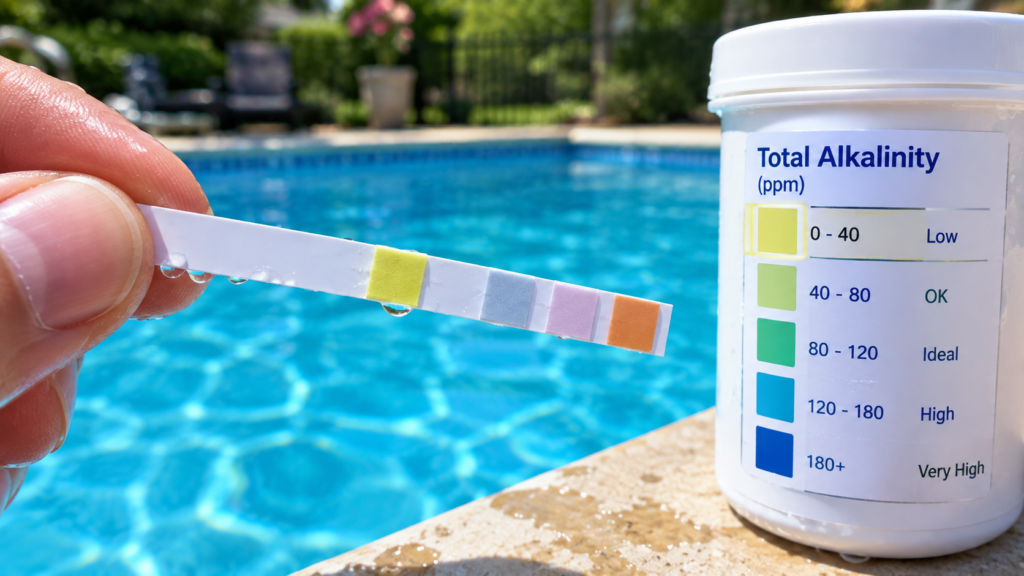
Low alkalinity usually announces itself through your pH readings before it shows up anywhere else. The clearest sign of low alkalinity is a pH level that won’t hold steady no matter how often you correct it.
Watch for these symptoms:
- pH bounce—your pH swings from low to high within days of adjusting it
- Stinging eyes and itchy, dry skin after swimming
- Corrosion on metal ladders, screws, heater components, or light fixtures
- Etching or pitting on plaster or concrete pool surfaces
- Chlorine burning off faster than usual, forcing you to add more to sanitize the same volume of water
If you’re seeing corrosion or surface damage alongside these symptoms, alkalinity has probably been low for a while—not just since your last test.
How to Raise Alkalinity in a Pool
Fixing low alkalinity is a straightforward five-step process, and the only tool you need is sodium bicarbonate. Baking soda dosed at roughly 1.5 pounds per 10,000 gallons is the standard, reliable method for raising total alkalinity.
- Confirm your pool’s volume in gallons. You need this number to calculate a dose—guessing leads to over- or under-correcting. Check your pool builder’s paperwork, or calculate it from length × width × average depth × 7.5 (for rectangular pools).
- Test both alkalinity and pH before you add anything. Knowing your starting pH tells you whether you’re likely to see a pH bump alongside the alkalinity increase, since baking soda raises both.
- Measure out sodium bicarbonate based on your pool size. Use 1.5 lbs per 10,000 gallons for every 10 ppm you need to raise. The dosage chart below does this math for you.
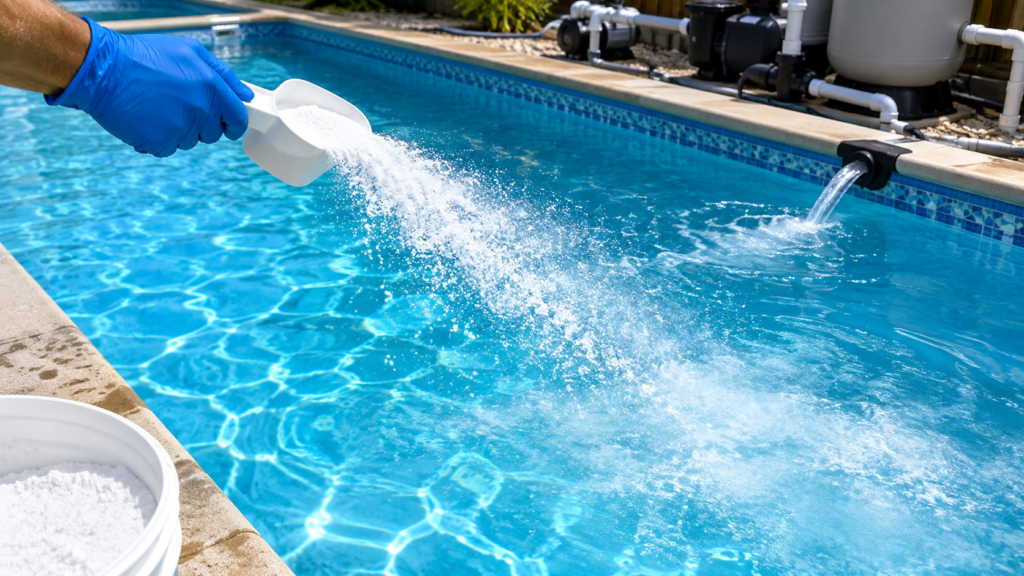
- Broadcast the baking soda across the pool surface with the pump running. Sprinkle it in wide arcs rather than dumping it in one spot, which prevents it from clumping on the pool floor before it dissolves.
- Wait at least 6 hours, then retest. If alkalinity is still below 80 ppm, repeat the dose rather than adding it all at once—smaller, repeated doses are easier to control than one large correction.
Baking Soda Dosage Chart by Pool Size
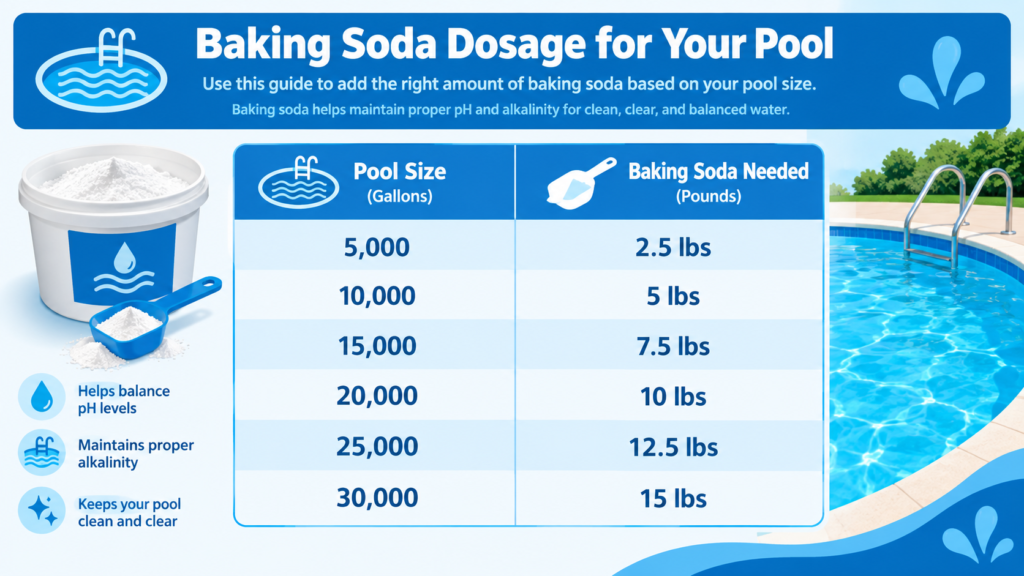
Here’s the calculation for typical pool sizes, using the 1.5 lbs per 10,000 gallons for each 10 ppm increase guideline from Arm & Hammer’s pool care recommendations.
| Pool Size (gallons) | To raise 10 ppm | To raise 20 ppm | To raise 30 ppm |
|---|---|---|---|
| 5,000 | 0.75 lb | 1.5 lb | 2.25 lb |
| 10,000 | 1.5 lb | 3 lb | 4.5 lb |
| 15,000 | 2.25 lb | 4.5 lb | 6.75 lb |
| 20,000 | 3 lb | 6 lb | 9 lb |
| 25,000 | 3.75 lb | 7.5 lb | 11.25 lb |
| 30,000 | 4.5 lb | 9 lb | 13.5 lb |
Save or screenshot this dosage chart — it covers the exact amount of baking soda for any pool size and any correction between 10 and 30 ppm.
If your alkalinity reading is under 50 ppm, dose in two separate rounds rather than trying to close the whole gap in one shot. Large single doses raise the risk of overshooting into the 120+ ppm range.
Baking Soda vs. Commercial Alkalinity Increaser
Both options work through the same active ingredient, so the choice mostly comes down to cost and convenience. Baking soda and commercial alkalinity increaser are chemically the same product at very different price points.
Most bottled “alkalinity increaser” products sold at pool stores are sodium bicarbonate — identical to what’s in the grocery-store baking soda aisle, just packaged and marked up for pool use. Buying food-grade baking soda in bulk typically costs a fraction of the pool-store version for the same amount of active ingredient.
The one place a commercial product earns its price is convenience — pre-measured scoops or tablets remove the need to weigh out pounds yourself. If you’re dosing a large pool regularly, that convenience can be worth it; for a one-time correction, plain baking soda does the same job.
Should You Raise Alkalinity or pH First?
Alkalinity comes first, always. Fixing alkalinity before pH matters because alkalinity is what keeps your pH correction from immediately drifting back out of range.
If your pH and alkalinity are both low, adjusting pH first is like painting over a crack that’s still moving — the low alkalinity will let your pH swing again within days. Get alkalinity into the 80–120 ppm range first, then retest and adjust pH separately if it still needs correcting. For pH-specific corrections, see poolownerguide’s guide to lowering pH in a pool once alkalinity is stable.
How Long to Wait Before Swimming or Retesting
Give baking soda time to fully dissolve and circulate before you test again or let anyone back in the water. Six hours of circulation is the minimum wait time before retesting alkalinity after dosing.
Run your pump continuously during this window so the baking soda disperses evenly instead of settling in one area. Swimming isn’t dangerous during this wait, but retesting too early will give you a false low reading and tempt you to overdose.
Common Mistakes to Avoid
The biggest mistake pool owners make with alkalinity corrections is dosing by feel instead of by the numbers. A few others worth flagging:
- Skipping the pool volume calculation. Without an accurate gallon count, every dosage number is a guess.
- Dumping the full dose in one spot. This causes localized clumping and uneven correction — always broadcast it.
- Retesting too soon. Testing before the 6-hour mark almost always reads artificially low.
- Mixing pool chemicals together before adding them. Chlorine products and acids should never be combined with each other or with baking soda in the same container — the CDC’s pool chemical safety guidance warns this can produce toxic gas.
- Ignoring pH after correcting alkalinity. Baking soda raises both, so a follow-up pH check is part of the job, not optional.
According to the CDC, pool chemical mishandling sends an estimated 3,000 to 5,000 people to U.S. emergency rooms every year — a reminder that “it’s just baking soda” is still worth handling with basic care: gloves, no mixing chemicals, and following label directions.
Want the Full Pool Chemistry Cheat Sheet?
If keeping alkalinity, pH, and chlorine balanced feels like a moving target, poolownerguide is putting together a printable pool chemistry cheat sheet — sign up for the newsletter to get it as soon as it’s ready.
FAQ
What happens when pool alkalinity is low?
Low alkalinity lets your pH swing sharply with every chemical addition, a condition called pH bounce. Left uncorrected, it leads to metal corrosion, etched or pitted pool surfaces, chlorine burning off faster than normal, and stinging eyes or itchy skin for swimmers.
Does shocking a pool raise alkalinity?
No. Pool shock is a concentrated dose of chlorine used to oxidise contaminants and kill algae or bacteria — it doesn’t meaningfully change total alkalinity. Some shock products can shift pH slightly, but alkalinity correction requires sodium bicarbonate specifically.
Is baking soda better than a commercial alkalinity increaser?
They’re typically the same active ingredient — sodium bicarbonate — so neither is chemically “better”. Baking soda is usually far cheaper per pound; commercial products offer pre-measured convenience, which matters more for larger pools or frequent dosing.
Should you raise alkalinity or pH first?
Alkalinity first. It acts as the buffer that keeps pH stable, so correcting pH before alkalinity often means the pH drifts back out of range within days. Get alkalinity into the 80–120 ppm range, then reassess pH.
Can I use washing soda instead of baking soda to raise alkalinity?
Washing soda (sodium carbonate) is a different, more concentrated compound that raises pH much more aggressively than it raises alkalinity, making dosing harder to control. Sodium bicarbonate (baking soda) is the standard, safer choice specifically for alkalinity correction.
What if my alkalinity stays low after adding baking soda?
Confirm you waited the full 6 hours and used an accurate gallon count before retesting. If levels still haven’t moved, an underlying issue — like a leak diluting the pool with untreated fill water, or a miscalculated pool volume — may be working against your corrections.
When to Call a Pool Professional
Most alkalinity corrections are safe to handle yourself with a test kit and a bag of baking soda. Call a pool professional or bring a water sample to a pool store for a full panel test if your alkalinity won’t stabilise after two full correction cycles, or if pH keeps swinging despite alkalinity sitting in range — that combination usually points to a problem beyond a simple dosing fix.
What to Do Next
With alkalinity corrected, check whether your pH needs its own adjustment — see the guide to lowering pH in a pool. If you’re also dealing with a stubborn chlorine reading, compare free chlorine vs. total chlorine to see what’s actually being measured. And if cyanuric acid has crept up alongside your other readings, here’s how to handle cyanuric acid that’s too high.1.5 lbs per 10,000 gallons raises alkalinity by about 10 ppm
