
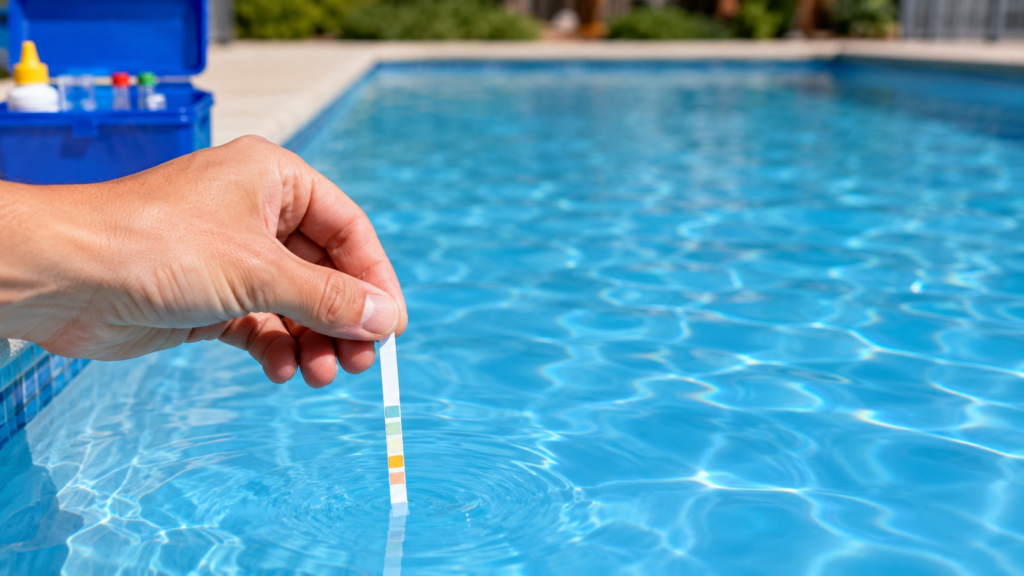
The water is still lightly hazy, even though you shocked the pool two days ago. That’s a high pH, and it’s fixable in an afternoon with the right amount of acid and a little patience.
Quick Answer: To lower pool pH, add muriatic acid or sodium bisulphate based on your pool’s gallon volume and current pH reading. Pour it slowly near the return jets with the pump running, then wait 4–6 hours before retesting. Adjust in small increments — dumping in too much at once will overcorrect the pH below 7.2.
Table of Contents
What You Need to Know
- The ideal pH range for pools is between 7.2 and 7.8, with most pool professionals aiming for a target of 7.4 to 7.6.
- Two chemicals do the job: liquid muriatic acid or granular sodium bisulphate (dry acid).
- Dose by pool volume and current pH — not by guesswork. A dosage chart is below.
- Retest 4–6 hours after adding acid, and wait a full day before adding more if it’s still high.
- If pH keeps creeping back up within a day of correcting it, the real problem is usually total alkalinity, not pH itself.
Why Pool pH Rises in the First Place
High pH is almost always caused by something adding alkalinity to your water faster than it’s being used up. Common culprits include topping off with hard tap water, heavy splashing that releases dissolved carbon dioxide, fresh rain, and debris breaking down in the water.
Here’s the part that surprises most pool owners: pH is measured on a logarithmic scale, so a jump from 7.4 to 8.4 isn’t a 35% increase — it’s a tenfold increase in actual alkalinity. That’s why “just a little high” on a test strip can matter more than it looks.
High pH doesn’t just feel uncomfortable. It also cripples your sanitizer — at a pH of 8.0, a large share of your chlorine converts into a form that barely kills anything, which is part of why pool water can look cloudy or smell “off” even when your free chlorine reading looks fine on paper.
What You Need: Muriatic Acid vs. Sodium Bisulphate
Muriatic acid works faster and costs less per gallon, but it’s harsher to handle; sodium bisulphate is easier and safer for beginners but pricier per dose.
| Muriatic Acid (Liquid) | Sodium Bisulfate (Dry Acid) | |
|---|---|---|
| Form | Liquid, ~31.45% concentration | Granular powder |
| Speed | Fast-acting | Slightly slower to dissolve |
| Cost per treatment | Lower | Higher |
| Handling risk | Fumes, splash risk — needs dilution | Less fuming, easier to measure |
| Effect on other chemistry | Minimal | Slightly raises total dissolved solids over time |
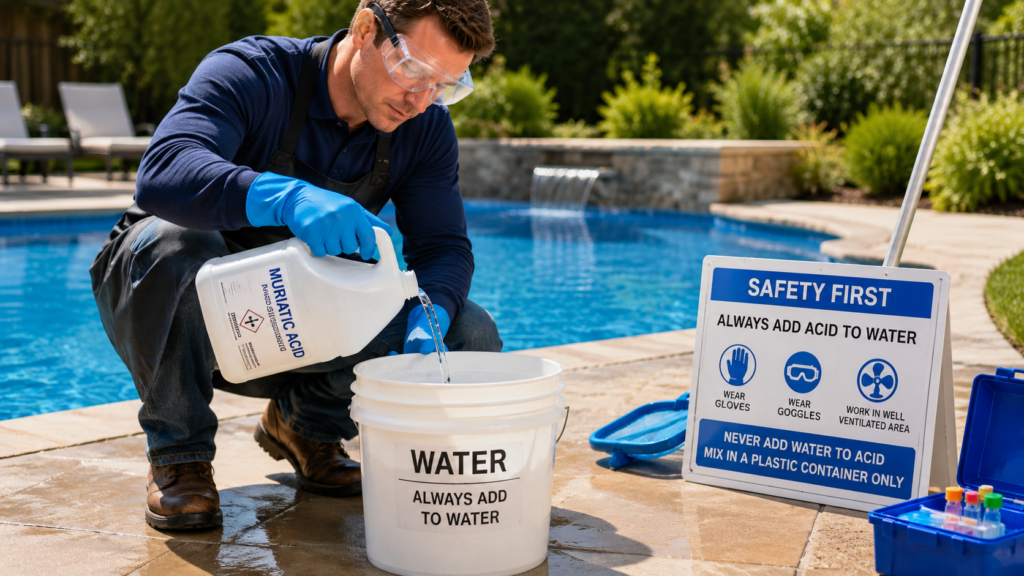
Whichever one you choose, wear gloves and goggles before you open the container. Never pour water into acid—always add acid to water if you’re diluting muriatic acid in a bucket first. Check the product’s Safety Data Sheet for full handling guidance before your first use.
Pool pH Lowering Dosage Chart
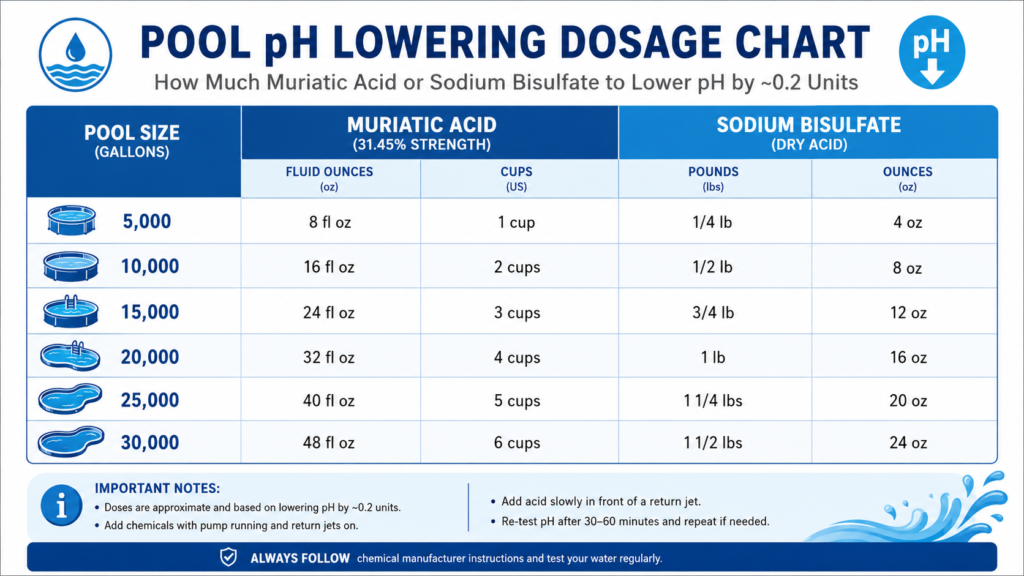
These are the standard industry rule-of-thumb amounts pool professionals use as a starting point. Always confirm against your specific product’s label, since concentrations vary by brand.
| Pool Volume | Lower pH by 0.2 (Muriatic Acid) | Lower pH by 0.4 (Muriatic Acid) | Lower pH by 0.2 (Sodium Bisulfate) | Lower pH by 0.4 (Sodium Bisulfate) |
|---|---|---|---|---|
| 5,000 gal | 8 oz | 16 oz | 6 oz | 12 oz |
| 10,000 gal | 16 oz | 32 oz | 12 oz | 24 oz |
| 15,000 gal | 24 oz | 48 oz | 18 oz | 36 oz |
| 20,000 gal | 32 oz | 64 oz | 24 oz | 48 oz |
| 25,000 gal | 40 oz | 80 oz | 30 oz | 60 oz |
| 30,000 gal | 48 oz | 96 oz | 36 oz | 72 oz |
Save or screenshot this dosage chart—it covers the two most common pH decreasers across the pool sizes most backyard owners actually have.
Step-by-Step: How to Lower Pool pH Safely
- Test your water first. Confirm your exact pH reading with a liquid test kit or fresh test strips—don’t estimate. Anything above 7.8 needs correction.
- Calculate your dose. Use the chart above based on your pool’s gallon volume and how far your pH needs to drop.
- Dilute muriatic acid in a bucket of water (skip this step for sodium bisulfate—it can go in dry or pre-dissolved). Always add the acid to the water, never the reverse.
- Pour the solution slowly near the return jets, moving around the pool’s perimeter, and keep it away from skimmers, ladders, and pool walls.
- Run the pump for 4–6 hours to circulate the chemical evenly through the water.
- Wait, then retest. Give it a full 4–6 hours minimum—24 hours for the most accurate reading—before testing again.
- Repeat in small increments if needed. If pH is still above 7.8, add a smaller follow-up dose rather than repeating your first full dose.
pH Won’t Drop? Here’s Why
If you’ve added acid correctly and pH still won’t budge, your total alkalinity is almost certainly too high and is buffering the water back toward its old pH. Total alkalinity acts like a shock absorber for pH—the higher it is, the harder your pool resists any change.
Test your total alkalinity and aim for 80–120 ppm. If it’s above that, you’ll need additional acid dosing specifically to bring alkalinity down before pH will hold steady. This is also worth checking if you recently added a large dose of pool shock, since some shock products are alkaline and can undo your correction.
Common Mistakes That Cause Overcorrection or Re-Spiking pH
The single most common mistake is dosing the full amount all at once instead of testing between smaller doses. This regularly overshoots the target and drops pH below 7.2, which brings its own problems—corroded metal fixtures and irritated skin, just from the opposite direction.
Other frequent mistakes: pouring acid directly onto the pool liner or steps (it can etch or bleach the surface), skipping the dilution step with muriatic acid, and retesting too soon before the chemical has fully circulated. Give the numbers time to settle before you judge whether you need another round.
Cheapest Way to Lower Pool pH (Cost Comparison + Myth Check)
Muriatic acid is the cheapest per-treatment option, typically costing a fraction of what sodium bisulfate costs for the same pH drop. A gallon of muriatic acid usually runs a few dollars and handles multiple treatments, while dry acid comes at a higher per-pound price for a comparable effect.
One thing worth debunking here: vinegar and lemon juice are not effective pool pH reducers. They’re far too diluted and too acidic in the wrong way to make a meaningful dent in thousands of gallons of buffered pool water—you’d need an impractical amount, and you’d introduce organic material that feeds algae and bacteria instead.
FAQ
What is the cheapest way to lower pH in water?
Muriatic acid is the cheapest option per treatment for pool water, generally costing less than sodium bisulfate for an equivalent pH drop. Buy it in bulk if you maintain your own pool regularly, since it doesn’t expire quickly when stored properly in a cool, dark place away from other chemicals.
What happens when pool pH becomes too high?
High pH reduces chlorine’s ability to sanitize the water, which can lead to cloudy water and a higher risk of algae or bacteria. It can also cause scaling on pool surfaces and equipment, plus skin and eye irritation for swimmers, even when chlorine levels look normal on a test strip.
Can baking soda lower pH in a pool?
No—baking soda (sodium bicarbonate) raises pH and total alkalinity; it doesn’t lower either one. If your pH is already high, adding baking soda will make the problem worse. Baking soda is the correct choice only when your pH or alkalinity is too low.
Is a 7.8 pH too high for a pool?
A pH of 7.8 sits at the very top edge of the acceptable range, so it’s not an emergency, but it’s worth correcting before it climbs higher. At 7.8, chlorine is already noticeably less effective than it is at the ideal 7.4–7.6 range recommended by most pool professionals.
How long does it take for pH to drop after adding acid?
Most pools show a measurable pH drop within 4–6 hours once the chemical has fully circulated, though some pool owners prefer to wait a full 24 hours for the most accurate retest. Circulation speed depends on your pump’s flow rate and how evenly you distributed the acid.
Can I lower pool pH without chemicals?
Yes, to a limited degree—increasing aeration through water features, fountains, or higher pump turnover encourages dissolved carbon dioxide to escape, which gradually lowers pH. It’s slow and only useful for minor adjustments; anything above 7.8 usually still needs a chemical decreaser.
When to Call a Pool Professional
If your pH and total alkalinity are both correct on paper but the water still looks cloudy or your chlorine keeps burning off fast, something else is likely going on—high calcium hardness, a filtration problem, or a testing kit that’s giving inaccurate readings. A professional water test at a pool supply store can rule out what a home kit might miss.
Getting your dosing right the first time saves you money and repeat trips to the pool store—if that’s the kind of practical detail you want more of, our newsletter sends pool maintenance breakdowns like this one straight to your inbox.
What to Do Next
Once your pH is back in range, check that your free chlorine and total chlorine readings actually line up now that your sanitizer can work properly. If you shocked your pool recently and pH spiked afterward, review how much shock you actually need so you’re not overdosing next time. And if cloudy water doesn’t clear up within a day or two of correcting pH, it’s worth ruling out black algae as a separate issue.
