
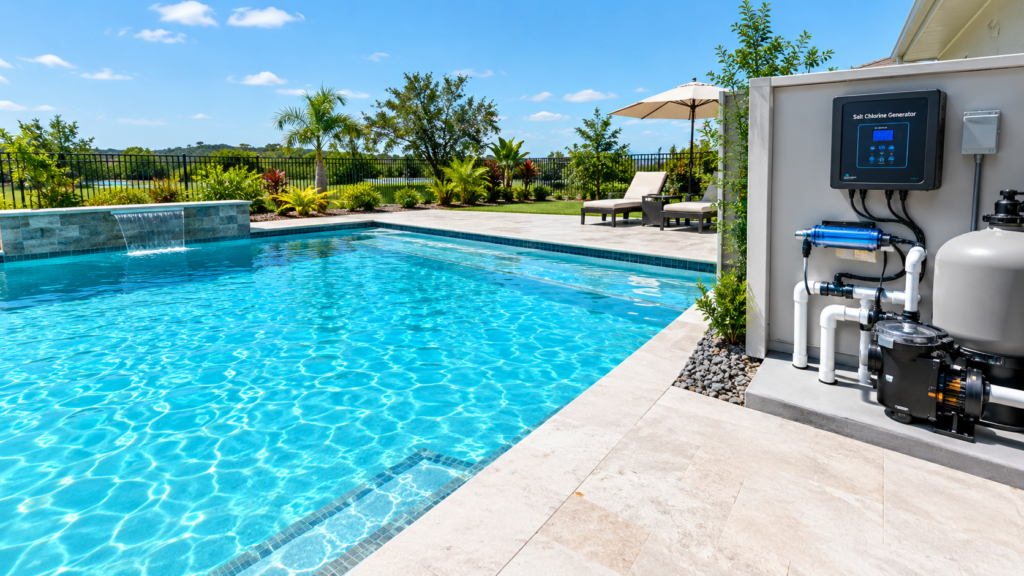
You’re standing at a fork in the road—building a new pool, quoting a renovation, or just tired of red eyes and a chemical smell—and every pool company gives you a different answer about saltwater vs. chlorine. Here’s the straight version, with real numbers, so you can decide without a sales pitch attached.
Quick Answer: Saltwater pools generate their own chlorine using a salt cell, while chlorine pools use chlorine added directly. Saltwater costs $500–$2,500 more upfront but roughly $150–$400 less per year in chemicals; chlorine pools are cheaper to install but need more hands-on weekly maintenance and can irritate skin and eyes more.
Table of Contents
What You Need to Know
- A saltwater pool still uses chlorine—it just makes its own, continuously, instead of you adding it.
- Chlorine pools cost less to install (often under $100 for a basic feeder); saltwater generators run $500–$2,500 installed.
- Saltwater pools drift toward high pH and require the salt cell to be cleaned and eventually replaced ($200–$700 every 3–5 years).
- Chlorine pools use $300–$800 a year in chemicals; saltwater pools typically run $150–$400.
- Saltwater is mildly corrosive to metal fixtures and some coping stone—chlorine is not.
What’s the Key Difference Between Saltwater and Chlorine Pools?
Both pool types sanitize with chlorine—the difference is where that chlorine comes from. A saltwater pool is not a chlorine-free pool; it’s a pool that manufactures its own chlorine on-site through a salt cell, instead of you adding chlorine by hand.
In a traditional chlorine pool, you add chlorine directly—tablets, liquid, or granules—and the level spikes, then falls until the next dose. In a saltwater pool, a salt chlorine generator runs dissolved salt through an electrolytic cell, producing a small, steady stream of chlorine around the clock. Both systems ultimately rely on the same active sanitizing compound: hypochlorous acid.
How a Salt Chlorine Generator Actually Works
A salt cell splits dissolved salt (sodium chloride) into chlorine through electrolysis, then that chlorine dissolves back into the water as sanitizer. This happens continuously as water passes through the cell during normal filtration.
Residential systems need a specific salt concentration to function—not “some salt,” but a calibrated range. Hayward AquaRite systems run an ideal midpoint around 3,200 ppm within a 2,700–3,400 ppm window; Pentair IntelliChlor and similar systems fall in a comparable 2,700–3,500 ppm range depending on model. For context, that’s roughly a tenth of ocean salinity—closer to the salt concentration of tears than seawater, which is why most swimmers don’t taste or feel it.
If the salt level is too low, the cell can’t produce enough chlorine, risking algae growth. Run it too high and you accelerate corrosion and cell wear. The manufacturer’s spec sheet for your specific generator, not a generic number, is the number that matters.
Saltwater vs. Chlorine: Cost, Maintenance, and Corrosion Compared
| Saltwater Pool | Chlorine Pool | |
|---|---|---|
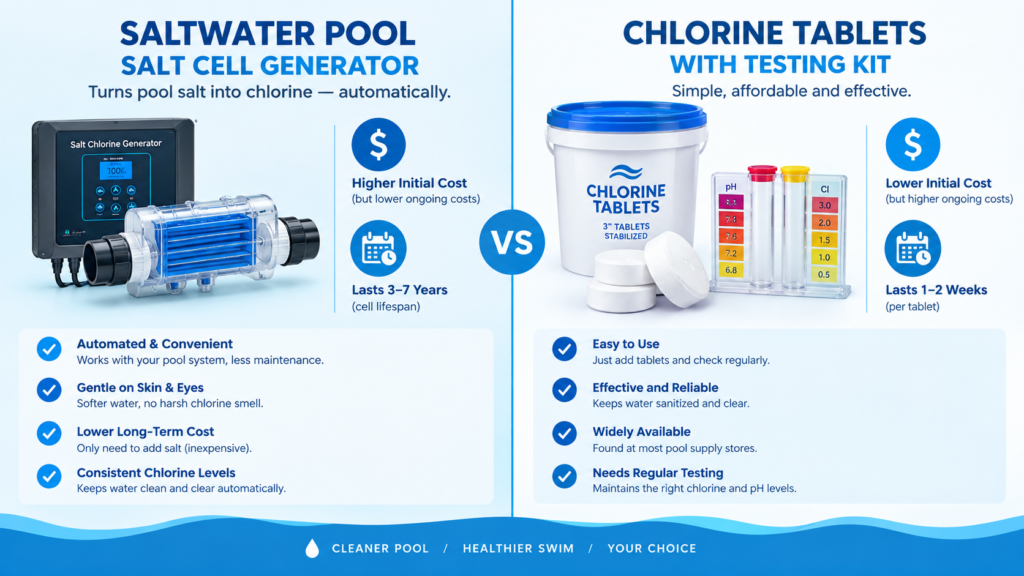
| Upfront cost | $500–$2,500 for generator + installation | Under $100 for a basic chlorinator |
| Annual chemical cost | ~$150–$400 | ~$300–$800 |
| Salt cell replacement | $200–$700 every 3–5 years | N/A |
| pH behavior | Drifts high, needs more frequent acid dosing | More stable, adjusted as tested |
| Corrosion risk | Moderate — metal fixtures, some coping stone | Minimal |
| Electricity draw | Runs continuously to maintain output | Pump-only, no generator load |
| Skin/eye feel | Softer, milder odor | Sharper odor, more irritation reports |
Save or screenshot this comparison table—it covers the seven variables that actually decide which system fits your budget and pool, not just the sticker price.
Over a 5–7 year horizon, saltwater’s lower annual chemical spend typically overtakes the higher upfront cost, but the salt cell replacement cycle narrows that gap more than most sales pitches admit.
Which Is Gentler on Skin, Eyes, and Hair?
Saltwater pools are generally gentler because they avoid the chlorine spikes that come with manual dosing. The stinging and odor most people blame on “too much chlorine” is actually caused by chloramines—compounds formed when chlorine reacts with sweat, body oils, and urine, not by chlorine itself.
According to the CDC, chloramines are what irritate eyes, skin, and the respiratory tract when they off-gas from pool water, and most health departments cap combined chlorine (chloramines) at 0.4 ppm or lower for exactly this reason. Because saltwater pools maintain a steadier, lower-grade chlorine level rather than cycling through spikes, they tend to build up fewer chloramines between doses—which is the real mechanism behind “saltwater feels softer,” not the salt itself.
Neither system eliminates chloramines completely. Showering before swimming and keeping the water properly balanced (see the section below) matters for both.
Maintenance: What Each System Actually Asks of You Week to Week
Chlorine pools ask for more frequent, hands-on attention—testing and dosing chemicals, typically weekly. Saltwater pools ask for less frequent chemical additions but introduce a different chore: watching pH, since saltwater systems consistently drift alkaline and need more regular muriatic acid corrections than a chlorine pool does.
Beyond that, saltwater cells need periodic physical cleaning to prevent calcium buildup on the plates, which otherwise cuts chlorine output and shortens the cell’s life. If you already keep up with balancing your water in a chlorine pool, that routine (testing free chlorine, pH, alkalinity, calcium hardness, and stabilizer) carries over directly—you’re just swapping “add chlorine” for “watch pH and clean the cell.”
Corrosion and Equipment Wear: What Saltwater Costs You Long-Term
Salt is mildly corrosive, and it’s the cost line most saltwater pitches leave out. Metal fixtures like ladders, handrails, and heaters, along with certain porous coping stones, are the most exposed to salt-related wear over time.
This is manageable—sacrificial anodes, salt-resistant hardware, and sealed coping all reduce the risk—but it’s a real cost to budget for, especially if you’re converting an older pool with existing metal fixtures rather than building new. If your pump has been running longer than expected without issue, it’s worth checking how many hours a day your equipment actually needs to run, since over-running a pump accelerates wear on everything downstream, salt or not.
Can You Convert an Existing Chlorine Pool to Saltwater?
Yes, and it’s a common project, but it’s not just “add a generator.” You need a compatible pump and filtration setup, a correctly sized generator for your pool’s gallons, and an honest look at which metal components might need replacing before switching. An undersized generator is the most common conversion mistake—it can’t keep up in peak summer use, so owners end up dosing chlorine manually anyway, which erases most of the benefit of converting in the first place.
Common Mistakes People Make Choosing Between the Two
Assuming saltwater means “no chemicals,” you’ll still test and adjust pH, alkalinity, and calcium hardness—you’re just not manually dosing chlorine.
Undersizing a salt generator to save money. A generator sized for your exact pool volume, not the cheapest model that technically fits, avoids the “supplementing with chlorine anyway” trap.
Ignoring metal fixtures during a conversion. Ladders, rails, and heaters installed for a chlorine pool aren’t always rated for long-term salt exposure—check before you switch.
Letting saltwater pH drift unchecked. Because saltwater doesn’t sting like an unbalanced chlorine pool does, high pH can go unnoticed longer, which speeds up scaling and corrosion.
Whichever system you choose, keeping your water properly balanced is what actually prevents most of these problems—our beginner’s guide to balancing pool water walks through testing and adjusting each of these levels step by step. And if you want a seasonal maintenance rundown sent straight to your inbox instead of digging through search results every time something looks off, that’s exactly what our newsletter is for.
Which One Should You Choose?
Choose saltwater if you want softer water and fewer manual chemical additions, and you’re comfortable paying more upfront for lower annual costs. Choose chlorine if you want the lowest possible starting cost, don’t mind weekly testing and dosing, and aren’t dealing with sensitive skin or eyes.
Neither system removes pool ownership work—it just changes what that work looks like.
FAQ
What are the disadvantages of saltwater pools? Saltwater pools cost more upfront ($500–$2,500 for the generator), are mildly corrosive to metal fixtures and some coping stone, require the salt cell to be replaced every 3–5 years ($200–$700), and tend to drift toward high pH, which means more frequent acid dosing than a chlorine pool.
What is the healthiest type of swimming pool? Neither system is inherently “healthier”—both sanitize with chlorine. Saltwater pools tend to produce fewer chloramines because chlorine output is steadier rather than spiking, which is why they’re often gentler on skin, eyes, and the respiratory tract. Proper maintenance matters more than the sanitizer source.
Is It Possible to Convert a Chlorine Pool Into a Saltwater Pool? Yes. You’ll need a correctly sized salt chlorine generator, a compatible pump and filtration system, and an assessment of whether existing metal fixtures can handle long-term salt exposure. Undersizing the generator is the most common conversion mistake.
Is it cheaper to have a saltwater pool or a chlorine pool? Chlorine is cheaper upfront (often under $100 for a basic chlorinator vs. $500–$2,500 for a salt system). Saltwater is usually cheaper annually—roughly $150–$400 in yearly chemicals versus $300–$800 for chlorine—though the salt cell’s 3–5 year replacement cost narrows that long-term gap.
Do saltwater pools need chlorine tablets too? Not for routine sanitizing—the generator produces chlorine continuously. Most saltwater owners still keep granular shock on hand for heavy-use spikes (parties, storms, heat waves) the generator can’t ramp up for fast enough.
How often do I need to test a saltwater pool compared to a chlorine pool? Both need regular testing of chlorine, pH, alkalinity, calcium hardness, and stabilizer. Saltwater pools need less frequent chlorine dosing but more frequent pH checks, since they drift alkaline faster than chlorine pools do.
What are the disadvantages of saltwater pools?
Saltwater pools cost more upfront ($500–$2,500 for the generator), are mildly corrosive to metal fixtures and some coping stone, require the salt cell to be replaced every 3–5 years ($200–$700), and tend to drift toward high pH, which means more frequent acid dosing than a chlorine pool.
What is the healthiest type of swimming pool?
Neither system is inherently “healthier”—both sanitize with chlorine. Saltwater pools tend to produce fewer chloramines because chlorine output is steadier rather than spiking, which is why they’re often gentler on skin, eyes, and the respiratory tract. Proper maintenance matters more than the sanitizer source.
Is It Possible to Convert a Chlorine Pool Into a Saltwater Pool?
Yes. You’ll need a correctly sized salt chlorine generator, a compatible pump and filtration system, and an assessment of whether existing metal fixtures can handle long-term salt exposure. Undersizing the generator is the most common conversion mistake.
Is it cheaper to have a saltwater pool or a chlorine pool?
Chlorine is cheaper upfront (often under $100 for a basic chlorinator vs. $500–$2,500 for a salt system). Saltwater is usually cheaper annually—roughly $150–$400 in yearly chemicals versus $300–$800 for chlorine—though the salt cell’s 3–5 year replacement cost narrows that long-term gap.
Do saltwater pools need chlorine tablets too?
Not for routine sanitizing—the generator produces chlorine continuously. Most saltwater owners still keep granular shock on hand for heavy-use spikes (parties, storms, heat waves) the generator can’t ramp up for fast enough.
How often do I need to test a saltwater pool compared to a chlorine pool?
Both need regular testing of chlorine, pH, alkalinity, calcium hardness, and stabilizer. Saltwater pools need less frequent chlorine dosing but more frequent pH checks, since they drift alkaline faster than chlorine pools do.
What to Do Next
If you’re currently dealing with hazy or discolored water while you decide between systems, start with fixing cloudy pool water—the cause is usually the same regardless of which sanitizer you choose. If things have gotten further along, our 24-hour green pool fix covers rapid recovery. And before committing to either system, check how long you actually need to run your pool pump—pump runtime affects both chlorine and saltwater sanitizing performance equally.
