
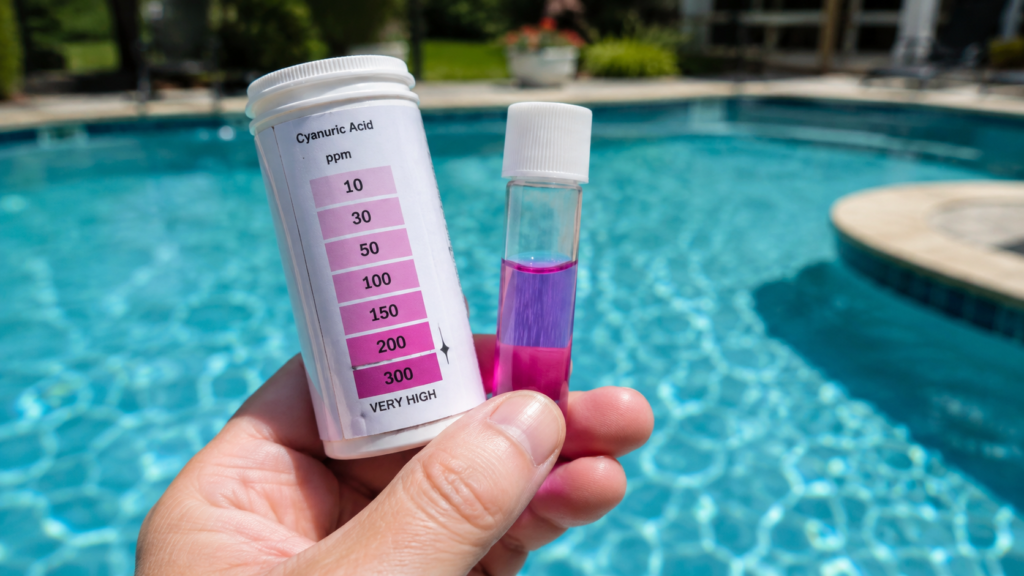
Your test strip just came back with cyanuric acid pegged at the top of the scale—or your pool store handed you a printout with CYA circled in red. Maybe you’re just tired of shocking a pool that won’t clear up. Either way, the fix is more straightforward than it looks, and you don’t need to drain the pool completely to get there.
Quick Answer: Cyanuric acid (CYA) is too high above 50 ppm for most residential pools. Above that range, chlorine can’t sanitize effectively even when test kits show normal levels—a condition called chlorine lock. The only reliable fix is diluting the water by partially draining and refilling, since CYA doesn’t break down on its own.
Table of Contents
What You Need to Know
- The ideal CYA range for outdoor residential pools is 30–50 ppm; indoor and many commercial pools should have none at all.
- High CYA doesn’t show up as a chlorine problem on a basic test—your chlorine reading can look fine while it’s barely working.
- Cyanuric acid is chemically stable. It doesn’t evaporate, break down in sunlight, or get consumed like chlorine does.
- Dilution—draining part of the pool and refilling with fresh water—is the only method proven to lower it.
- Baking soda and sunlight are both common myths for lowering CYA. Neither does anything to it.
What Does It Mean When Cyanuric Acid Is Too High?
Cyanuric acid is a stabilizer that shields chlorine from breaking down in sunlight, and it’s considered too high once it climbs past 50 ppm in a typical outdoor pool. Above that point, chlorine molecules bind so tightly to the excess CYA that they lose most of their ability to kill bacteria and algae—a state pool owners call chlorine lock. Your chlorine test can read “normal” the entire time this is happening, because the test measures how much chlorine is present, not how much of it is actually free to sanitize.
That’s the counterintuitive part: a “good” chlorine number and a genuinely under-sanitized pool can coexist for weeks.
Signs Your Cyanuric Acid Is Too High
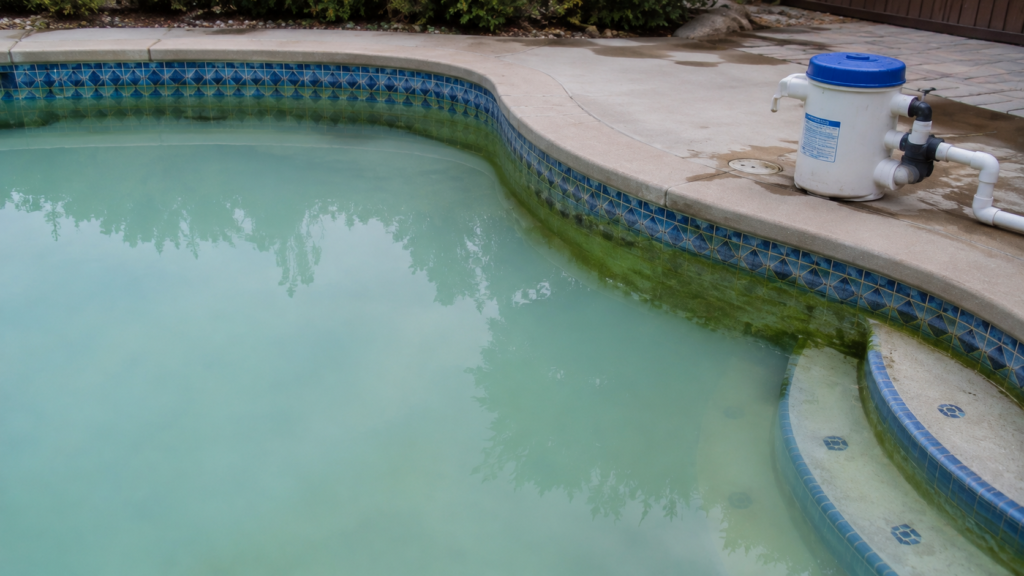
The clearest sign is a pool that won’t respond to chlorine the way it used to, even when your readings look normal. You’ll typically notice a combination of these:
- Cloudy or hazy water that does not clear up after shocking the pool is a sign of trouble.
- Algae—often mustard algae or black algae—returning within days of treatment
- If you find yourself needing more chlorine than usual to maintain a normal reading, it may indicate an issue.
- A chlorine smell that’s stronger than it should be for a properly balanced pool (the odor comes from chloramines building up because free chlorine isn’t doing its job)
If you’re fighting recurring algae despite dosing chlorine correctly, high CYA is one of the most overlooked reasons why—it’s worth ruling out before you assume it’s a filtration or circulation problem.
What Makes Cyanuric Acid Levels Rise Too High
Stabilized chlorine products are the cause in almost every case. Trichlor and dichlor tablets, pucks, and granules all contain cyanuric acid baked into the chlorine itself—every time you add them, you’re adding chlorine and CYA together.
Because CYA never breaks down under normal pool conditions, it has nowhere to go. Every dose of stabilized chlorine adds a little more, and over a season — or several seasons if the water isn’t replaced — it accumulates well past the ideal range. This is different from how much shock to add to a pool: standard pool shock is usually calcium hypochlorite, which doesn’t contain CYA, so shocking correctly isn’t what’s driving the number up.
Why Dilution Is the Only Real Fix (and Why That’s True)
Cyanuric acid is a stable ring-shaped compound that doesn’t hydrolyze, oxidize, or photodegrade under the temperatures and UV exposure a backyard pool experiences. That’s the entire reason it works as a stabilizer in the first place—it’s built to resist breakdown. But that same stability means there’s no chemical treatment, additive, or amount of sunlight that removes it from the water once it’s there.
The only variable you can actually change is concentration, and the only way to change concentration is to replace some of the water. According to the CDC’s Model Aquatic Health Code, this is also why many public and indoor facilities avoid stabilized chlorine products entirely rather than manage CYA buildup after the fact.
How to Lower Cyanuric Acid: Step by Step
- Retest to confirm your current CYA level. Use a liquid test kit rather than strips alone if you can—liquid kits tend to be more accurate at higher concentrations, where strips often max out and give a false “off the chart” reading.
- Set your target range. Aim for 30–50 ppm for a standard outdoor residential pool.
- Calculate how much water to replace. Use the reference chart below or the formula: percent to replace = 1 − (target ÷ current reading).
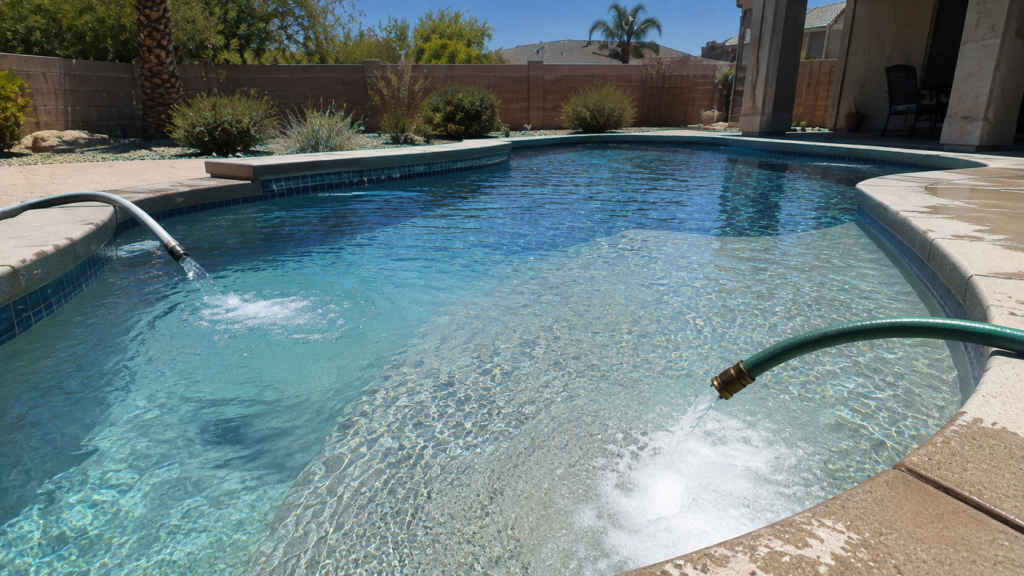
- Drain the calculated percentage of pool water, then refill with fresh water. Never drain a pool completely unless it’s specifically built for it—an empty pool can pop out of the ground from groundwater pressure.
- Wait for the water to fully mix and refilter, typically 24 hours, then retest.
- Repeat the process if you’re still above 50 ppm. Very high starting levels often take two dilution cycles to bring down fully.
CYA Dilution Reference Chart
| Current CYA (ppm) | Target CYA (ppm) | Approximate % of Pool Water to Replace |
|---|---|---|
| 100 | 50 | 50% |
| 100 | 30 | 70% |
| 150 | 50 | 67% |
| 150 | 30 | 80% |
| 200 | 50 | 75% |
| 200 | 30 | 85% |
| 300 | 50 | 83% |
Save or screenshot this dilution chart—it covers the most common CYA scenarios pool owners run into and saves you from doing the math poolside.
Preventing It From Happening Again
The fix that actually prevents this from recurring is switching some or all of your chlorine dosing to an unstabilized source. Liquid chlorine (sodium hypochlorite) and calcium hypochlorite both sanitize without adding any CYA at all, which means you can keep chlorine levels topped up without ever pushing stabilizer back into the danger zone.
Many pool owners alternate between unstabilized chlorine for routine dosing and stabilized tablets only when convenience matters, like during a week away. Understanding the difference between free chlorine and total chlorine also helps you catch chlorine-lock symptoms earlier, before CYA has climbed far enough to need a full dilution cycle.
Common Mistakes to Avoid
The single most common mistake is treating high CYA like a chlorine problem and just adding more chlorine. That makes chlorine lock worse, not better, since more stabilized product usually means more CYA too.
Other frequent missteps:
- Trusting a maxed-out test strip reading instead of retesting with a liquid kit
- Draining the entire pool at once instead of a calculated partial drain
- Switching back to trichlor tablets immediately after fixing the problem, undoing the work within a season
- Skipping the retest after refilling, so the real number never gets confirmed
Frequently Asked Questions
What causes cyanuric acid to be high?
Cyanuric acid gets too high almost entirely from stabilized chlorine products like trichlor and dichlor tablets, which contain CYA alongside the chlorine. Since CYA doesn’t break down under normal pool conditions, repeated use causes it to accumulate season after season until it exceeds the ideal 30–50 ppm range.
How do you bring cyanuric acid levels down?
The only reliable method is dilution: partially draining the pool and refilling with fresh water to lower the concentration. There’s no chemical additive that removes cyanuric acid from water. Calculate the percentage to replace based on your current and target ppm, drain and refill, then retest after 24 hours.
Does baking soda lower cyanuric acid?
No. Baking soda (sodium bicarbonate) raises pH and total alkalinity—it has no chemical effect on cyanuric acid whatsoever. This is one of the most common pool-chemistry myths, likely because baking soda is treated as a fix-all for water balance issues.
Does sunlight reduce cyanuric acid?
No. Sunlight breaks down unstabilized chlorine, which is exactly why CYA is added in the first place—to protect chlorine from that breakdown. Cyanuric acid itself is stable under normal outdoor pool conditions and doesn’t degrade from UV exposure.
Do cyanuric acid reducer products actually work?
Results are inconsistent and often slow, and many require narrow water conditions to function at all. Dilution remains the dependable method; reducer products are generally not a substitute for a proper partial drain and refill.
How often should I test cyanuric acid?
Test monthly during swim season, and more frequently if trichlor or dichlor tablets are your primary chlorine source. Retest after any high-bather-load event or heavy rainfall, since both can shift your water chemistry faster than usual.
What to Do Next
If algae keeps coming back despite normal-looking chlorine readings, start with mustard algae in the pool or black algae in the pool to confirm what you’re dealing with before you treat it. If you’re not confident your chlorine readings are telling the full story, free chlorine vs. total chlorine explains the gap that high CYA can hide.
