
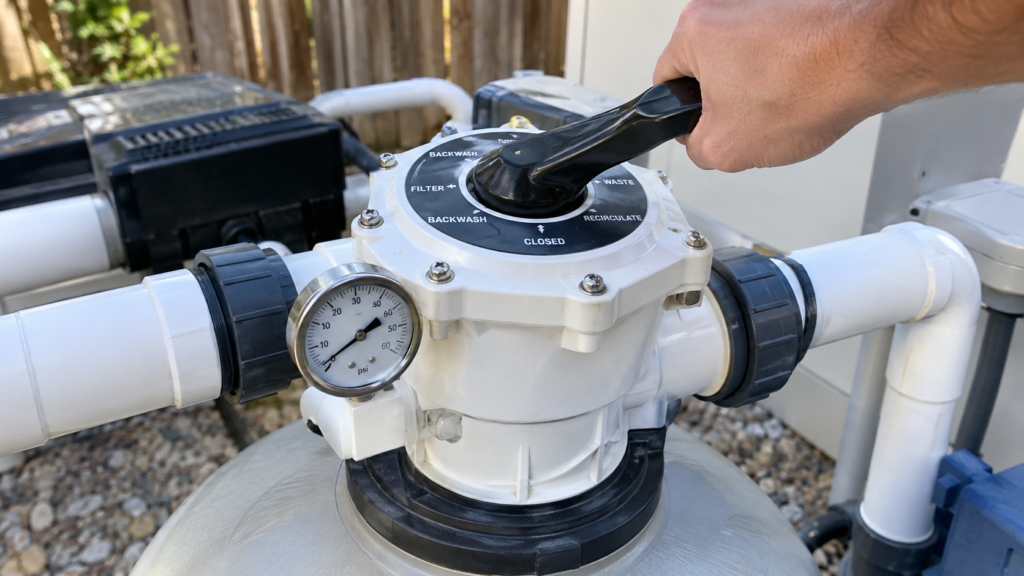
The pressure gauge on your filter has been creeping up for a few days, and now the water isn’t quite as sharp as it was last week. You’re standing at the pad wondering if it’s time to backwash — and whether you’re about to do it wrong. You’re not. The process takes about five minutes once you know the sequence, and getting it right protects both your filter and your pump.
Quick Answer: Backwash a sand filter when pressure reads 8–10 PSI above the clean starting point. Shut the pump off, turn the multiport valve to “Backwash”, run it 2–3 minutes until the sight glass runs clear, then switch to “Rinse” for 30 seconds before returning to “Filter”.
Table of Contents
What You Need to Know
- Backwash based on pressure rise (8–10 PSI over clean), not a fixed calendar schedule.
- Never move the multiport valve while the pump is running — it can shear the internal gasket.
- The full cycle (backwash + rinse) takes 2.5–3.5 minutes of pump run time.
- You’ll lose 150–400 gallons of pool water to the waste line each time, depending on filter size.
- Skipping the rinse step sends a cloud of dirty water straight back into the pool.
When to Backwash Your Sand Filter
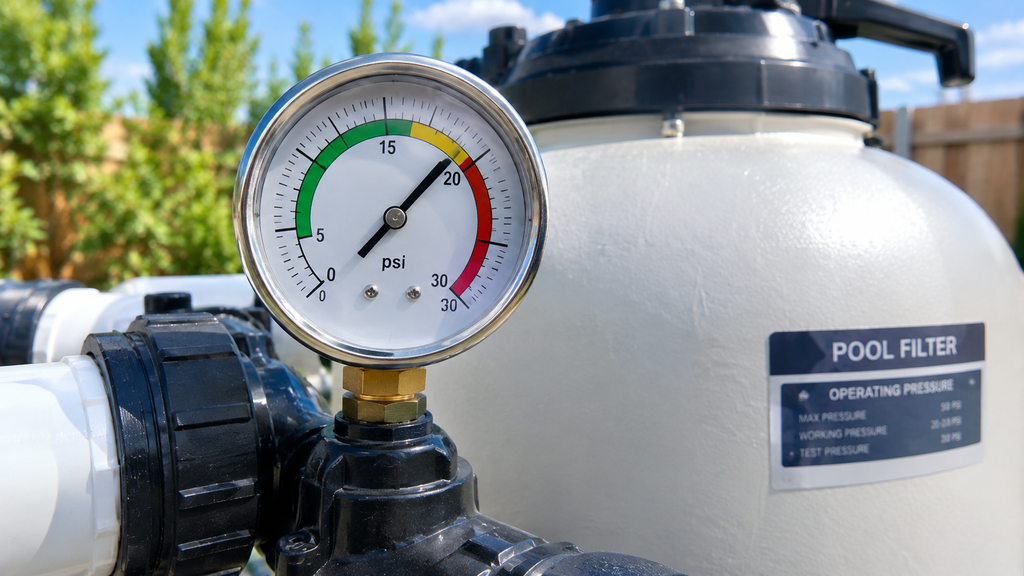
Backwash when the pressure gauge reads 8–10 PSI above your filter’s clean starting pressure — not on a fixed weekly schedule. Note your baseline PSI right after you install fresh sand or do a deep clean; that number is your reference point going forward. As debris packs into the sand bed, resistance builds and the gauge climbs. Once it’s 8–10 PSI over that baseline, water is struggling to push through, and your pump is working harder than it needs to.
A counterintuitive point: a slightly dirty sand bed actually filters better than a freshly backwashed one, because the trapped debris helps catch finer particles the clean sand would miss. Backwashing too early, before pressure has actually climbed, works against you rather than for you.
How to Backwash a Sand Filter: A Step-by-Step Guide
1. Shut the pump off completely. Turning the multiport valve while the pump is running puts high-pressure water directly against the internal gasket and can tear it — a repair that costs far more than the five minutes this step saves. Hayward’s own sand filter owner’s manual outlines this same valve-handling sequence for its multiport valves, and the “pump off before touching the valve” rule applies to this same valve-handling sequence for its multiport valves, and the “pump off before touching the valve” rule holds across nearly every major sand filter brand, not just Hayward.
2. Roll out the backwash hose if you have one. Point it somewhere the water can drain away from the pool structure and any septic or soakaway systems.
3. Turn the valve handle to “Backwash”. This reverses the water path so it flows up through the sand bed instead of down through it.
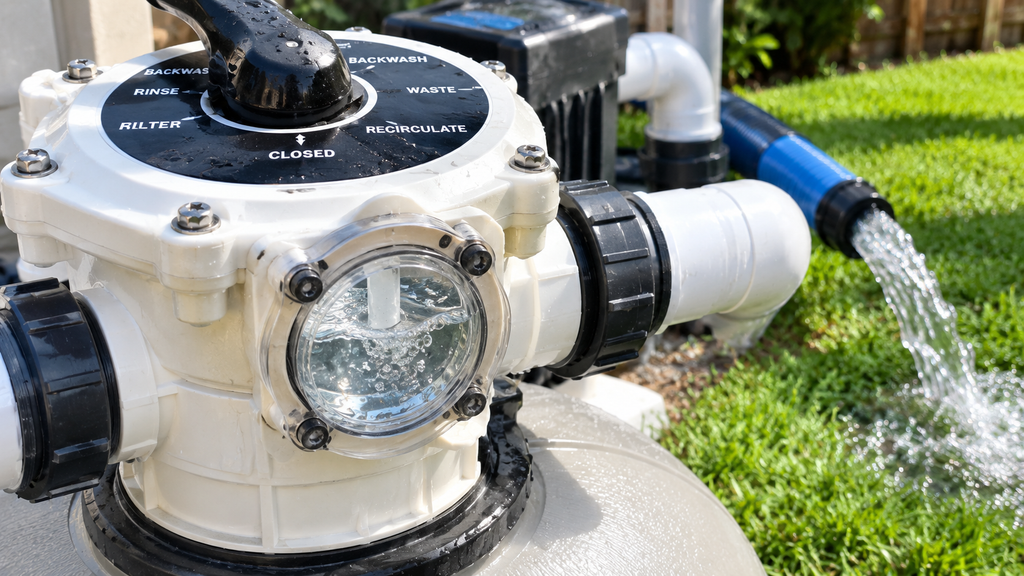
4. Turn the pump back on and let it run 2–3 minutes. Watch the sight glass on the valve or the waste line. Once the water runs clear instead of cloudy or tan, the sand bed has released what it was holding. Longer neglect between backwashes usually means a longer clear-up time.
5. Shut the pump off again, then switch the valve to “Rinse”. This settles the sand bed evenly before you resume normal filtration.
6. Turn the pump on and run “Rinse” for about 30 seconds. Skipping this step is the single most common mistake — it sends the just-loosened sediment straight back into your pool the moment you switch to a filter.
7. Shut the pump off, switch the valve to “Filter”, and turn the pump back on. You’re done. Top off the pool to replace the water you sent to waste, and check your chemistry once the fresh water has circulated.
How Long Should You Backwash?
A full backwash cycle takes 2.5 to 3.5 minutes total: 2–3 minutes on “Backwash” plus 30 seconds on “Rinse”. The backwash portion itself is done once the sight glass runs clear — that’s your visual cue, not a fixed timer. If your filter hasn’t been backwashed in a long time, or you’re clearing it after heavy pool use, it can run closer to 4–5 minutes before the water clears.
How Often Should You Backwash?
There’s no universal weekly number — backwash is based on the 8–10 PSI pressure rise, checked once or twice a week during swim season. Pool size, bather load, and debris (leaves, pollen, sunscreen) all affect how fast pressure climbs. A heavily used pool in late summer might need backwashing every 1–2 weeks; a lightly used pool might go a month between backwashes. Checking the gauge is more reliable than guessing on a calendar.
Backwash Troubleshooting Quick-Reference
| What You’re Seeing | Likely Cause | What to Do |
|---|---|---|
| A little sand in the pool right after backwashing | Normal in small amounts — fine sand settles after the cycle disturbs the bed | Vacuum it up; no action needed unless it recurs |
| A steady stream of sand coming through the return jets | Cracked lateral or standpipe inside the tank | Stop running the filter and inspect or replace the laterals |
| Pressure won’t drop after a correct backwash and rinse | Channeling in the sand bed, or sand is overdue for replacement (every 5–7 years, per industry service techs) | Backwash again for a full cycle; if it still won’t drop, the sand likely needs replacing |
| Water stays cloudy well after backwashing | Rinse cycle was skipped or cut short | Run “Rinse” again for a full 30 seconds before switching to Filter |
| Backwash water won’t run clear even after 5+ minutes | Filter was left far too long between backwashes, or sand is compacted | Let it run longer; if no improvement, sand may need replacing |
Save or screenshot this troubleshooting table—it covers the situations that come up most often once you’re doing this regularly.
Common Backwashing Mistakes
Moving the valve with the pump running is the mistake that costs the most to fix. The multiport valve’s internal gasket isn’t built to handle full water pressure while shifting position, and a torn gasket means water leaking out the waste line even when you’re set to “Filter.”
Backwashing on a fixed schedule instead of watching pressure wastes water and shortens the sand’s useful filtering window—remember, slightly dirty sand filters better than freshly rinsed sand.
Skipping or shortening the rinse cycle undoes the entire backwash by sending loosened debris right back into the pool. Thirty seconds is not optional.
What Happens After: Water Level and Chemistry
Every backwash sends 150–400 gallons of treated pool water out the waste line, depending on your filter’s size and how long the cycle ran. That water was carrying chlorine, cyanuric acid stabilizer, and—if you run a saltwater system—dissolved salt, all of which just left with it. Where that water is allowed to go isn’t universal: Austin, Texas’s guidance on pool backwash disposal, for example, prohibits sending it to a storm sewer and instead directs it to a vegetated area on the property—check your own city or county’s rules before assuming your setup is compliant. Public health guidance for commercial pools, like the CDC’s Model Aquatic Health Code, reflects the same underlying principle: filtration maintenance and wastewater handling are treated as connected, not separate, concerns.
Top the pool back up to its normal level before testing, since diluted water reads differently than your usual baseline. If your levels come back low, check whether you need to raise your alkalinity or bring pH back down after the fresh water shifts the balance, and compare your free chlorine against total chlorine readings before adding anything. If you’re backwashing frequently through a heavy swim season, keep an eye on whether your cyanuric acid is running low from repeated dilution—it’s easy to assume it’s only ever a “too high” problem, but frequent backwashing pulls stabilizer out too.
If you’d rather not recheck this math every time you backwash, our newsletter sends a short post-backwash chemistry checklist you can run through in under two minutes—worth grabbing if backwashing is a regular part of your routine.
FAQ
How many minutes should I backwash?
Run the “Backwash” setting for 2–3 minutes until the sight glass shows clear water, then switch to “Rinse” for about 30 seconds. Total cycle time is usually 2.5–3.5 minutes. Filters that have gone a long time between backwashes may take a bit longer to clear.
How do I backwash step by step?
Shut the pump off, turn the valve to “Backwash,” and turn the pump back on for 2–3 minutes until the water runs clear. Shut it off again, switch to “Rinse” for 30 seconds, then switch to “Filter” and resume normal operation.
How often do you backwash a sand pump?
Base it on pressure, not a fixed schedule—backwash once the gauge reads 8–10 PSI above your clean starting pressure. In practice that’s roughly every 1–4 weeks during swim season depending on pool use and debris load.
Should sand come out when backwashing?
A small amount of fine sand right after a backwash is normal and settles on its own. A steady, ongoing stream of sand through the return jets is not normal and usually points to a cracked lateral or standpipe that needs inspection.
Does backwashing waste a lot of water?
Each cycle sends roughly 150–400 gallons to the waste line, which you’ll need to replace by topping off the pool. It’s a real cost in water and chemicals, which is exactly why backwashing on pressure rather than a fixed schedule matters—you’re only doing it when the filter actually needs it.
Can I damage my filter by backwashing incorrectly?
Yes—the most damaging mistake is turning the multiport valve while the pump is still running, which can tear the internal gasket. Always shut the pump off first, change the valve position, then turn it back on.
What if the pressure doesn’t drop after I backwash?
Try a second full backwash-and-rinse cycle first, since one round doesn’t always clear a heavily loaded bed. If pressure still won’t come down, the sand itself may be due for replacement, which is typically every 5–7 years, or there may be a mechanical issue worth having a pool professional look at rather than continuing to force it.
What to Do Next
Once your levels have settled after topping off, work through your free chlorine vs. total chlorine reading to confirm your sanitizer is where it should be, then check whether the dilution pulled your alkalinity or pH out of range. If you’re backwashing often enough that stabilizer keeps dropping, it’s worth tracking your cyanuric acid levels over a few cycles rather than just reacting once.
